Werner’s question notebook
All the Light We Cannot SeeWerner’s question notebook is a soft-covered record of the questions, drawings, and schemes through which Werner Pfennig tried to understand the world. Marked Fragen and begun by his sister Jutta, it survives the war as one of his recovered possessions. When it returns to Jutta decades later, its pages make the lost boy present again—and reveal that Werner had kept a message for Frederick among them.
Form and Contents
The notebook is described as a soft-covered rectangle, its single cover word, Fragen, meaning questions. Its physical plainness contrasts with the energy packed inside: Werner’s tiny cursive slopes uphill across pages of lists, drawings, and schematics. The surviving descriptions do not present the book as a polished scientific record. It is an accumulation, where practical invention and unanswerable curiosity share space.
Some pages propose devices. Jutta finds the design for something resembling a blender powered by bicycle pedals and another for a motor for a model airplane. Elsewhere, questions turn from making things to asking how the world behaves: why some fish have whiskers, why lightning striking the sea does not kill all the fish, and why a flag flutters instead of standing straight out. A question about whether cats are gray when the candles are out brings ordinary perception into the same field of inquiry as engineering and natural science. Together, these entries show a mind moving freely between tangible problems, observation, and speculation.
The notebook also contains puzzles with sharply different scales. One asks why a knot holds; another asks how many cats would be required to catch one hundred rats in one hundred minutes if five cats catch five rats in five minutes. The questions do not resolve into a single discipline or a record of answers. Their sequence preserves the act of asking: Werner’s impulse to test what seems obvious, find the rule beneath it, or imagine a device that might make something possible.
From Werner’s Possession to Jutta’s Hands
The notebook’s return begins with an effort to identify the owner of objects left among the dead. A veterans’ service organization sends Frank Volkheimer a package containing photographs of three items, each displayed against a white background beside a numbered card. The canvas soldier’s bag is identified as 14-6962; the partly crushed wooden model house as 14-6963; the notebook as 14-6964. The letter explains that the bag was collected at a United States Army prisoner-of-war processing camp in Bernay, France, in 1944, and that the organization believes Frank Volkheimer served as ranking officer in the unit that included its owner.
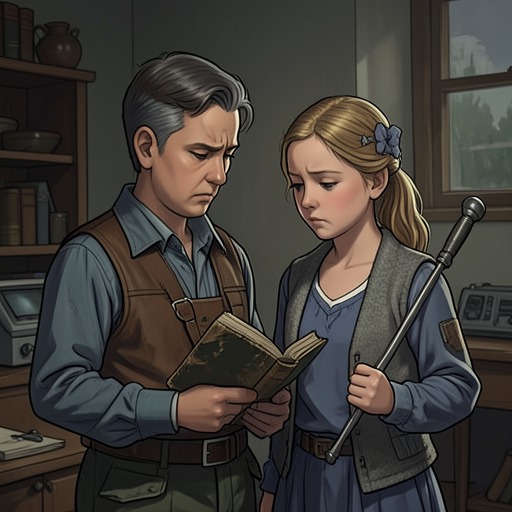
Frank Volkheimer does not recognize the model house, and the bag could have belonged to any soldier. The notebook, however, carries W.P. in ink on its lower corner. He recognizes it immediately. In the account of his response, two fingers rest on the photograph as if he might lift the notebook out of the image and turn its pages. The photograph cannot return the object to him, but its marked corner gives him the knowledge the other objects cannot: this is Werner’s.
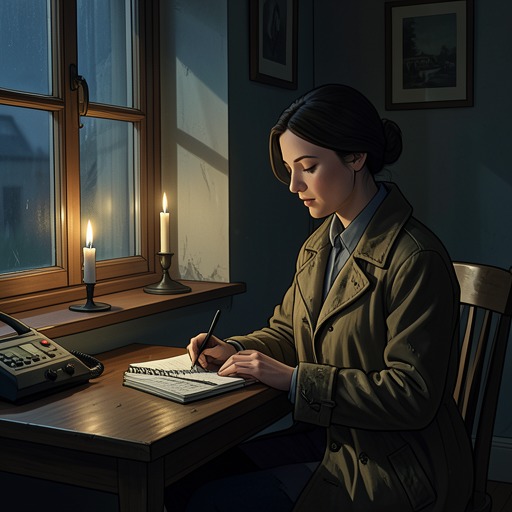
The chain of recovery continues when the bag reaches Jutta. Trying to grade an exam, she cannot keep the numbers from drifting into unintelligible piles; she sets the bag in her lap and opens it. The old zipper moves smoothly. Inside she finds a thick envelope and a newspaper-wrapped package containing a tall, narrow model house no bigger than her fist. The envelope holds the notebook she had sent Werner forty years earlier. In this scene the object is not merely identified from a photograph: it is physically opened, and its intimate contents return to the person who first gave it to him.
A Message Within the Questions
Jutta can read only a few pages at first. The handwriting, drawings, and lists draw memories after them: Werner’s cot in the attic, her drawings of imaginary cities above it, and the radio and wire threaded through the window and eave. She closes the notebook, then opens it again. Its movement between pages and remembered scenes makes reading an encounter with a past she cannot take in all at once. The notebook has remained materially intact enough to be opened; the life it records cannot be restored in the same way.
Among its last pages Jutta finds a sealed envelope marked For Frederick. The inscription identifies the intended recipient as Frederick, Werner’s former bunkmate, the boy he used to write about and who loved birds. The notebook therefore holds more than Werner’s own questions: tucked inside it is evidence that he carried another person in mind and preserved a message for him. The evidence does not disclose the letter’s contents, but the envelope’s placement and address establish a connection Werner chose to maintain beyond the pages of his designs and puzzles.
What the Notebook Preserves
The book’s significance lies in the contrast between its intimate contents and the impersonal means by which it returns. In Frank Volkheimer’s package, the objects are numbered photographs and a lost soldier’s bag, part of an attempt to deliver effects to next of kin when the dead men’s names have been lost. The notebook’s little initials reconnect that administrative record to a particular boy; its handwriting and questions carry that recognition further, into the texture of his thought and his sister’s memory.
Its questions also preserve Werner in a register distinct from the military world that later claimed him. The pages ask about knots, fish, cats, lightning, flags, and machines—not as a summary of his life, but as the surviving traces of a boy’s attention. Jutta’s response moves between close reading and interruption: she shuts the book, remembers, and returns to it. The notebook thus works both as a record of Werner’s curiosity and as a material link between the siblings after his death. Its final envelope extends that link to Frederick, leaving the book not as a sealed account of the past but as a container for a message meant to pass from one life to another.