Zollverein
All the Light We Cannot SeeZollverein is the vast coal-mining and industrial complex outside Essen that forms the first landscape of Werner Pfennig’s life. Its mines, mills, and impoverished neighborhoods are not merely a setting: they establish the hardship from which Werner and his sister Jutta imagine a different future, and they leave him with images that return throughout the war.
Industrial Landscape and Setting
Zollverein lies about three hundred miles northeast of Paris and covers four thousand acres. It is described as steel and anthracite country, a place full of holes: smokestacks send out fumes, locomotives travel on elevated conduits, and leafless trees stand on slag heaps. The scale of the works exceeds the children’s immediate neighborhood. From Werner’s dormer window, rainwater traces a path from cloud to roof to eave, while the winding tower and the roofs below sit within a larger field of cokery, smelter, and gasworks. The complex continues beyond his view toward villages and cities, part of a machine he understands as extending across Germany.
The industrial landscape also shapes the rhythm of the area’s public life. Workers move in opposite directions as shifts change: one group heads into warehouses while another returns home. Laid-off miners sit by the lanes, and the working men appear hunched and hungry beneath their helmets. Their movement is set against the steady mechanical activity of the mines and mills, while unemployment and Germany’s economic collapse press on the surrounding neighborhoods. The place’s scale and repetition make industry seem both a source of work and a force that organizes the lives of those who live beside it.
Children’s House and Childhood Poverty
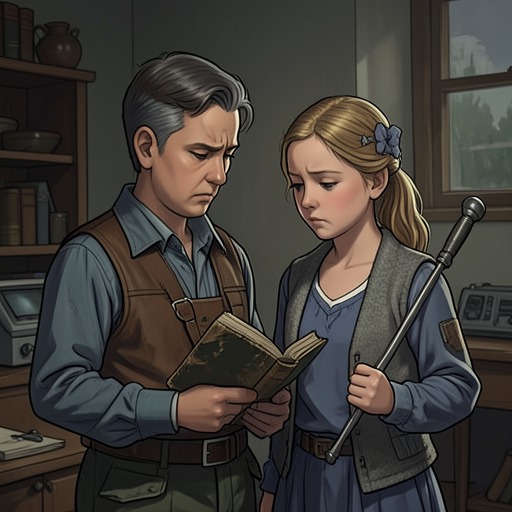
Werner and Jutta are raised at Children’s House, a two-story clinker-brick orphanage on Viktoriastrasse. Its rooms hold sick children, newborns, and battered trunks containing the remaining possessions of parents lost to the mines. The children’s private family histories are thus gathered inside an institution, among the belongings of other families whose absence is also tied to mining.
The household’s hardship is severe. Eggs are prohibitively expensive, there is no butter or meat, and fruit belongs to memory rather than ordinary meals. During the worst months, Frau Elena, the house directress, sometimes has only cakes made from mustard powder and water for her dozen wards. Against this scarcity, Werner and Jutta make small things from what they can find. They collect potato peels and carrot greens from rubbish bins, gather paper for drawing, and dry the last traces of toothpaste from old tubes to use as chalk. Their childhood is resourceful, but its resourcefulness comes from deprivation.
Frau Elena offers Werner a different measure of what his life might become. She encourages him to dream beyond the judgments that he is too small or comes from nowhere, and tells him that she believes he will do something great. The hope she gives him contrasts with the expectation awaiting boys in the mining district: one more year, and he will be issued a helmet and lamp and sent underground with the others. Zollverein is therefore both Werner’s home and the future he fears being unable to escape.
The Children’s Routes Through the Mines
After lessons, Werner pulls Jutta through the complex in a wagon assembled from discarded parts. One wheel regularly comes loose; he crouches beside it and threads the bolts back into place before they continue along the gravel lanes. Their route passes pit cottages, fires in rubbish barrels, unemployed miners sitting on crates, and workers going to and from their shifts. Werner greets the men, but they usually pass without answering, their attention fixed on the ground.
The siblings also search the industrial margins for useful things. They sift through black dust, climb over rusting machinery, pick berries from brambles, and collect dandelions from fields. At times Werner takes Jutta as far as Pit Nine, the largest mine. Its five-story coal elevator rises over an entrance filled with noise and activity; cables swing, hammers strike, and men emerge from warehouses with their lunch pails before going toward the elevator. The scale of the mine makes the children small observers of a system that is already determining the adults’ working lives.
At Pit Nine, Werner tells Jutta that their father died below. The statement makes the mine more than an imposing workplace: it is the place that has already taken someone from their family, and the place toward which Werner fears being sent. At night he brings Jutta back through the close-set neighborhoods to Viktoriastrasse 3, where Frau Elena tends the crowded household. Their ordinary circuit—from the orphanage to the lanes, the mine entrance, and back—joins play and scavenging to the loss that defines the family’s history.
Memory Beyond Zollverein
When Werner leaves Zollverein for the school at Schulpforta, the contrast first appears in the air. The castle-like school stands among hills, athletic fields, and a river; Werner notices that the air is free of the dust he has known at home. Yet the change of surroundings does not release him from the mine’s hold on his imagination. In a nightmare, he walks through black tunnels as the ceiling descends and the walls close around him. The dream gives physical form to his fear of the work awaiting him if he returns to Zollverein.
His view from the dormer also expands from the local industrial complex to Germany as a whole. The winding tower, cokery, smelter, and gasworks seem to continue into an ever-expanding national machine, with men prepared to give their lives for it. As Nazi allegiance becomes the public norm, Werner registers the pressure of a world in which the expected greeting is changing. The landscape of home thus connects his personal prospects to a political order that is larger than the neighborhoods he can see.
Zollverein returns to him in other places and at other stages of the war. Beneath the rubble at Saint-Malo, Werner remembers the coal dust suspended in the air on winter mornings at home. The white dust around him feels like an inversion of the black mine, both familiar and opposite, and recalls the mine that killed his father. At Schulpforta, waiting for his turn in a cruel exercise imposed on a prisoner, he sees in his mind the hauling machine above Pit Nine and the miners bent beneath their labor. He links the trapped roles of cadets, orphans, and others he knows to the people of his childhood neighborhood.
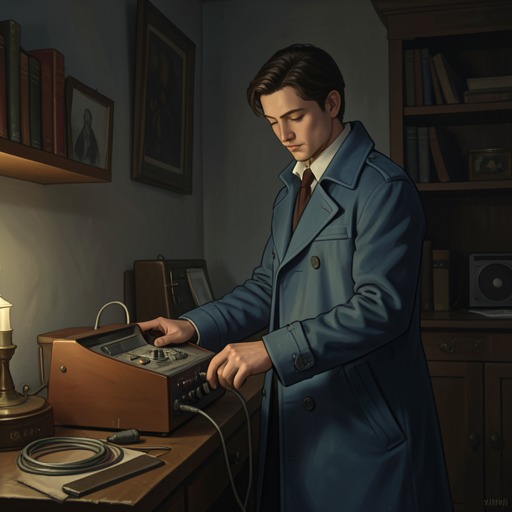
Even during his later work searching for radio transmissions, Werner remembers prowling Zollverein’s alleys with Jutta in the wagon. The radio hunt becomes a different kind of search through darkness and distance, while the remembered streets keep the sister and home he left present in his thoughts. Across these returns, Zollverein remains a place of industrial hardship, family loss, and childhood ingenuity—and a measure against which Werner understands both the futures he was offered and the ones he tried to imagine.