von Rumpel forces museum staff to show him the Sea of Flames
All the Light We Cannot SeeReinhold von Rumpel forces museum staff to show him the Sea of Flames by converting a formal inspection of the Muséum national d’Histoire naturelle into a prolonged act of intimidation. His search reaches its apparent climax when officials open a concealed store and reveal a blue stone, but the specimen proves to be a convincing copy. The encounter gives him access to what the museum has hidden without giving him the certainty he wants: the real diamond remains somewhere beyond his grasp.
The museum and the missing stone
In wartime, the museum’s collections are being dispersed for protection. Its staff secure crates and transport manifests, while couriers move objects toward country estates; among the objects to safeguard are fossils, manuscripts, precious minerals, pearls, gold, and a sapphire large enough to suggest the fabled Sea of Flames. The urgency of this work makes the question of custody practical as well as mysterious: the diamond may be in the museum’s care, but its exact location is closely guarded.
That concealment has a deliberate logic. The museum director has arranged for three decoys to travel in different directions, while a fourth stone—the real diamond—is carried out of Paris by Daniel LeBlanc, the museum’s principal locksmith. The plan is that no carrier should know whether the stone in their possession is genuine, and that each should act as though it is. This distributed uncertainty complicates Reinhold von Rumpel’s search: even a convincing discovery cannot by itself establish that he has found the original.
A polite tour becomes pressure
Reinhold von Rumpel begins with the public Gallery of Mineralogy. Its length, its mostly vacant display cases, and the silhouettes left on their felt shelves show how much has already been removed. What remains still impresses him: yellow topaz crystals, pink beryl, a violet tourmaline from Madagascar, and many other minerals. Professor Hublin explains the collection’s institutional purpose, tracing it to Louis XIII’s Cabinet of Medicines and noting that its catalog contained two hundred thousand entries by 1850. To a curator, he insists, no mineral is superior to another.
The explanation does not answer the question Reinhold von Rumpel has come to ask. After the tour, he politely asks about collections that are not on public display. When the assistant director says that he has seen everything the museum can show him, Reinhold von Rumpel asks to see its most protected specimens, naming a specimen he believes has recently emerged from the vaults. The assistant director counters with the museum’s responsibility to preserve scientific collections for future generations. Reinhold von Rumpel says he will wait.
His patience is a tactic, not a retreat. He eats while the officials remain with him and explains that he wants something small, not the destruction of the collections. Then he demonstrates how much he knows about their private lives: he names the school attended by the assistant director’s daughter and the school attended by Professor Hublin’s ten-year-old twin sons, even describing their instruments and their walk home. Their children become leverage. The officials do not consent freely; the threat makes continued refusal dangerous.
Through the locked rooms
Once the assistant director agrees to show him the place where the diamond has been kept, the route itself reveals the layers of concealment. A secretary named Sylvie brings a ring of keys, and the assistant director takes another key from a desk drawer. Two keys open a small door at the back of the main-floor gallery. The party descends a winding stone staircase, passes through a second locked gate, and follows a maze of corridors to an unremarkable storeroom filled with dropcloths, pallets, and crates.
Behind a sheet of plywood, Professor Hublin reveals a combination safe, which the assistant director opens. Inside it sits a second, heavier box. There are no alarms and only one guard. When Reinhold von Rumpel orders the felt bag inside opened, the assistant director unties it and tips a wrapped bundle into his palm. The folds part to reveal a blue stone about the size of a pigeon’s egg. The hidden specimen has been reached, but its appearance alone does not settle whether it is the Sea of Flames.
The replica and the unresolved search
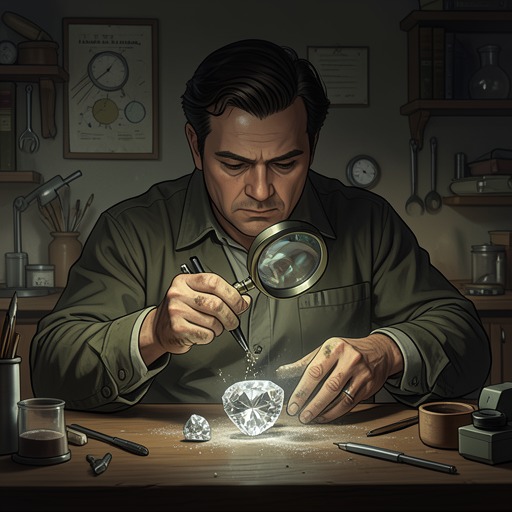
For Reinhold von Rumpel, the stone initially carries the force of a victory. He remembers holding the pear-shaped diamond between thumb and forefinger and seeing its blue interior enlarged by a loupe, its colored facets seeming to confirm the legend. Yet inspection eventually replaces excitement with doubt. The facets are not quite sharp enough, the girdle is slightly waxy, and the stone has none of the delicate cracks or inclusions he expects in a real diamond. His father’s lesson—that a genuine diamond is never entirely perfect—turns apparent perfection into evidence against the stone.
The provenance of the copies explains the trap. In the two months before the invasion of France, a man named Dupont made three replicas for the museum using a casting; he never saw the real diamond. Reinhold von Rumpel believed him. The museum’s hidden stone is therefore a decoy, and the vault’s secrecy has protected not the answer but another layer of uncertainty. Three replicas plus the real stone make four possible stones; one replica remains in the museum, while three are still to be found. The real diamond’s location remains unknown.
The episode makes museum access a contest between institutional custody and coercive possession. The staff’s locks, catalogues, concealment, and decoys are practical defenses, while Reinhold von Rumpel answers them with surveillance, calculated waiting, and threats against families. His success in reaching the vault is consequently incomplete: he can force people to disclose a hiding place, but he cannot force a replica to become authentic or make the real stone’s chain of custody visible. The more closely he examines the prize, the more the search returns him to uncertainty.