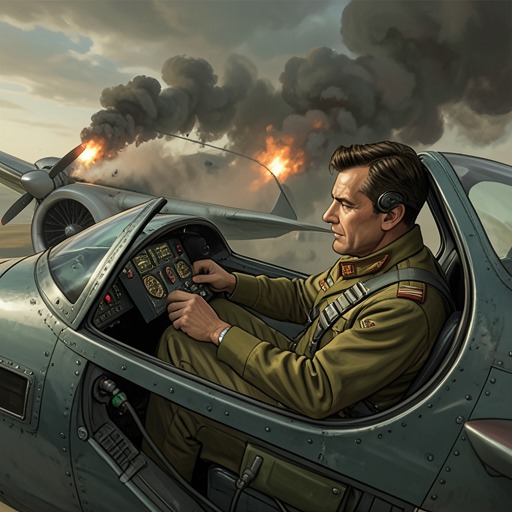
“Take away your spy!”
All the Old Knives“Take away your spy!” is Ibrahim Zahir’s command at the close of a recorded killing aboard the Flight 127 aircraft. Its blunt accusation gives the departing figure a name in political terms—a spy—even as the footage leaves his identity uncertain; later revelations about Celia Favreau’s concealment of a call record make the language of accusation resonate beyond the scene itself.
The Recorded Command
The footage is low-light and grainy, but clear enough to show the Flight 127 aircraft parked on an empty tarmac, with the airport shut down. A fixed camera catches the forward entry door opening. A man with gray hair, a mustache, dark skin, a white shirt with rolled-up sleeves, and beige slacks stands in the doorway. His head suddenly blurs as a distant thump sounds, and he falls out of the plane and onto the tarmac.
The camera dips to the crumpled body, then turns back to the doorway. Ibrahim Zahir appears there: younger than the dead man, also dark-skinned and wearing a white shirt with rolled-up sleeves, but holding a pistol. As the microphone gain rises and hissing fills Gene Wilcox’s speakers, Zahir shouts, “Take away your spy!” He then pulls the aircraft door shut. The command is the recording’s only quoted speech in this moment, and its accusation is paired with the visible gun and the body below.
Accusation and Uncertainty
The recording supplies a forceful label but does not, in the available description, establish the dead man’s identity or prove that he was a spy. That gap matters: the line is presented as Zahir’s declaration, not as an independently confirmed account of the victim. The camera offers evidence of the fall, the body, the gunman, and the words, while leaving the accusation itself unresolved.
The command therefore works both as an order and as a public-sounding charge. Zahir speaks in English to demand that the alleged spy be taken away, then closes the door on the scene. The abrupt sequence gives the phrase its menace: the demand follows a killing, and the recording preserves it as part of the act rather than as detached commentary.
Later Context and Significance
The phrase’s later resonance comes from the story’s return to the deaths and the evidence surrounding them. Celia Favreau tells Henry Pelham that when they were all killed, she could not determine whether he was innocent or whether the Russian-speaking person on the other end of the phone number had been Ilyas Shishani. She says she buried the call from Bill Compton’s phone to protect Henry, reasoning that a tribunal would not bring the dead back.
Celia then accuses Henry of choosing that call record and pressing the issue in a way that frightened Bill and could expose Henry himself. Her account does not repeat Zahir’s command or establish the dead man’s identity, but it places the recorded accusation beside a later struggle over innocence, evidence, and concealment. The phrase’s lasting force lies in that tension: the footage records a man branded a spy and killed, while the later conversation shows how difficult it is to separate accusation from proof after the deaths.