Ahmed Najjar
All the Old KnivesAhmed Najjar is a veteran courier caught aboard a hijacked airliner, where his messages become the Vienna station’s only direct view of the crisis inside the cabin. His reports first offer practical intelligence and a possible way to intervene; later, a change in their language reveals that someone else may be writing in his place. Ahmed’s importance lies in that reversal: the channel that seemed to connect the station to the passengers becomes evidence that its source has been compromised.
Identity and Background
Ahmed is identified as a courier working for the American intelligence service. Traveling on a Lebanese passport, he is described by Vick as one of theirs and as an unusually lucky presence on the flight: the hijacking has put a trained source among the passengers, where he can report what the station cannot see for itself.
His file complicates the initial hope that he might act directly. Ahmed speaks both Arabic and Farsi, but he has spent the previous six years doing little more than placing dead drops. At fifty-eight, he is nearing retirement. Celia regards his training as useful but does not expect him to overpower anyone. Her assessment is cautious rather than dismissive: Ahmed may be able to help, but neither his age nor his recent work suggests that he can physically control the attackers.
A Warning Before the Flight
Ahmed’s appearance aboard the aircraft is preceded by intelligence from a source called TRIPWIRE. A message from Damascus warns of an airline-related event within seventy-two hours on a flight bound for Austria or Germany, with Damascus, Beirut, and Amman all possible departure points. The report names Aslim Taslam, whose likely operatives are said to have been recruited from outside Somalia.
The warning is consequential but uncertain. Aslim Taslam had split from Al-Shabaab after an ideological dispute and received financial, logistical, and operational support from Ansar al-Islam. Langley had observed growing cooperation between groups that would otherwise be antagonists, while Aslim Taslam had been linked to deaths and explosions in Rome, Nairobi, and Mogadishu. Yet TRIPWIRE had previously sent a false report about an al-Qaeda cell in Salzburg, wasting the station’s time. Bill therefore doubts the new warning until an Europol message reports that Mashood Al-Fakeeh, believed by analysts to be Ilyas Shishani, arrived in Barcelona from Jordan. That possible connection between an Ansar al-Islam planner and Aslim Taslam makes the airline warning harder to dismiss. The intelligence does not establish Ahmed’s role in the plot; it sets the uncertain background against which his reports will be read.
Messages from the Cabin
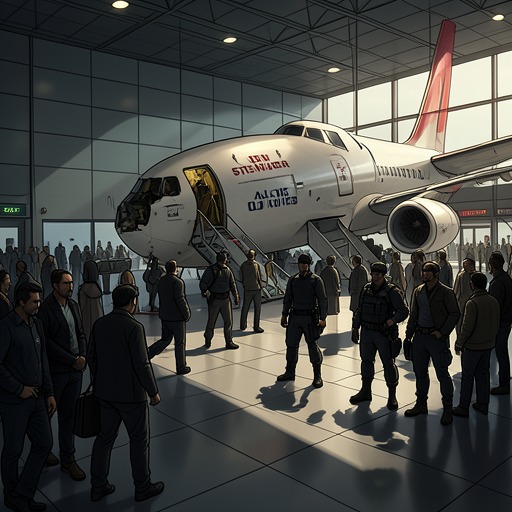
Five hours after the hijacking begins, Ahmed sends a text to an emergency Langley number. Forwarded to Vick, it gives a compressed inventory of the danger: four attackers and two guns; children in first class; passengers divided between the economy cabin’s two sides; two women in critical condition; and dwindling water. The plane has no power, so there are no cameras inside. Ahmed also proposes an attack through the rear undercarriage. The message is brief and telegraphic, but it gives the station a map of the immediate crisis and a possible course of action.
A later message reports that an elderly Austrian passenger has died of a coronary. Ten minutes after that report, staff watch television footage of the aircraft door opening and an old man being lowered to the tarmac by rope. The broadcaster ORF identifies him as Günter Heinz, an engineer from Bad Vöslau. Ahmed’s report thus connects a cabin-level account to a visible consequence outside the plane, though the death is attributed to a coronary rather than to an execution or attack.
His next report says that the lead hijacker is speaking Russian, a language Ahmed does not know well enough to translate. The limitation matters: Ahmed can observe and relay information, but he cannot interpret every exchange or supply a complete picture. As the station debates whether to involve Austrian authorities, Bill explains that they have kept Ahmed’s presence secret from them. Celia argues that sharing information may be necessary if anyone is to be rescued; Vick replies that the station has not vetted the Interior Ministry. Ahmed’s reports therefore arrive inside a larger problem of coordination and trust, not in an uncomplicated line from source to decision-maker.
The Rescue Plan Fails
Ahmed’s fourth message overturns the first proposal. He says to abandon the rear-undercarriage attack because the hijackers have a camera mounted there. He cannot explain how they installed it, but judges that they know what they are doing and that the situation is very serious. He recommends giving them what they demand, warning that otherwise everyone may die. The report removes the apparent opening for a rescue and raises the stakes from a difficult operation to a threat to every passenger.
The station does not know how a camera could have been attached to the aircraft. Ernst suggests that someone at Amman airport security, perhaps a baggage loader, could have fixed a remotely operated device to the hull. This remains a hypothesis, not an established explanation. The uncertainty around the camera mirrors the limits of Ahmed’s own position: he can report what he sees and draw conclusions about the attackers’ competence, but neither he nor the station can explain how the threat was put in place.
A Changed Voice
Celia eventually compares all four messages rather than treating the latest one in isolation. The earlier reports use incomplete, compressed phrasing. The fourth has complete sentences, a more leisurely use of words, and articles absent from Ahmed’s earlier style. Those differences lead her to conclude that the last message comes from someone else. Ahmed has been discovered; the reporting channel is no longer reliable evidence that he remains free to communicate.
The discovery is an inference from language, not a witnessed capture. Celia considers whether Ahmed might have been part of the hijacking or might be sending misinformation, but recognizes that this possibility runs against the available evidence. Even after identifying the change in voice, she cannot answer the question of how the hijackers found him. She reaches for Bill’s phone, intending to alert him, then stops when that unanswered question occurs to her. Ahmed’s fate is not resolved in the available account. His arc ends at the point where intelligence becomes uncertainty: the messages have made him indispensable, and their altered style signals that the station may have lost him.