Austria
All the Old KnivesAustria shifts from an abstract possibility in a counterterrorism discussion to the country at the center of the Flight 127 hostage crisis. In Vienna, the hijacking forces Austrian officials and their American advisers to weigh a threatened mass killing against a deadline, public scrutiny, and the risks of an assault.
Strategic Assumptions
Before the hijacking, Ernst argues that Austria is an implausible target for Aslim Taslam. He reasons that Austria has only about a hundred troops in Afghanistan and few militants in prison, whereas Germany has more than four thousand troops in the International Security Assistance Force and holds more prisoners. In his analysis, neither military withdrawal nor prisoner releases gives the group a convincing reason to target Austria.
The narrator counters that the group need not choose its target according to a single country’s policies. A hijacking in one European Union country could put pressure on governments across the union, allowing the perpetrators to make demands of Germany without landing in Frankfurt or Berlin. Austria’s apparent lack of strategic importance thus becomes part of the logic that makes it a possible soft target.
Vienna and the Hijacking
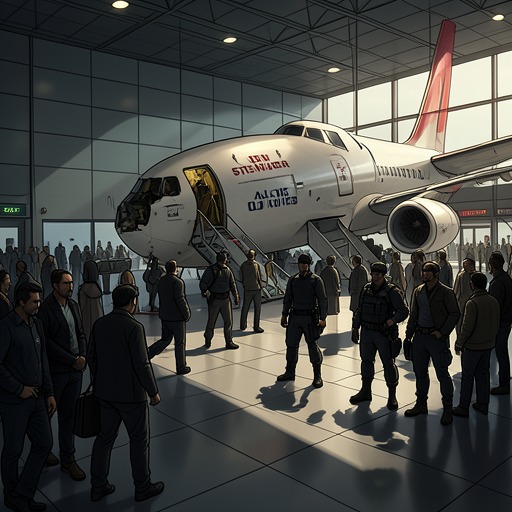
That possibility becomes reality when Royal Jordanian Flight 127 lands in Vienna. The four hijackers announce their affiliation with Aslim Taslam in calls to the control tower and ORF, Austria’s national radio and television outlet. The crisis has already turned deadly: the hijackers have killed stewardess Raniyah Haddadin. Their demands include the release of five prisoners within forty-eight hours, two held in Austria and three in Germany.
Austria is therefore not merely where the aircraft happens to be. Its prisons and government are directly implicated in the demands, while the presence of German prisoners makes the crisis a shared political test. The briefing also reports that seventeen Americans are aboard, though that figure is still being verified. The authorities must respond to an immediate threat to hostages while the full facts remain uncertain.
Political and Operational Pressures
The American team considers how each government might react. Vick speculates that Germany may yield, noting that Angela Merkel has only recently taken office; he regards Austrian President Heinz Fischer as facing a different pressure, since the right and the Social Democrats have been accused of weakness on immigration. These assessments make the Austrian response a domestic political issue as well as a hostage-rescue problem.
Austria’s EKO Cobra assault team is on standby, but its readiness does not reassure the American advisers. Owen Lassiter argues that if Austria and Germany reject the demands, the only remaining option may be to storm the aircraft before the deadline. Vick draws a firm boundary: the American team will advise the Austrians, not conduct the assault itself. The distinction leaves the operational decision with Austria while making the advisers answerable for the advice they give.
Public Visibility and Narrative Significance
The crisis cannot be managed as a private exchange. ORF television cameras are positioned at the airport fence, and the narrator recognizes that the hijackers want outside attention. Simply cordoning off reporters would not make the situation disappear: newscasters would speculate that an assault was being prepared, turning the attempt to control information into another signal about the authorities’ intentions.
Austria’s role in the story is shaped by this collision of territorial responsibility, multinational pressure, and visible uncertainty. The country first enters the discussion as the supposedly unlikely choice; it then becomes the place where a hostage deadline must be met and an assault considered. The American agency’s insistence that it is advising rather than acting underscores the gap between influence and formal responsibility, even as the crisis makes clear how difficult that separation is to maintain.