Bill Compton and Sally Compton’s marriage
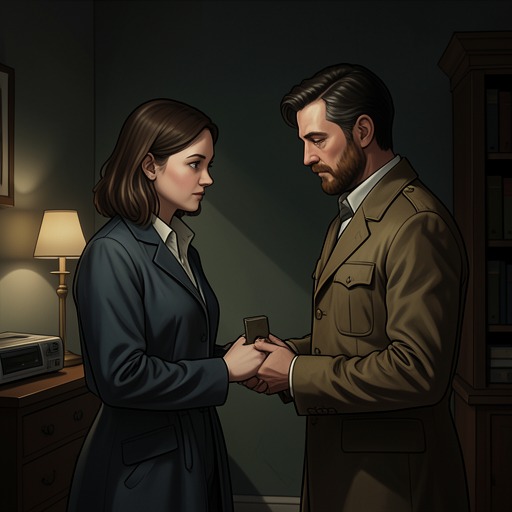
All the Old KnivesBill Compton and Sally Compton’s marriage is portrayed as a relationship of sustained emotional control, one that Bill recognizes as damaging yet finds difficult to escape. Its pattern emerges through two sharply different views: an account of daily life in which Sally’s verbal attacks and silences wear Bill down, and a later London visit in which Henry sees the couple’s domestic world as the settled result of that imbalance. The marriage matters not only as a private conflict but as a measure of how difficult it is for Bill to act on what he knows.
Identity and Background
Over the year preceding the office conversation, Bill is usually at work by eight thirty. The narrator interprets his early arrival as an effort to get beyond Sally’s reach as soon as he wakes. That interpretation is not presented as a fact Bill has explained; it belongs to a colleague who knows both spouses and has watched the pattern long enough to fear reproducing it in her own relationships. Her concern is already personal: Bill’s marriage becomes an image of a future she does not want for herself.
The narrator characterizes Sally’s bullying as deliberately nonphysical. Sally does not strike Bill; instead, she controls him through words, body language, and silences that are selectively brutal. The contrast matters because the harm is not made visible by a physical assault, while its cumulative effect appears in Bill’s apparent inability to resist. His experience in the Agency makes the narrator wonder why he does not recognize or oppose the dynamic, but her account emphasizes that professional competence has not protected him in his marriage.
A Relationship Interpreted Through Conflict
The narrator’s response becomes more than sympathy. She says that over the past year she has grown to hate Sally, and sometimes corners Bill in a subtle imitation of Sally’s aggression so he will stay and listen. Bill does listen, but answers her anger by recounting Sally’s history: her mother was a cruel role model, and her first husband used physical backhanded rebuttals. These details complicate the narrator’s picture of Sally without changing it. She rejects childhood trauma as an explanation that should determine how someone behaves now, invoking her own parents’ fatal-looking car accident when she was fourteen as an example of hardship that does not settle the moral question. Her standard is what a person does with the present.
That position gives the marriage a second conflict: not only whether Bill can leave, but whether his colleague can accept explanations for Sally’s conduct without treating them as excuses. The narrator believes Bill is carrying too little of the anger needed to confront his situation, and she finds herself carrying it for him. Her support is therefore forceful and potentially overbearing, as well as protective. The text shows the limits of her intervention when concern becomes pressure rather than a decision Bill is ready to make.
The Attempt to Leave
Bill eventually tells Sally that he is leaving, late at night. According to his account, she first went on a rampage against him; after she calmed down, she developed pain in her arm, dismissed it as nothing, and told him to sleep because he did not care about her. He remained awake while she moaned in pain and refused his help. In the morning, she collapsed on the kitchen floor while making coffee and bled from her nose. The sequence leaves Bill trying to understand whether the crisis is illness, manipulation, or some combination he cannot confidently distinguish.
Driving to the embassy, Bill comes to regard the episode as a long con or an extended pattern of reward and punishment. He believes Sally has shifted from controlling him by attacking him to controlling him by attacking herself. This is Bill’s interpretation, not an independently confirmed diagnosis. Doctors find nothing conclusive, suggest nerves, prescribe bed rest, and keep Sally overnight for observation. The uncertainty does not make the effects on Bill less real: after attempting to leave, he is once again occupied by Sally’s distress and responsibility for what happens to her.
The narrator immediately offers him her apartment, telling him he can move his belongings there. She urges him to visit Sally with flowers or pay her medical bills if he chooses, but insists that illness does not make the marriage bearable. Her offer makes separation practical in a way it had not been before, yet Bill replies that it is not simple. He then redirects the conversation to the day’s work. The return to business steadies him, but the subject of the marriage has not been resolved; the possibility of escape has surfaced and receded without becoming action.
The Marriage in London
A later account of Henry’s visit to London revisits Bill and Sally from outside their home. Henry takes a short flight, conducts casual surveillance of their townhouse in Hampstead, and studies the street and its inhabitants as clues to the world Bill now occupies. He follows Sally for twenty minutes from the house to a flower shop and then a gourmet grocer. She appears healthy and strong, unlike the Sally Henry remembers in Vienna.
Henry reads that change as evidence that Sally has achieved her dream: in his assessment, she has completely emasculated Bill and transplanted their master-servant relationship into a country where her control will be tightest. He describes her life as a victory. This is Henry’s judgment of what he observes, not a neutral account of the marriage’s private arrangements; nevertheless, it sharply contrasts with the earlier crisis. The Sally who collapsed at home is now seen moving through London with apparent strength, while Bill’s condition is inferred from the domestic order Henry surveys.
Change and Significance
Together, the episodes give the marriage a pattern of attempted departure followed by renewed capture. In the earlier scene, Bill names the possibility that Sally’s illness has become another way to govern his response, yet he cannot sustain his decision to leave. In the later scene, Henry approaches him only after observing the household and concludes that Bill has already been broken. The shift from the narrator’s urgent offer of shelter to Henry’s distant surveillance measures the difference between a moment when change seems available and a later view of the marriage as a settled arrangement.
The relationship is shown through other people’s interpretations as well as Bill’s report, and those perspectives are not interchangeable. The narrator’s anger pushes toward immediate separation; Bill’s account holds uncertainty about Sally’s illness and his obligation to her; Henry sees a completed victory from the street. Their accounts converge on Bill’s compromised ability to act, but the evidence does not establish Sally’s medical condition or give her own explanation of the marriage. That restraint preserves the central tension: Bill can recognize the pattern and still remain within it, while those who see his predicament cannot make the decision for him.