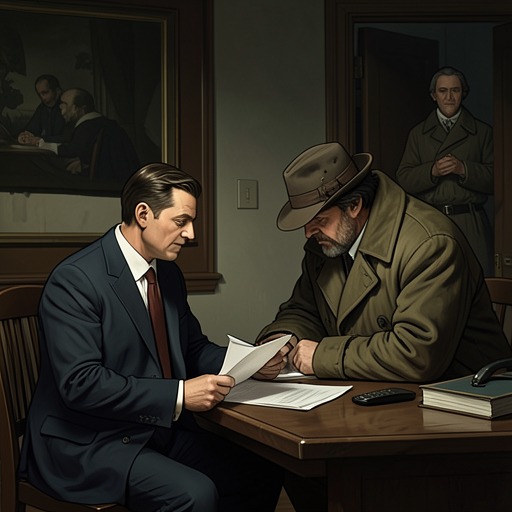
Celia Favreau
All the Old KnivesCelia Favreau, born Celia Harrison, is a former CIA case officer whose departure from Vienna was both a break with the intelligence world and an attempt to escape the guilt and secrecy attached to it. Once Henry Pelham’s lover and trusted companion, she becomes a wife and mother in Carmel-by-the-Sea. When Henry returns years later to investigate a concealed call record, Celia’s old loyalties and her hard-won life collide: she acknowledges that she hid evidence to protect him, then tells him the veal he has eaten was poisoned.
Identity and Background
Celia arrived in Vienna in 2002 after a successful posting in Dublin, requesting the city because she regarded it as exceptionally civilized. By December 2006 she was a case officer working under William Compton at a station operating almost entirely under diplomatic cover. Her work involved arranging meetings and questioning reluctant sources. She was busy and mobile, in a career she had long wanted, and at that point did not spend much time worrying about the future or about having children.
Her attraction to intelligence work was not only professional. Celia prized the feeling of seeing beneath ordinary appearances: public statements carried meanings she could recognize, and she believed she could distinguish politicians acting from fear or greed from those who resisted those pressures. Public reputation, in her experience, was a poor guide to private truth. That privileged access to hidden motives was part of what made the work exhilarating, and part of what would later make its burden difficult to leave behind.
Vienna and Henry Pelham
Celia met Henry Pelham after he transferred to Vienna in 2003. She admired William Compton as a boss and valued the stable benefits of the job, but her private life also gave her a companion in the work’s dangers. Henry was still working in the field; she could encounter the thrill of danger indirectly through the time they spent together. She remembers him as her lover and a dependable emotional support after work, while acknowledging that their intimacy did not prevent later loss or disillusionment.
Before the crisis she calls the Flughafen, Celia says she was having the time of her life. She was in her thirties, occupied with her work, and not yet troubled by thoughts of children or a settled future. The contrast matters: the life she later chose was not simply the inevitable endpoint of a long-standing wish for domesticity. Her friends had struggled to understand why she left the restless life they associated with her, and she had offered them an unconvincing explanation about wanting to stop running around. Her retreat followed a specific rupture, not merely a change in taste.
The Crisis and Family Life
The Flughafen became the dividing line in Celia’s account of herself. She connects it to the deaths of about a hundred and twenty people and to the guilt that followed. She explains that ordinary life in Vienna had come to mean continual pressure to keep secrets, a maze in which even loved ones could not be trusted. She initially hoped that she could recover and return to normal; instead, normality itself reproduced the conditions that had harmed her. She therefore left Vienna, married Drew Favreau quickly, and moved away.
Drew, a GM manager who had spent much of his working life in Vienna, had retired at fifty-eight. The two dated for only four months before he proposed. Friends found the match surprising, particularly because Celia had previously moved through a succession of relationships and seemed unsuited to stillness. In Carmel-by-the-Sea, however, she made a life with him and their children. Evan Favreau was taking dance classes at the local academy and excelling; Ginny Favreau, not yet two, had drawn a remarkably accomplished face. In a message to Henry, Celia described the family with affectionate pride and presented their domestic life as a world of its own.
Retreat, Return, and the Buried Record
Five years after leaving Vienna, Celia tells Henry that she has built a life on the coast: marriage, children, and new responsibilities in a village beside the sea. She does not claim that the past has vanished. She says she had shed one skin and grown another, while insisting that the Agency had largely left her alone. A visit from Karl Stein shortly after the family’s arrival and a later call from him about the capture of an enemy were among the few intrusions she names. Her response to Henry’s return is therefore mixed: she welcomes the chance to let fresh air into the bubble she has constructed, even as the meeting brings the concealed past into the room.
The record at the center of their confrontation concerns a call from Bill Compton’s phone. Celia had examined four messages connected to the plane operation and noticed that Ahmed’s last message differed sharply in grammar from the others. Its suggestion that the attack be called off because of cameras attached to the aircraft also seemed unlike the earlier messages. She recognized that another person had written it, and Henry confirms that her inference was right.
After the killings, however, Celia did not pursue the call as evidence against Henry. She admits that she wanted to believe he might be innocent, or that the Russian-speaking person on the other end had been someone else. She buried the call record to protect him, reasoning that an inquiry or tribunal could not restore the dead. When Henry later revived the leak investigation and pressed her about the evidence, she understood the danger of his decision to make the call from Bill’s line. She suspects that by drawing attention to that evidence he meant to frame Bill or her, without realizing that reopening the issue would also expose himself.
Conscience and Ending
Celia’s final disclosure to Henry is shaped by both their history and the change she has tried to make in herself. She tells him that she is trying to follow her conscience more often than her calculations. This is not a claim that she has become free of the habits of intelligence work: she has already concealed evidence, weighed competing explanations, and protected someone she loved by choosing what not to reveal. Rather, the poisoned meal forces a different choice. As Henry sits with her, visibly unwell, she tells him plainly that his veal was poisoned and that he does not have much longer.
Her role in the ending is thus neither simply that of a betrayed former lover nor that of an uncomplicated protector. She concealed the call because she could not accept the consequences for Henry, even while recognizing the deaths that made the question urgent. Years later she faces him with what she knows and gives him the truth about his immediate condition. The movement from silence to disclosure does not undo her earlier choice; it makes her final act of candor register as a choice made within, rather than outside, the moral compromises that have defined her life.