Federal Security Service of Russia
All the Old KnivesThe Russian Federal Security Service (FSB) occupies an uneasy place in the book’s account of intelligence work: it is an agency the CIA assists, but also the recipient of a source’s identity whose disappearance leaves Henry Pelham with lasting doubts about his responsibility. Its significance emerges not through an institutional portrait, but through the consequences of cooperation, political expediency, and a contested investigation into the Dubrovka Theater hostage crisis.
Intelligence cooperation and Chechnya
In the aftermath of the Dubrovka Theater disaster, Washington and the American embassy in Moscow condemned the Russian Special Forces operation, which had caused many unnecessary deaths. The political climate shifted when Vladimir Putin invoked the threat of international terrorism, comparing it with the attacks on the World Trade Center the previous year. Washington came to regard Russia’s argument as persuasive and softened its response. A planned reduction of Russian forces in Chechnya was soon reversed, and large-scale operations resumed in Grozny and elsewhere.
Despite the criticism, the United States continued assisting the FSB. Under orders, American personnel helped identify anti-Putin and pro-Chechen activists in the United States and discussed with FSB agents the CIA’s dealings with Russian human-rights organizations that challenged official accounts. The collaboration extended beyond general political intelligence: Henry was ordered by his station chief, George Lito, to hand over Ilyas Shishani, a Chechen source who had given the Americans privileged access to Moscow’s closed Chechen community. The episode makes the cooperation concrete: information gathered through a personal source relationship was passed to a foreign service amid a widening conflict over Chechnya.
The Dubrovka investigation
A group of politicians, journalists, and former FSB officers in Moscow later investigated the Dubrovka Theater disaster. Their report concluded that the FSB had used at least one agent provocateur, Khanpasha Terkibayev, to direct the terrorists to the theater. Sergei Yushenkov, a liberal politician involved in the inquiry, interviewed Terkibayev about his role. Yushenkov was subsequently shot dead in Moscow; Terkibayev died in a car accident in Chechnya.
The sequence deepens the suspicion surrounding the security service without establishing that it caused either death. Henry is furious at the apparent pattern, while his superior treats the political outcome as already settled: after Putin’s speech, he says, everyone else is following history. Henry sends an angry cable to Langley to put his objection on record and requests a quieter posting. The contrast between the investigation’s grave allegations and the American station’s decision to continue cooperation shows how political priorities can outlast moral protest.
Ilyas Shishani and the cost of disclosure
After Henry gives the FSB Ilyas’s identity, Ilyas disappears. Henry later explains that he had been ordered to provide a list of sources and that Ilyas was among them. A week after the disclosure, Henry tried to make contact but could find no trace of him. He eventually heard that Ilyas had ended up in Tehran, though he did not know what had happened in the intervening period. Because Ilyas had lived in Moscow for at least fifteen years and worked as a baker, Henry could not easily accept that he had simply chosen to leave.
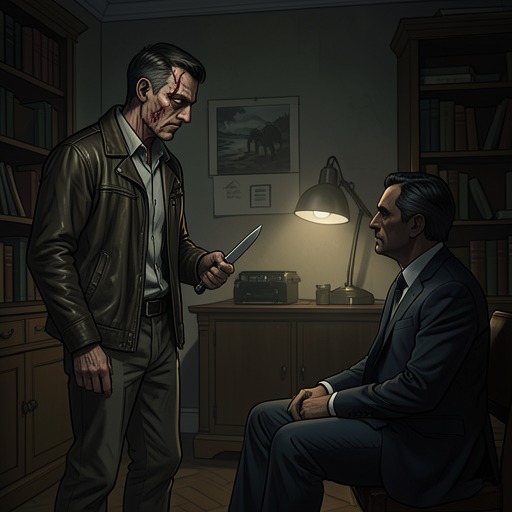
When they speak again, Ilyas describes being seized after the hostage crisis by seven armed men in black, whom he identifies as Russian Spetsnaz. He says he was held for two months, questioned and tortured, and that his leg was broken and badly reset. He denies having been a terrorist and suggests that his interrogators may have used information about his American connections to accuse him. The account does not establish that the FSB itself carried out the arrest or torture; it does show Ilyas linking his treatment to what Russian interrogators knew about his relationship with Henry.
Secrecy, responsibility, and the limits of trust
Ilyas tells Henry that his interrogators knew details about their relationship that surveillance could not have supplied. For him, that knowledge confirms that the Americans had revealed more than his name. Henry says he acted under orders during a politically difficult period and points to the complaint letter he sent to Langley afterward. Ilyas’s bitter response makes the letter no remedy for the harm: protesting after compliance cannot restore the trust or undo the disclosure.
The FSB therefore functions in the narrative as more than a foreign counterpart in intelligence exchanges. Its receipt of a source’s identity connects institutional cooperation to an individual’s disappearance, while the later conversation exposes the unequal risks hidden by the language of partnership. The narrative preserves uncertainty about precisely what happened to Ilyas and which Russian body was responsible, but not about Henry’s part in making his identity available. In that distinction, the FSB’s significance is inseparable from the larger question the episode raises: what intelligence institutions call cooperation may be experienced by a source as betrayal.