Flight 127 aircraft
All the Old KnivesFlight 127 aircraft is the physical center of the hijacking: a confined passenger cabin, a forward entry door opening onto the tarmac, and a cockpit whose recorded stillness becomes evidence of death. The plane’s changing visibility—from a grainy news image to remembered spaces inside it, then to high-resolution surveillance—makes it more than a setting. It is the place where coercion and resistance occur, and the object through which their consequences are witnessed.
The aircraft as a public image
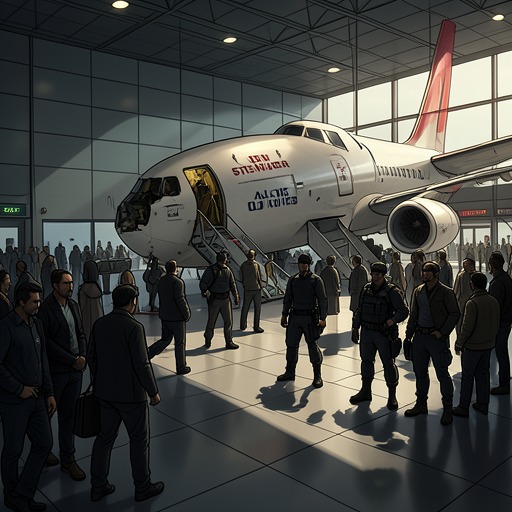
The aircraft first comes into view in an ORF Web report Gene brings to Celia Favreau. The article, titled “Third Death at Airport,” contains video only two minutes old. In its low-light, stable long shot, Flight 127 sits on an empty tarmac; the airport has been shut down, and distant buildings are visible beyond the open field. The camera makes the plane seem almost like a still photograph until its forward entry door opens.
The cameraman zooms in on a man standing in the doorway: elderly-looking, gray-haired, dark-skinned, wearing a white shirt with rolled sleeves and beige slacks. His head suddenly blurs after a distant thump, and he falls from the plane onto the tarmac. The camera dips to his body, then returns to the doorway, where a younger dark-skinned man—later identified as Ibrahim Zahir—stands holding a pistol. He shouts, “Take away your spy!” and shuts the door. The aircraft’s threshold briefly exposes an execution to the distant camera, then closes again, turning the doorway into both a frame for violence and a barrier against further sight.
The cabin under threat
Inside the aircraft, the cabin is organized by commands and the captors’ control over passengers. In Celia Favreau’s recollection, Ibrahim Zahir calls first in Arabic and then in English, “Children to the front!” A woman clutches her five-year-old son, but the boy calms her, slips from her loosened embrace, and takes Ibrahim Zahir’s hand toward first class. The scene makes the plane’s rows and divisions consequential: people are moved through its interior under armed authority, and a child’s small act of separation from his mother becomes part of that coercive process.
Celia Favreau is in row 22, while the command comes from seven rows ahead, at row 15. When Suleiman Wahed turns his attention toward Evan and Ginny, she rises partway from her seat to block his view and refuses to let them be taken. The aircraft’s confined seating leaves little distance between a threat and the people it endangers; the same cabin that holds passengers together also forces Celia Favreau to confront the danger at close range.
The cockpit and the aircraft’s aftermath
The cockpit becomes the site of Celia Favreau’s violent intervention. After forcing open its door against Nadif Guleed’s attempt to close it, she shoots him and steps inside. She sees the mess at her feet and understands it as the physical reality of death, immediately connecting that violence to the need to protect her children. Beyond her, the pilots remain in their seats, their blue caps visible above the headrests. They do not look toward her. The cockpit’s lights are on, but the scene offers no response—only the ventilation’s hiss and the pilots’ turned-away presence.
Later information makes the aircraft’s apparent immobility more ominous. The engine has started, yet the plane has neither moved nor lit up. Austrian observers receive a message: “Aslim Taslam does not negotiate.” High-resolution cameras trained on the cockpit record both pilots dying in their seats. They were not shot; they suffocated. The sequence links the aircraft’s mechanical signs of activity to its continued physical confinement and to deaths occurring inside it. Flight 127 remains an enclosed space in which those outside can watch, receive signals, and record what happens, but cannot mistake surveillance for safety.