Flight 127 hijacking and mass killing
All the Old KnivesThe hijacking and mass killing aboard Royal Jordanian Flight 127 begins as a tightly bounded hostage crisis in Vienna and ends with passengers, crew, and pilots dead. Its public deadline and the evidence left behind turn the disaster into the center of a later investigation into whether an intelligence officer’s actions helped destroy the chance of saving those aboard.
Hijacking and Demands
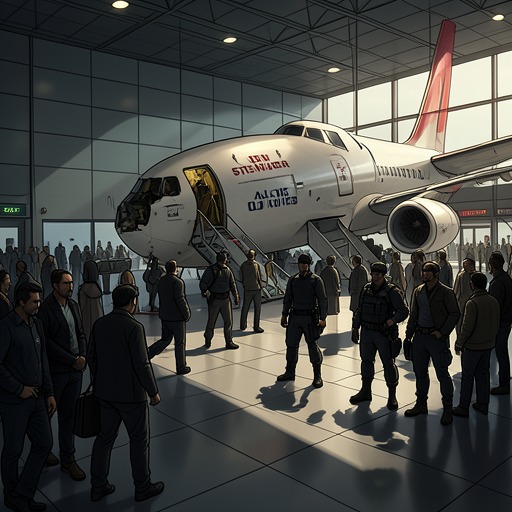
Flight 127, an Airbus 319 carrying 120 passengers and crew, departed Amman at 10:35 a.m. and landed in Vienna at 1:25 p.m. The four hijackers caused no trouble during the three-hour-and-fifty-minute flight, according to the account assembled by the Austrians. Immediately after landing, Suleiman Wahed stood and shot stewardess Raniyah Haddadin in the chest when she told him to sit down. The hijackers were identified as Suleiman Wahed, Ibrahim Zahir, Omar Ali, and Nadif Guleed; the intelligence team had their passport photographs but little further information about them. They were members of Aslim Taslam, a fact made clear in their calls to the control tower and to ORF, Austria’s national radio and television outlet.
The hijackers demanded the release of five prisoners within forty-eight hours: two held in Austria and three in Germany. Seventeen Americans were believed to be on board, though their presence was still being verified. The crisis therefore placed the hostages’ lives alongside the political consequences of compliance. The team discussed whether the Austrian and German governments would yield; if they refused, Owen Lassiter argued, the only remaining option was to storm the plane before the deadline. Vick drew a boundary around the American role: the team would advise the Austrians, not lead an assault.
The demand for a response unfolded in public. ORF cameras were already watching the aircraft from the airport fence, and the hijackers had not contacted the media by accident: the cameras gave them an audience outside the plane. Simply ordering the broadcasters away would itself invite speculation that authorities were preparing to storm the aircraft. The hostage crisis thus became a contest over what could be seen and inferred as well as over the prisoners’ release; the prospect of intervention could reach the hijackers through the very news coverage meant to report the standoff.
The Violence on the Tarmac and Inside the Cabin
The deadliness of the standoff became visible beyond the airport fence. In a grainy ORF video, Flight 127 sits alone on the dark, closed airport’s empty tarmac, distant buildings lit behind it. The camera holds steady until the forward entry door opens. An older, dark-skinned man in a white shirt and beige slacks appears in the doorway; his head suddenly jerks, and he falls out of the aircraft. The cameraman follows his body down to the tarmac, then back up to the entrance, where a younger man—later identified as Ibrahim Zahir—stands with a pistol. He shouts, “Take away your spy!” and shuts the door. The footage turns the hijackers’ threat into a public spectacle, while leaving the identity of the man who fell unresolved.
The killings continued out of sight. After the plane’s engine was started, it did not move, but the Austrians began receiving signals. The message was that Aslim Taslam did not negotiate. High-resolution cameras trained on the cockpit recorded both pilots dying in their seats. They had not been shot: they suffocated. The engine’s purpose, investigators concluded, was likely to start the ventilation system and spread sarin through the aircraft. Because they could not be certain what was happening, the Austrians hesitated to enter; the suggestion that the gas was sarin brought an urgent call for atropine and pralidoxime.
The scale of the deaths becomes fully apparent in Celia Favreau’s later recollection. In the cabin, she steps over Omar Ali’s corpse and sees six children, aged two to nine, with blood running from their noses. At row 22 she finds Evan’s sneaker protruding into the aisle, his foot limp after he slipped from his seat during his death tremors; above him, Ginny is curled in her seat in a dark pool. The remembered details make the mass killing intimate and specific: the numbered row, the loose shoe, the children’s faces. The plane is not only a sealed crime scene but also the site of the loss that will shape Celia’s later choices.
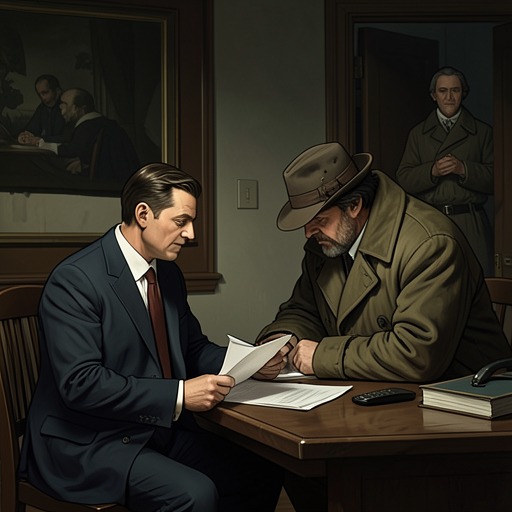
After the passengers and crew are dead, Celia says she buried a call from Bill Compton’s phone because she wanted to protect Henry Pelham. She had seen that the call might connect him to Ilyas Shishani and to information about Ahmed, but uncertainty gave her room to hope Henry was innocent; a tribunal, she reasoned, could not bring the dead back. That concealment later becomes central to Henry’s accusation that her call destroyed the only chance of rescuing the hostages. The catastrophe therefore leaves two kinds of evidence behind: visible deaths on the aircraft and a hidden phone record whose meaning becomes a question of responsibility.
Accountability Without a Tribunal
The later dispute over the call turns on a distinction between what Celia Favreau concealed and what Henry Pelham says she did. Henry accuses her of contacting Ilyas Shishani with information about Ahmed and thereby destroying the only chance to get the hostages out alive. But Celia’s account establishes that she hid a call record because she feared what it might imply; it does not, by itself, establish that she made the call Henry describes. Her brief response, “Did I?”, leaves that gap exposed rather than resolving it. The record is incriminating, but Henry treats his interpretation of it as a verdict.
Celia also reverses the accusation. She says Henry’s renewed focus on the phone call frightened Bill Compton and suggests Henry may have used a call from Bill’s line to frame either Bill or Celia. In her view, by pressing the evidence as proof against her, Henry has made his own conduct newly visible. The confrontation therefore shifts from a question of who suppressed a record to a question of who manipulated its meaning—and whether the available evidence can settle either charge.
Henry has already decided that Celia will die, and wants her answer as a final justification in case Vick or someone at Langley traces the killing to him. He invokes the Agency’s inability to prosecute suspected traitors as a reason for taking matters into his own hands: “We don’t do tribunals these days.” Celia knows that practice, but her knowledge does not make the decision lawful or the accusation certain. The mass killing’s aftermath thus reproduces the crisis’s collapse of ordinary safeguards: the dead cannot be restored by a hearing, and the living are placed at the mercy of secret judgments that substitute institutional logic for proof.
Political Stakes of Compliance
The hostage count sharpened the governments’ calculations: seventeen Americans were believed to be aboard, while twenty-nine Germans were on the passenger list. The team could not tell whether Angela Merkel, only a few months into office, would be inclined to yield to the demand for prisoners. Austria’s position appeared less flexible for a different reason: Heinz Fischer and the Social Democrats were already being attacked by the right for weakness on immigration, and releasing prisoners under pressure could strengthen that criticism. The crisis therefore confronted each government with a public choice in which the cost of concession was political, but refusal left the hostages exposed to the hijackers’ deadline.