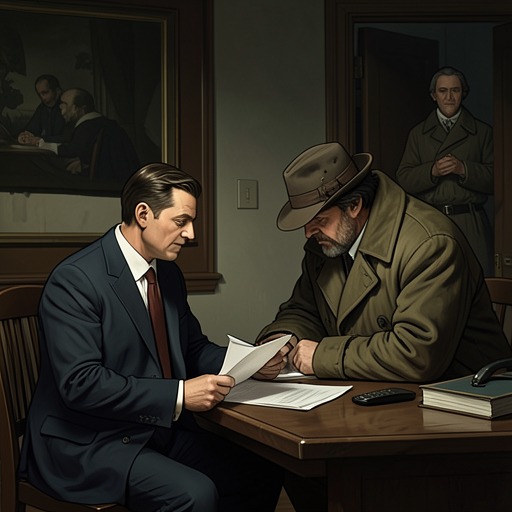
Henry Pelham and Ilyas Shishani’s handler-informant relationship
All the Old KnivesHenry Pelham and Ilyas Shishani’s handler-informant relationship is built on access and secrecy, then defined by Henry’s decision to surrender Ilyas’s identity to the Russian Federal Security Service. Ilyas’s disappearance turns an intelligence transaction into a personal burden for Henry: he cannot know what became of his source, but he fears his own disclosure helped change the man he once knew. Years later, reports connect Ilyas to militant activity and Henry accuses Celia Favreau of passing him information during the Flight 127 crisis, bringing the old betrayal into a new emergency.
Source, Access, and Disclosure
In Moscow, Ilyas was one of Henry’s sources and gave the Americans privileged access to the city’s closed Chechen community. Their work together lasted at least a year. The relationship is presented through its operational value, but the later recollections make clear that Ilyas was not simply an expendable name in a file: Henry remembers that he had a settled life and had baked bread there for at least fifteen years.
That source relationship ended under pressure from the institution employing Henry. Following orders from his station chief, George Lito, Henry supplied the Russian Federal Security Service with Ilyas’s identity. The disclosure took place amid American assistance to Russian efforts against anti-Putin and pro-Chechen activists in the United States, and discussions with Russian agents about dealings with human-rights organizations that challenged official accounts. Henry’s act was therefore part of a wider policy of cooperation, but its consequence fell on a particular source whose whereabouts and fate Henry could not control.
Soon after Henry gave up Ilyas’s name, Ilyas vanished. Henry later recalled trying to make contact a week after the disclosure and finding that Ilyas had disappeared without explanation. When Henry asked himself why a man with a life established in Moscow would simply leave, he could not find a convincing answer. The absence of an answer became one of the relationship’s defining facts: Henry had passed on information that could expose Ilyas, then lost the ability to learn what had happened to him.
Disappearance and Henry’s Guilt
Henry’s disclosure also became bound up with his break from the Moscow assignment. He was furious at the American response to the Dubrovka Theater hostage crisis and at the consequences of cooperation with Russian authorities. He sent an angry cable to Langley to put his frustration on record, requested a quieter posting, and was later pulled off the street before moving to Vienna. The source’s disappearance and Henry’s institutional disillusionment belong to the same period, even though Henry cannot establish a direct causal account of Ilyas’s fate.
Much later, Henry told Celia Favreau that he had heard Ilyas ended up in Tehran. He emphasized the contrast between the man he had known and the radical he was subsequently understood to be: Ilyas had not been a radical when he served as Henry’s source. Henry wondered whether giving his name to the Russians had pushed him toward that later identity. The thought is expressed as uncertainty, not proof. Its force lies in Henry’s recognition that a decision made in the name of intelligence work may have helped set consequences in motion beyond his reach.
Ilyas Reappears in the Investigation
During the inquiry into the threatened airline-related operation, a Europol message reported that a traveler named Mashood Al-Fakeeh, carrying a Saudi passport, had arrived in Barcelona from Jordan. Analysts believed that Mashood Al-Fakeeh was in fact Ilyas, now a Chechen radical reportedly aligned with Ansar al-Islam. The report raised the possibility that he was among the operational planners lent to Aslim Taslam for its planned airline-related event. This was an intelligence assessment and a possibility under investigation, not a confirmed account of Ilyas’s role.
The lead altered the atmosphere of the investigation. Bill Compton, who had doubted another report about a supposed militant cell, read the Europol message and immediately took it to Vick. Ilyas’s name thus returned not as a source Henry could contact, but as a disputed identity in a fast-moving threat assessment. The contrast is stark: the man who once opened a community to Henry’s work was now being considered as a possible participant in an operation endangering an aircraft.
The crisis involved Royal Jordanian Flight 127, which had landed in Vienna with 120 passengers and crew. The hijackers identified themselves as members of Aslim Taslam; one stewardess had already been killed, and the group demanded the release of five prisoners in Austria and Germany within forty-eight hours. With the possibility that everyone aboard could die if the demands were refused, officials considered the prospect of storming the plane. The presence of television cameras outside the aircraft also complicated any plan to act without signaling the government’s intentions. These circumstances gave the suspected link to Ilyas immediate stakes, while leaving the intelligence about his precise involvement unresolved.
The Alleged Call and the Relationship’s Unresolved End
During a later conversation, Henry described the effort to locate Ilyas after the crisis began. He had traced another safe house in Penzig, but Ilyas changed locations twice a day and never doubled back, making him exceptionally difficult to catch. Celia recalled that Henry had described the same pattern to Ernst Pul. Henry also acknowledged that Ilyas was eventually captured in Afghanistan and was then being held at Guantanamo Bay; Celia said she knew this through Karl Stein. The path from source to fugitive to detainee is recounted in fragments, through information obtained at different times and from different people.
At the confrontation between Henry and Celia, the relationship becomes the basis of a grave accusation. Henry says he believes Celia made a call to Ilyas and told him about Ahmed, thereby destroying what Henry regarded as their only chance of getting the people on the aircraft out alive. He points to the concealed phone-call record as evidence that Celia saw the call and did not bring it to Bill. But his demand that Celia admit making the call is still an accusation, and her reply does not confirm it. The passage therefore distinguishes Henry’s certainty about the evidence he has assembled from a definitive disclosure by Celia.
Henry has already decided what to do before seeking her answer. He invokes the agency’s treatment of suspected traitors, which it cannot prosecute and does not let go, and describes his decision as following Agency logic to its conclusion. The original disclosure of Ilyas’s identity and the later alleged disclosure of Ahmed’s information echo one another: in both cases, confidential knowledge moves through an intelligence network, with human lives exposed to decisions made in secret. The relationship’s ending remains morally unsettled. Henry bears guilt for what may have followed his own act, yet in the present crisis he turns that history into grounds for condemning Celia, while the truth of her alleged call remains unconfirmed.