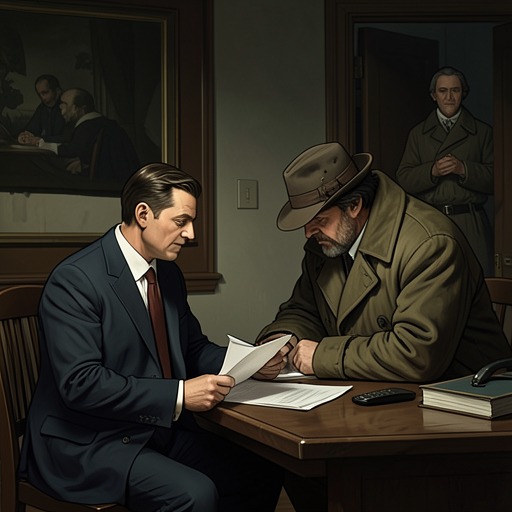
Ilyas Shishani
All the Old KnivesIlyas Shishani moves through the story in three forms: a Chechen source who gives Henry Pelham access to Moscow’s closed community, a suspected radical linked to the hijacking of Royal Jordanian Flight 127, and a survivor who returns to make Henry serve him. His disappearance follows the Central Intelligence Agency’s decision to identify him to the Russian Federal Security Service; his later demands expose how the earlier relationship of trust has become a tool of coercion.
Identity and Background
Ilyas is a Chechen who had lived in Moscow for at least fifteen years. In Henry’s earlier dealings with him, he was a baker, and Henry remembers their meetings in the back room of Ilyas’s bakery in the Arbat District. That ordinary life was also a point of contrast with the political danger surrounding him: he gave the Central Intelligence Agency privileged access to Moscow’s closed Chechen community, making him a valuable source.
Ilyas’s status as a source ends after Henry, acting under direct orders from station chief George Lito, gives the Russian Federal Security Service a list that includes him. Ilyas disappears soon afterward. Henry later recalls trying to contact him a week after the handover, with no one able to explain what had happened. He reasons that Ilyas had no obvious reason to leave: his life had been in Moscow for years, and he baked bread there. The timing invites suspicion that the handover led to his disappearance, but the account does not establish what happened to him during those missing years.
From Source to Suspect
During the later investigation into a threatened airline-related attack, a Europol message reports that a man named Mashood Al-Fakeeh arrived in Barcelona from Jordan on a Saudi passport. Analysts believe that Mashood Al-Fakeeh is in fact Ilyas, now described as a Chechen radical who reportedly joined Ansar al-Islam. The message raises the possibility that he is among the operational planners Ansar al-Islam has supplied to Aslim Taslam. This is presented as an inference from intelligence, not as a confirmed account of his role.
Ilyas becomes the only serious suspect the team identifies outside the hijacked aircraft. Henry’s knowledge of him makes Henry the person expected to search for him if he is in Vienna. Yet the lead remains uncertain: the analysts’ identification rests on the alias and reported associations, while the available account does not show the team locating Ilyas during the immediate search.
The Vienna Crisis and the Missing Source
The hijackers seize Royal Jordanian Flight 127 after it lands in Vienna. Four attackers take control of the aircraft, and their demands give the governments of Austria and Germany forty-eight hours to release five prisoners. As the crisis develops, a source inside the aircraft sends four text messages describing the passengers, dwindling water, loss of power, and a possible assault through the rear landing gear. One message says the lead hijacker speaks Russian, prompting Henry to consider Ilyas as a possible connection.
The messages also reveal that the source may have been discovered. Their final installment recommends abandoning the attack because of a camera on the aircraft’s undercarriage. Henry notices that its grammar differs from the earlier texts: the previous messages are compressed and incomplete, while this one uses complete sentences and more formal constructions. He concludes that someone else has written the last message and that Ahmed Najjar has been discovered. The change in language is a warning that the intelligence from the aircraft may have been intercepted or taken over; it does not, by itself, identify who did so.
The team then asks who could have revealed Ahmed’s identity. Henry’s first thought is Ilyas, because he speaks Russian. The identity of Ahmed, however, is said to have remained within a small group in the office, and the crisis evidence does not prove how the hijackers learned it. Later, Celia Favreau explains that she too recognized the abrupt change in the messages’ grammar and sought the phone records. Henry eventually confronts her over a call from his phone to Jordan on the first evening. He accuses her of calling Ilyas and telling him about Ahmed, but her question in response leaves the accusation unresolved in the exchange. The story therefore links Ilyas to the suspected breach without establishing that he was the person who exposed Ahmed.
Reappearance and Coercion
Four years later, Henry receives a request to meet at Schönbrunn Palace. In the winter quiet of the Gloriette, he finds a limping man who greets him by name. Henry takes a moment to recognize Ilyas: his features have aged and turned ashen, and he has grown fitter and more intense. He embraces Henry and kisses his cheeks, a gesture of familiarity that unsettles Henry because the man before him is no longer the gentle baker he remembers.
The meeting retains small traces of that former intimacy. With the electricity cut and no warm drink available, Ilyas produces two bottles of Coca-Cola from his coat pockets, remembering what Henry likes. The kindness of the gesture does not make the encounter safe. Ilyas tells Henry to provide an untraceable phone number; he will call from numbers that cannot lead back to him, ask for information, and expect Henry to answer. When Henry asks what happens if he refuses, Ilyas threatens to kill Celia. His threat makes the arrangement explicit: Henry’s renewed cooperation is not an act of trust but compliance enforced through danger to someone he loves.
Relationship and Narrative Significance
Ilyas and Henry’s history reaches back beyond the later crisis. Henry remembers offering him Marlboros in the bakery and invoking the American idea of trust. He also connects his eventual pact with Ilyas to love and guilt. The contrast between that earlier language and the later demand for intelligence marks the relationship’s transformation: personal familiarity survives, but it now helps Ilyas make the threat more effective.
The book’s final recollection places Ilyas on the other side of the mass killing aboard Flight 127. After the sarin has killed everyone, he calls Henry and tells him, “You’ve helped the cause of God, Henry. That is no small thing. You will be rewarded in Heaven.” Henry’s recollection of the call, followed by his statement that he does not believe in Heaven, gives Ilyas’s religious justification a bleak counterpoint. Across the relationship, Ilyas moves from a source whose access Henry depends on to a figure who can compel Henry to provide information; trust remains the language of their past, while coercion governs their future.