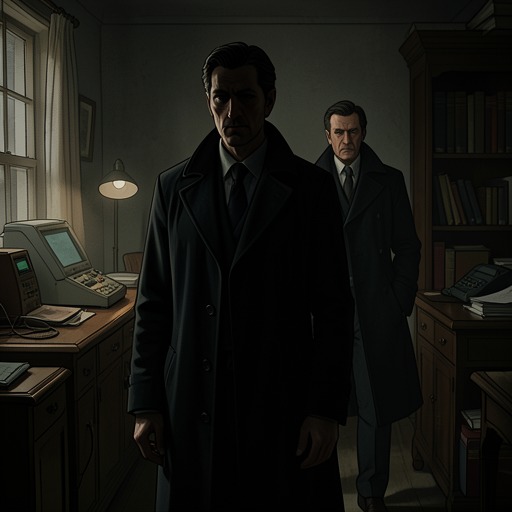
Rendez-vous Restaurant
All the Old KnivesRendez-vous Restaurant is the California setting where Henry Pelham and Celia Favreau’s former intimacy collides with the intelligence work both have tried to leave behind. First encountered by Henry as a disappointing substitute for an imagined old haunt, it later becomes the place where Karl Stein recruits Celia into an operation against Bill Compton and where Henry confronts Celia over the secret she kept. Its changing function—from restaurant, to meeting place, to exposed stage for accusation—makes the room a physical counterpart to the characters’ uncertain grasp of the past.
Setting and Appearance
Henry arrives half an hour early, treating the existence of a bar as a hopeful sign even though he sees no bottles. The restaurant behind the young hostess is completely empty, but she still asks whether he has a reservation. Dressed in black, with a ponytail high on her head and an iPad in hand, she gives the room an impersonal, contemporary welcome; Henry is not yet seated when the place has already unsettled his expectations.
The restaurant’s look acquires meaning through Henry’s recollection of The Song of Lunch, a dramatization of Christopher Reid’s poem that he watched after a painful evening alone. In the poem, a man meets an old flame at Zanotti’s, their former haunt, and expects time to have left both the restaurant and its occupants unchanged. Instead, the place has been modernized. Henry recognizes the same mismatch at Rendez-vous: the restaurant he encounters is not the familiar setting he might have imagined, but a reworked, conspicuously modern room. Its ceiling, rendered in the poem’s imagery as an origami form glowing like a Cubist thunderstorm, makes that transformation vivid rather than merely incidental.
A Place Recruited into the Operation
Rendez-vous is not only Henry and Celia’s meeting place. After arriving in California, Celia hoped for rest, a safe home for her children, and distance from the Agency. About two weeks later, Karl visits her at this very restaurant and tells her that Bill is suspected of selling secrets to Islamist groups. He asks her to return to Vienna, draw Bill out, and entrap him, arguing that the Flughafen remains a fresh wound for the Austrians and that they deserve answers. The location thus enters the plot as the setting where Celia’s intended escape is interrupted and converted into renewed service.
Later, Rendez-vous is arranged for a private party, with the charge assigned to a Big Sur company. The arrangement does not make the room feel secure: the person overseeing it worries that the party cannot put up a sign to keep everyone else out. Henry dismisses that concern by predicting that the unfashionable restaurant will attract only two or three customers that evening. The staffing details reinforce the improvised character of the occasion: a chef has been flown in from DC, and Jonas is to run the bar. A planned gathering can occupy the room, but it cannot fully control who enters or passes through it.
Reunion and Retrospective Expectation
At the table, Henry proposes to proceed through Celia’s account chronologically, beginning with her position under Bill in 2006 and eventually reaching the Flughafen. Their conversation is framed as an inquiry, but its setting and gestures keep the former relationship present. Celia grips her hands with her elbows together and adopts an air of girlish excitement; Henry answers with a remark that lets desire briefly show through before he returns to the interview. The restaurant holds both registers at once: the procedural reconstruction of an operation and the unresolved personal history between the two people conducting it.
Celia’s account of California gives the setting a second layer. She had expected relaxation, some luxury, intellectual stimulation, and, above all, a complete break from the Agency. Instead, Karl’s visit at Rendez-vous brought her back into its affairs. Her formulation that expectation is the source of human misery links the restaurant’s changed appearance to the reversal in her life: neither the hoped-for escape nor the imagined stability of the past survives contact with events. The room’s modernized surface becomes part of a wider pattern in which familiar places and old loyalties do not remain as their occupants remember them.
Accusation and Exposure
In the later confrontation, the restaurant is not a sealed chamber. A businessman seated there gets up, passes Celia, thanks the waiter without looking toward Henry, and leaves. Henry wonders whether Celia recognizes him, but the departure leaves the two former lovers alone. The moment emphasizes the fragile privacy of their meeting: other diners can be present, and a crucial participant can slip away, while the conversation continues toward a decision already made.
Henry accuses Celia of having found the record of a call to Ilyas Shishani and concealed it rather than bringing it to Bill. He says he wants her to confirm that she called Shishani and told him about Ahmed, compromising the only chance to get people out alive. Yet after two and a half hours at the restaurant, at nine thirty, Henry takes out his regular cell phone and notes that the other phone—the one recording their exchange—has stopped. With the recording no longer running, he tells Celia that he acted for her and recalls how she left him after what happened aboard the plane. The restaurant has carried the conversation from interrogation toward a confession that is personal as well as operational.
Rendez-vous therefore gathers several kinds of failed expectation into one ordinary commercial space: Henry’s imagined return to an unchanged past, Celia’s hoped-for escape from intelligence work, and the pair’s effort to control what can be heard, recorded, or witnessed. Its empty dining room, makeshift private-party arrangements, and intermittent traffic do not simply decorate the plot. They expose how little privacy or emotional distance the characters can secure, even when they believe they are alone.