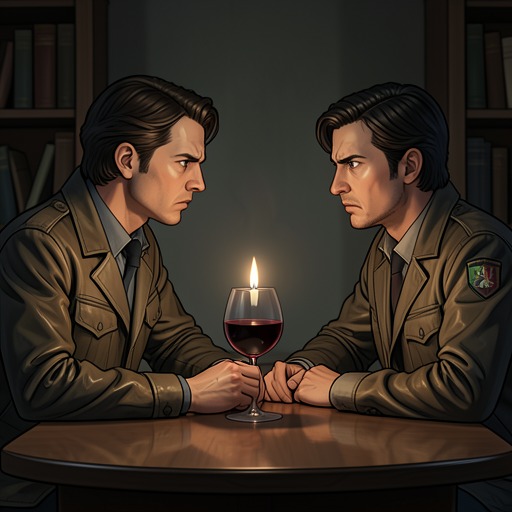
The Poisoning of Henry Pelham at the Carmel Restaurant
All the Old KnivesThe Poisoning of Henry Pelham at the Carmel Restaurant is the operation in which Celia Favreau’s carefully arranged private dinner becomes the setting for Henry Pelham’s death. The scene brings the story’s institutional logic into an intimate encounter: Henry is told that his meal has been poisoned and that he has little time, while Celia explains that the people behind the action will not give him a trial. Her confession makes the killing explicit, but her apology and difficulty watching him die prevent the scene from becoming a simple declaration of professional necessity.
Arrangement and Responsibility
The preparations are presented through Celia’s recollection of a conversation with Karl Stein. The dinner is booked as a private party at Rendez-vous Restaurant, with the charge placed on a Big Sur company. Karl objects that the restaurant cannot put up a sign to keep other customers out, a practical concern that also shows how much of the arrangement has to pass as ordinary business. Celia reassures him that the restaurant is so out of fashion that only two or three customers are likely to appear. She asks whether there is a chef; Karl says an excellent one has flown in from D.C., Jonas will run the bar, and there is a complication involving Jenny Dale. The available account does not explain that complication, but it does establish that the evening is planned around staffing and concealment as well as the private party.
Celia’s place in the operation becomes unmistakable when she recognizes that Karl is waiting for her direction. At the town house in Pacific Grove, she had told him what she thought would be necessary; now she understands that she is the one running the plan, because she called him and set its course. Karl asks whether they are right about Henry. His uncertainty is informed by a previous mistake: he had misjudged Bill Compton, and Celia had been right to challenge him. The exchange gives the operation a human point of hesitation. Karl seeks confirmation before acting, while Celia takes responsibility for naming Henry as the target.
The Restaurant as a Controlled Scene
When Karl appears at the front door, he uses keys to unlock it. The sound draws Henry’s attention, and he asks who has arrived. Celia identifies Karl, adding the small clarification, “With a K.” Henry works out the significance quickly despite his condition and asks what Karl is doing there. Celia answers that he is watching over her. Karl does not enter; his presence is limited to unlocking and guarding the door so Celia can leave. The distinction matters: he is part of the operation’s control of the space, but Celia remains alone with Henry at the moment of disclosure.
Freddy, who has emerged from the kitchen, goes from window to window and closes the blinds. Henry notices this too and understands that the encounter has been arranged around him: “You set me up.” Celia replies, “You tried to do it first.” Their brief exchange frames the poisoning as a reversal within a conflict already under way, rather than as an isolated act. The blinds, the guarded entrance, and the closed restaurant windows restrict the scene while making its practical arrangements visible to Henry. He sees enough to recognize the trap, but recognition does not give him a way out.
Disclosure and Death
Celia tells Henry plainly, “Your veal was poisoned. You don’t have much longer.” The directness removes any remaining uncertainty about what has happened, while the delay before Henry fully takes it in shows the news arriving through his failing body. His features contract; he shakes his head, and Celia reads the movement as painful. She observes that it is hard to watch someone die. The account does not specify the poison or describe how it was administered beyond the poisoned veal, so the force of the scene rests on the disclosure and its consequences rather than on an explanation of the method.
Celia then supplies the reason for the killing: “You know how it is. They don’t want a trial.” The explanation presents the absence of a trial as an established institutional practice, not as a decision Henry can contest. Henry looks back toward Freddy, who has finished closing the blinds but does not want to watch. He takes a pack of cigarettes from his pocket and goes outside to join Karl. The two men withdraw from the room, leaving Celia to face Henry’s response without their presence. Henry asks, “You’re killing me?” His voice is weak and innocent, and he cannot finish the sentence that follows. Celia tells him she is sorry, stands, and says, “Thank you, though.” When Henry asks what she means, the scene ends on his confusion and her departure rather than on a reply.
Significance and Aftermath
The encounter turns the operation’s planned secrecy into a personal confrontation. Celia has not only helped arrange the conditions that make the poisoning possible; she chooses to tell Henry what has happened, and she states the reason for it. Yet her admission that she is following her conscience more often than her calculations, coupled with her apology and inability to keep watching, complicates the role of a detached operative. Her words do not undo the decision or offer Henry recourse. They make her responsibility audible while leaving the institutional rationale intact.
Henry’s recognition that he has been set up, his question about whether Celia is killing him, and his unfinished sentence mark the human cost the plan’s controlled setting cannot contain. Karl’s guarded door and Freddy’s closed blinds secure the exit and screen the room, but they cannot make the killing impersonal. Celia leaves; Henry remains alive in the scene but is told that he has little time. The event’s final emphasis is therefore not on a completed procedural account of his death, but on the irreversible knowledge passed between former adversaries: Henry understands that Celia’s side has poisoned him, and Celia has to hear him understand it.