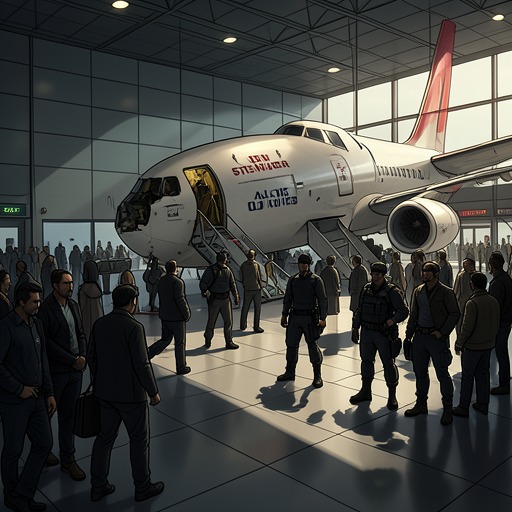
The sarin massacre aboard Flight 127
All the Old KnivesThe sarin massacre aboard Flight 127 transforms a hostage crisis into a suspected mass killing, with the aircraft itself turned into the means of death. The revelation comes through fragments of observation and inference: the plane’s engine is running, the pilots have died in their seats, and the Austrian authorities fear that the ventilation system has carried sarin through the cabin. At this point, they believe everyone aboard may be dead, though they do not yet know for certain.
Background and Stakes
Flight 127 was Royal Jordanian Flight 127, an Airbus 319 carrying 120 passengers and crew on a route from Amman to Vienna. It departed at 10:35 a.m. and landed at 1:25 p.m.; according to the passenger manifest and the pilot’s account from before the cockpit was taken over, the four hijackers had caused no trouble during the three-hour-and-fifty-minute flight. They acted only after touchdown. Suleiman Wahed, seated near the rear, stood when a stewardess asked him to sit down, drew a pistol, and shot her in the chest. The hijackers were identified as Wahed, Ibrahim Zahir, Omar Ali, and Nadif Guleed, and as members of Aslim Taslam. The murdered stewardess was named Raniyah Haddadin.
The hijacking’s demands made the passengers’ fate a matter of urgent political calculation. The hijackers sought five prisoners—two held in Austria and three in Germany—within forty-eight hours. Seventeen Americans were believed to be aboard, though that figure was still being verified; the plane also carried twenty-nine Germans. The crisis therefore placed several governments under pressure while leaving the hostages’ survival tied to negotiations across national boundaries.
The threat of a storming operation emerged as the deadline approached. Owen Lassiter argued that if Austria and Germany would not meet the demands, the plane would have to be stormed before time ran out. Vick drew a boundary around the American role: the United States was advising Austria, not leading the assault. The problem was not only how to enter the aircraft, but how to do so without alerting the hijackers. Television cameras from ORF were watching the plane from the airport fence; because the hijackers had summoned the media, their presence appeared deliberate. A cordon could push reporters back, but the move itself might prompt speculation that an assault was imminent. The cameras thus made the crisis visible while complicating the very intervention intended to save those aboard.
The Aircraft Becomes the Weapon
The report reached Celia through a tense exchange with Vick and Ernst: the engine had started, but the aircraft had not moved and had not caught fire. Then came a message from the hijackers: “Aslim Taslam does not negotiate.” High-resolution cameras trained on the cockpit had recorded both pilots dying in their seats. The first account put the start of the engine roughly five minutes earlier; Ernst corrected the interval to ten. The delay mattered less than what the images showed: the pilots had not been shot. They had suffocated, a conclusion Vick restated clinically as respiratory failure.
Celia connected the engine to the deaths: the hijackers had started the aircraft to activate its ventilation system. Vick said the Austrians shared that suspicion, but stressed that they could not enter without knowing what had happened inside. Ernst supplied the feared explanation—sarin—and called for doses of atropine and pralidoxime immediately. Vick remained cautious; Celia, recognizing that Ernst was right, understood that the running engine might have served not to move the plane but to spread poison through it. The massacre thus emerges first as an inference assembled from the cockpit images, the engine, and the pilots’ deaths, while the people outside still lack confirmation of what has happened to everyone else aboard.
Retrospective Blame and Institutional Logic
The massacre’s unresolved cause later becomes a weapon in Henry Pelham’s renewed inquiry into Celia Favreau. He accuses her of concealing a record of a call to Ilyas Shishani and of telling him about Ahmed, framing that disclosure as the loss of the hostages’ only chance of survival. The accusation turns the disaster into a question of individual culpability, but the scene does not establish that Celia’s call caused the deaths. When Henry demands that she confirm his account, she answers with a question: “Did I?” Her response leaves the charge unsettled rather than supplying the confession he wants.
Henry’s response exposes how the aftermath can generate further violence instead of accountability. He has already decided to have Celia killed, and treats the absence of prosecution as a reason to act outside legal process: in his view, the Agency cannot let suspected traitors go unpunished, yet cannot prosecute them. The massacre’s human cost is thus carried into a later institutional reckoning in which uncertain evidence is made to serve a lethal conclusion. The event’s consequences extend beyond the aircraft: its unanswered questions become part of the rationale for another planned killing.
The Limits of Confirmation
The episode draws a hard line between what the authorities can see and what they can only infer. The cockpit cameras establish the pilots’ deaths, but they do not reveal the condition of the cabin; the proposed use of sarin is a diagnosis made from the engine’s start and the pattern of suffocation, not a confirmed account of every death. That gap matters: the Austrian authorities fear that no one aboard survived, yet their uncertainty also restrains them from entering the aircraft. The massacre is therefore presented not as a fully witnessed event but as a catastrophe reconstructed from partial evidence, with the time needed to establish certainty itself carrying danger.