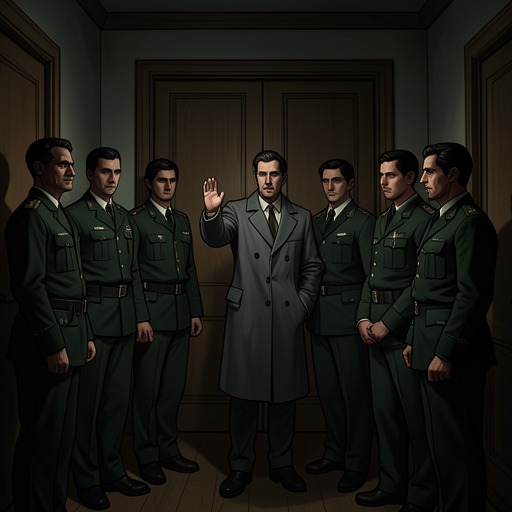
Victor Wallinger
All the Old KnivesVictor Wallinger, usually called Vick, is the Vienna station’s senior manager and a central decision-maker during both an investigation into the 2006 airport disaster and the later hijacking of Royal Jordanian Flight 127. His authority is practical rather than ceremonial: he sets investigations in motion, assigns people to urgent tasks, and defines the limits of what the station will do. Yet his judgments also reveal the pressures shaping the institution, where preventing scandal and protecting intelligence can compete with the effort to save lives.
Position and Working Style
Victor works in an office on the embassy’s fifth floor, above Boltzmanngasse, and presides over a staff whose less visible labor helps sustain his authority. Leslie MacGovern is described as the modest brains behind his rule: she has served him longer than the others, conveys her real thoughts discreetly, and is especially skilled at making him look good. The account presents Victor as the station’s public center, while also showing that his effectiveness depends on colleagues whose contributions may be concealed behind their roles or demeanors.
His management style combines brisk direction with humor and informal familiarity. When William Compton is absent from a morning meeting, Victor asks Celia Favreau whether she has heard from him; learning that William’s wife, Sally, is ill, he accepts the explanation in the midst of a gathering focused on an emerging emergency. His manner can be genial, but the office’s routine is quickly subordinated to operational needs. He calls for an all-night effort and distributes work across the station rather than treating the crisis as a problem for one investigator alone.
The Frankler Investigation
Victor assigns Henry Pelham to lead Frankler, an inquiry into the possibility that a source inside the U.S. embassy helped the 2006 Vienna Airport disaster. The theory originates with Larry Daniels, who has come from Langley after receiving material from Ilyas Shishani, a prisoner captured in Afghanistan. Victor’s decision makes Henry responsible for examining an allegation with grave institutional implications, even though its initial source is a terrorist detainee and Henry regards Daniels as inexperienced and eager to build his résumé.
When Henry argues that Daniels’s case rests on disinformation and should be dismissed, Victor is open to ending the inquiry. He recognizes that doing so would anger Daniels, but anticipates that Daniels’s superiors would welcome a chance to diminish him while avoiding a scandal. The exchange shows Victor considering not only whether the allegation is true, but also how the investigation itself may affect the agency. He does not simply defend the original theory: he is willing to bury it if doing so appears institutionally expedient. The unresolved possibility of an embassy source nevertheless forms the background to the later crisis and to the suspicion that falls on Celia Favreau.
Direction During the Hijacking
When intelligence warns of an imminent airline-related event involving Austria or Germany, Victor convenes the station’s personnel and helps organize its response. The warning identifies Aslim Taslam as the group involved and gives a seventy-two-hour window. Once Royal Jordanian Flight 127 lands in Vienna, Victor reports that the hijackers have identified themselves publicly and that a stewardess has already been killed. The plane had departed Amman with 120 passengers and crew; after landing, the four hijackers stood up and seized control. Victor relays the Austrian account and the limited identification information available, giving the office an initial picture of the threat without pretending that the perpetrators are fully understood.
The hijackers demand the release of five prisoners—two held in Austria and three in Germany—within forty-eight hours. Victor also reports that seventeen Americans are believed to be aboard, though that number is still being verified, and notes that twenty-nine Germans are on the plane. His discussion of the Austrian and German political contexts reflects the uncertainty surrounding whether either government will yield. These details make the crisis simultaneously a hostage emergency and a test of the governments’ willingness to negotiate under pressure.
Victor then assigns work across the station. Henry is pursuing his own leads, while William Compton and Celia Favreau are told to shake up their networks; Ernst Pul is asked to draw on his Austrian contacts; and Owen Lassiter is directed to consult technical contacts, especially in the Middle East, for information about the hijackers and their plans. Victor expects an all-night effort. When the prospect of storming the aircraft arises, he draws a boundary around the American role: the station will advise the Austrians, not conduct the assault itself. The distinction marks both an operational limit and Victor’s awareness that authority for action rests elsewhere.
Information, Cooperation, and Institutional Risk
The crisis also shows Victor managing the consequences of visibility. The hijackers have brought television cameras to the airport perimeter, and Celia points out that reporters will interpret any attempt to move them away as a sign that the authorities may be preparing to storm the plane. The scene places Victor’s office inside a wider information environment: decisions about security cannot be separated from what journalists and the public may infer from visible preparations. The danger is not only what the hijackers do, but also what a government’s response might signal to them.
Victor’s caution is clearest when the question of sharing information with the Austrians arises. Celia suggests they should be allowed to check on a matter that they may be better placed to investigate. William then discloses that the Austrians do not know about Ahmed, and Victor explains that the station is unsure it can trust the Interior Ministry because its personnel have not been vetted. The hesitation exposes the cost of secrecy: withholding intelligence may protect a source or prevent a leak, but it can also restrict the people responsible for responding to the emergency. Victor’s skepticism is not presented as proof that the Austrians are compromised; it is a risk calculation made under pressure, with lives aboard the plane depending on decisions about what to share.
Limits and Narrative Significance
Victor’s management connects the station’s immediate crisis work to its deeper institutional habits. He initiates an inquiry when an allegation threatens the embassy, considers burying it when it threatens to become a scandal, directs a broad response to the hijacking, and withholds information from local partners because they have not been vetted. These choices are not identical in purpose, but together they show an organization trying to control both danger and exposure. Its caution may be operationally understandable while still having consequences for cooperation and accountability.
Later, Henry confronts Celia over her concealment of a phone record and treats the possibility of her betrayal as grounds for an extrajudicial killing. He invokes agency logic as justification and worries that Victor or someone at Langley might connect the evidence to what he has done. Victor is not shown authorizing Henry’s decision, and the passage does not establish what Victor eventually learns. His presence in Henry’s calculation nonetheless gives the earlier managerial role a darker resonance: the same institution that investigates suspected leaks also supplies the language of secrecy and self-protection through which individuals rationalize actions beyond ordinary prosecution. The narrative leaves Victor’s response unresolved, preserving the distinction between his documented decisions and the violence Henry chooses to commit.