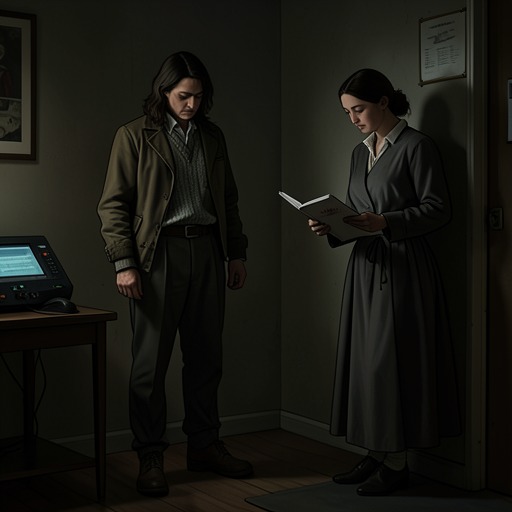
Vienna Airport Hijacking Incident
All the Old KnivesThe Flight 127 hijacking is a hostage crisis in which the danger to passengers becomes inseparable from the decisions of intelligence and government officials outside the aircraft. The hijackers use the children aboard as leverage, while the possibility of a forced entry is complicated by public scrutiny and uncertainty over the information available to the investigators.
Background and the Hijacking’s Opening
The crisis unfolds in Vienna in December 2006, a city Celia Favreau recalls as prosperous and outwardly stable, its confidence tempered by disputes over immigration and unease about political change. Her account appears in a later FBI transcript connected to a cell-phone flash card recovered from Karl Stein’s premises. The episode also arrives amid renewed reminders of the Moscow theater disaster: members of the Russian investigative team have been assassinated, Anna Politkovskaya has been shot, and Aleksandr Litvinenko has died after exposure to polonium-210. For Henry Pelham, those events revive fear and shame associated with the earlier disaster; rather than helping him step back, the reminders make him more determined to preserve his relationship with Celia.
The immediate intelligence lead comes from Larry Daniels, who has brought Victor Wallinger material obtained from Ilyas Shishani, a prisoner captured during a raid in Afghanistan. Among Shishani’s claims is that a source inside the U.S. embassy helped enable the 2006 Vienna airport disaster. Wallinger assigns Henry to investigate the allegation under the code name Frankler. Henry doubts the case: Shishani may be spreading disinformation, and he regards Daniels as an inexperienced officer eager to build his record. The suspicion of an embassy source thus forms part of the crisis’s wider intelligence backdrop, but at this stage it remains an allegation rather than an established explanation.
The aircraft is Royal Jordanian Flight 127, an Airbus A319 that departed Amman at 10:35 a.m. and landed in Vienna at 1:25 p.m. It carries 120 passengers and crew, although the aircraft can seat 138. According to the pilot’s account, the four hijackers cause no trouble during the three-hour-and-fifty-minute flight. They act immediately after landing: Suleiman Wahed stands near the rear of the cabin, draws a pistol, and shoots a stewardess in the chest when she tells him to sit down. The hijackers are identified as Suleiman Wahed, Ibrahim Zahir, Omar Samatar Ali, and Nadif Dalmar Guleed, and are described as members of Aslim Taslam.
The hijackers tell passengers that the aircraft is to serve as a safe house until their demands are met, not as a weapon. Their stated plan is to fly elsewhere afterward and release everyone, while warning that anyone who disobeys will be killed. They quickly move nine children, aged five to twelve, to the front of the cabin. The children serve both as human shields against a forced entry and as leverage: the hijackers threaten to kill one whenever anyone interferes. The tactic makes the passengers’ vulnerability part of the negotiating strategy from the crisis’s opening hours.
Demands, Intelligence, and the Limits of Intervention
The hijackers demand the release of five prisoners—two held in Austria and three in Germany—within forty-eight hours. Austrian officials report that seventeen Americans are aboard, while twenty-nine German passengers make the response a question of political as well as immediate human stakes. The investigators weigh whether the governments will yield: Germany’s new chancellor, Angela Merkel, may be accommodating, while Austrian president Heinz Fischer faces criticism from the right and Social Democrats over immigration. Conceding could expose him to accusations of weakness; refusing could leave the hostages in greater danger.
The intelligence team considers using Ahmed Najjar, whose file shows that he speaks Arabic and Farsi. Henry is wary of treating that ability as a solution: Ahmed is fifty-eight, has spent the preceding six years largely tending dead drops, and is nearing retirement. His language skills offer a possible opening, but his recent work and age make him an uncertain candidate for confronting the hijackers. The deliberation is overtaken by a message that an Austrian hostage has died of a coronary event. Ten minutes later, the team watches television as an old man is lowered from the aircraft to the tarmac by rope; ORF identifies him an hour afterward as Günter Heinz, an engineer from Bad Vöslau.
The prospect of an assault raises a different problem. Owen Lassiter argues that, if Austria and Germany will not meet the demands, the plane must be stormed before the deadline, but Victor Wallinger insists that the American team is there to advise the Austrians, not conduct the operation itself. Celia points to the television cameras gathered at the airport fence. The hijackers have brought the media into the crisis deliberately, she observes, so that events outside the aircraft remain visible to them. Simply ordering reporters away would itself attract attention and invite speculation that a government assault was being prepared; the public presence that broadcasts the crisis also constrains how officials can respond.
A further message appears to change the operational picture. It reports that the lead hijacker is speaking Russian and that the sender cannot translate, then warns that the attack plan should be abandoned: the hijackers have a camera trained on the aircraft’s undercarriage and appear to know what they are doing. The message recommends giving them what they demand to prevent everyone aboard from dying. Henry notices that its fluent, complete sentences differ from Ahmed’s earlier, telegraphic wording. That discrepancy suggests the latest communication came from someone else, making the intelligence channel itself a source of uncertainty at the moment officials are trying to decide whether any intervention is possible.
Retrospective Blame and Agency Logic
Years after the hijacking, the crisis returns as the central charge in Henry Pelham’s confrontation with Celia Favreau. Henry says that she saw a crucial phone call in the records, failed to bring it to Bill Compton, and concealed the recording. He accuses her of calling Ilyas Shishani and telling him about Ahmed Najjar, thereby destroying what Henry calls their only chance of getting the hostages out alive. The accusation makes the intelligence channel more than a source of imperfect warnings: in Henry’s account, a hidden communication has altered the possibilities for rescue and become evidence of betrayal.
The scene does not establish Celia’s guilt as an uncontested fact. Henry presents the logs and Bill’s account as decisive, but Celia answers his demand for confirmation with, “Did I?” Her response leaves the accusation unresolved in the exchange, even as Henry treats it as sufficient grounds for judgment. He says that suspected traitors cannot be released or prosecuted and describes his intended response as the inevitable conclusion of Agency logic. Thus the hijacking’s aftermath is not only a question of what officials knew or could do during the forty-eight-hour crisis; it is also the means by which Henry later justifies action outside a courtroom. The passengers’ peril remains the moral weight behind his claim, while the secrecy that once complicated intervention now allows him to treat accusation as authorization.
Documentary Frame and Unsettled Record
The hijacking reaches the reader through a record assembled after the crisis, not through a single uninterrupted account. The FBI transcript identifies its source as a cell-phone flash card removed from Karl Stein’s premises on November 7, 2012, during an investigation into actions taken by Stein on October 16. Within that documentary frame, Celia Favreau’s recollection of Vienna sits beside operational messages and scenes of the station’s deliberations. The shifts in form make the episode legible as both a hostage emergency and a later inquiry into what the people outside the aircraft knew, communicated, and withheld. The record supplies concrete details—the flight’s route, the prisoners demanded, the cameras at the fence—but it also preserves uncertainty: the warning that changes the team’s assessment is attributed to an unidentified sender, and Henry’s later accusation about Celia is not confirmed by her reply. The crisis therefore remains a contest over evidence as well as action, with the surviving account exposing the limits of what can be established even as its fragments acquire deadly consequences.