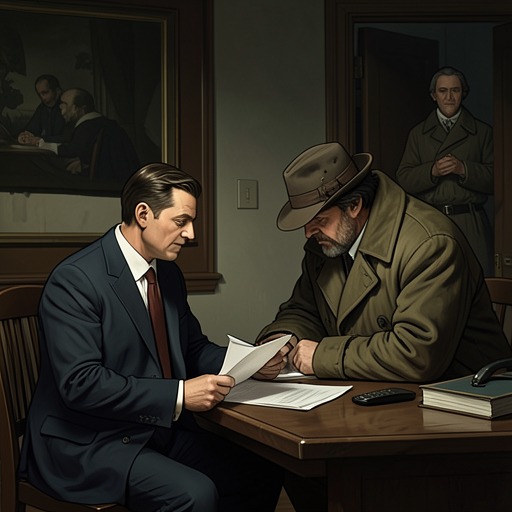
Vienna Embassy relay call to Amman
All the Old KnivesThe Vienna Embassy relay call to Amman is a short telephone connection whose importance lies less in what it proves than in the questions it opens. A record shows a twenty-seven-second call at 9:38 P.M. from extension 4952 to Amman. Celia Favreau traces the number and discovers that it served as a relay, but the available evidence never identifies who placed the call or what destination lay beyond it. The record becomes both a lead in the Vienna station’s leak inquiry and a weapon in Henry Pelham’s interrogation of Bill Compton.
Discovery in the phone records
Celia finds the call while trying to obtain the station’s phone logs. She first asks Gene Wilcox, whose refusal she experiences as patronizing; after seeking approval from Victor Wallinger’s secretary, she is sitting at Bill Compton’s desk when the entry appears. Its particulars are unusually exact: extension 4952, a call lasting twenty-seven seconds, country code 962, city code 6, and Amman. The minute detail makes the discovery feel at once concrete and incomplete. The record gives her a time, a duration, and a destination, but not a speaker or a purpose.
The speed of the reversal sharpens the moment. Celia has moved from suspicion to a possible lead within half an hour, and the simplicity of the apparent mistake unsettles her: someone involved in clandestine affairs seems to have used an office line. The call’s ordinary administrative trace cuts across the secrecy expected of intelligence work. Yet the record alone cannot show whether the call was made by Bill, by someone else with access to his line, or by someone using the number for another purpose.
The relay and Celia’s test call
Celia dials the number. The connection begins with the thin beeps of a distant phone, followed by clicks, then another ringing tone, deeper than the first. From that sequence she realizes that she has not reached an ordinary endpoint: the number has connected her to another line and is functioning as a relay. This distinction matters. The number recorded in the logs is a link in a chain, not necessarily the final recipient’s number.
After three rings, a man answers in Russian. Celia recognizes the language but does not speak it. If she speaks English, she fears he will learn that an American woman has his number; if she hangs up, she worries he will become suspicious. Either response, she thinks, could lead him to change his plans. She instead answers in German, pretending to seek someone named Luther. The exchange does not establish the caller’s identity. Although Celia considers whether the man might be Ilyas Shishani, the scene supplies no confirmation that he is Shishani or that the relay reaches him.
The call takes place against Celia’s wish to be elsewhere: at home, preferably with Henry Pelham. That private longing is abruptly interrupted by the professional danger attached to the line. Her test is not a controlled identification of the person at the other end; it is a risky attempt to learn what kind of connection the suspicious number makes while avoiding an immediate disclosure of who she is.
The number traced
Later, Henry tells Bill that the call was made from Bill’s line. Henry says he examined the records a week earlier and enlisted contacts in Jordan to check their own records. Their trace led to a number that had existed for only a week and served an unoccupied studio apartment in Amman. The number was disconnected two days after the Flughafen. Henry’s contacts also determined that it had been set up as a relay.
The trace strengthens the suspicion without closing the case. The Jordanian contacts could not determine which number the relay had been patched to; Henry says he can make guesses, not that he knows the destination. Nor does the apartment’s status explain who arranged the connection or who used it. The call’s limited duration, the relay, and the number’s short life make it look deliberate, but those circumstances remain circumstantial. The information offers a path for inquiry while preserving a critical gap between a suspicious phone record and proof of a particular caller or recipient.
Evidence turned into pressure
Henry introduces the record to Bill by asking what Celia might have found if she had discovered questionable calls from the boss she admired. He then states the time and duration and points out that the call came from Bill’s line. The method is deliberate: Henry makes the log sound incriminating before the unanswered questions have been resolved. Bill reacts with shock, asks whether Henry is looking for a scapegoat, and argues that anyone could have used his office phone because he never locked his office. He names several colleagues as possible users and singles out Ernst Pul’s movements to make calls to his Austrian contacts as a reason to investigate him.
Henry refuses to follow Bill into a list of suspects. He says the investigation must follow evidence rather than speculation, then warns that Bill’s comfortable life could disappear and that the agency no longer takes prisoners. The call therefore does not settle the leak inquiry; it becomes a means of testing and intimidating Bill. Its central significance is its double edge: the relay is a tangible clue, but its unknown user and unknown destination leave room for both investigation and coercive interpretation.