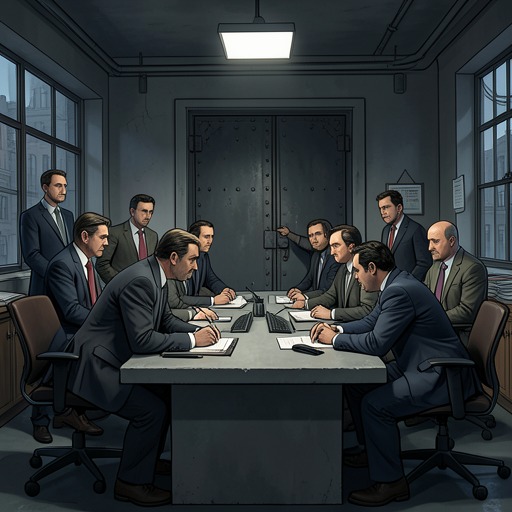
CRP subpoenas of Washington Post journalists
All the President's MenThe subpoenas issued by the Committee for the Re-election of the President turned The Washington Post’s Watergate reporting into a direct legal confrontation over journalists’ notes, confidential sources, and the First Amendment. The committee demanded testimony and reporting materials in a civil suit, while the newsroom moved to protect its files and prepared to contest the demand. The episode followed reporting that traced Watergate espionage to a secret campaign fund and exposed how much remained concealed inside the Nixon campaign organization.
Background: Following the money
The reporting had developed through the accumulation of records and guarded accounts. In one pivotal discovery, Bernstein copied a fifth check among the Mexican checks: a cashier’s check for $25,000, drawn on a Florida bank and payable to Kenneth H. Dahlberg. Deposited with the four Mexican checks, it brought the total deposit to $114,000. Four days later, Bernard Barker withdrew $25,000; the remaining $89,000 was withdrawn separately. At that point, Bernstein and Martin Dardis were still trying to establish who Dahlberg was. The check supplied a concrete financial link, but its significance had to be built through further reporting.
A later Washington Post story reported that funds for the Watergate espionage operation were controlled by principal assistants to John Mitchell and held in a special account at the Committee for the Re-election of the President. The account contained more than $300,000 for sensitive political projects; G. Gordon Liddy had received money from it, records had been destroyed, and Hugh Sloan’s resignation followed his suspicions about Watergate. The paper described the withdrawals cautiously as financing intelligence-gathering activities against Democrats: Deep Throat linked the money to the bugging, but the Bookkeeper could not independently confirm that specific allegation. Editors were developing a two-source standard for criminal claims, a restraint that made the reporting both more defensible and more dependent on continuing access to people inside the campaign.
That access was difficult to secure. In nighttime visits to Committee employees, Bernstein encountered fear and silence: one worker trembled and asked him to leave before others saw him, while another began to cry. The Bookkeeper told him that people had already lied to the grand jury and that Sally Harmony and others had lied, though she did not establish precisely what each had concealed. Sloan, the former treasurer, said the circumstances were worse than the published account suggested, but his lawyers advised against public statements that might be used in civil litigation. He described the pressure not as an explicit instruction to lie, but as a repeated appeal to hold ranks and keep the organization together. This climate formed the background to a subpoena demanding the reporters’ accumulated work.
The demand for the Post’s files
On February 26, after returning from an unsuccessful effort to confirm a Time magazine account of government wiretapping, Bernstein was pulled back into the Post lobby by reporter Laura Kiernan. She warned him that a process server was upstairs with a subpoena for him and his notes, and that Ben Bradlee did not want him served before the paper’s lawyers could advise him. Bernstein hurried up seven flights to an office in the accounting department and called Bradlee. Bob Woodward was away, but the two reporters had already agreed that they would not hand over notes or identify sources in a grand-jury proceeding or judicial hearing without a court fight. Bernstein told Bradlee where the files were so they could be moved to safety.
The demand was broader than a request for Bernstein’s notes. The Committee for the Re-election of the President had subpoenaed five people at the Post: Bernstein, Woodward, Jim Mann, Howard Simons, and Katharine Graham. It had also subpoenaed journalists from the Washington Star-News, The New York Times, and Time magazine. The recipients were ordered to give depositions in the committee’s civil suit and bring their Watergate notes, tapes, and story drafts. Simons and Graham, the only people on the Post’s list who were not reporters, had already been served. Bradlee initially told Bernstein to leave the building while he sought legal advice, sending him to a movie and asking him to call back at five.
The newsroom’s response
When Bernstein called, Bradlee explained the strategy: Bernstein would accept the subpoena, but custody of at least some of his notes would pass to Graham. The paper intended to fight the demand through the courts. Bradlee’s account of the plan made Graham’s position deliberately visible: if the judge ordered someone jailed, the target would be the publisher rather than a reporter, and the resulting image of her going to jail to uphold the First Amendment would itself become news. It was a legal defense and a public challenge to the committee’s attempt to obtain the newsroom’s working files.
That night Bernstein was back at his desk when a committee page approached with the subpoena. Bernstein kept typing, raised one hand, and took the document without stopping his work. The ordinary gesture contrasted with the extraordinary demand: the committee sought not only testimony but the notes, recordings, and drafts through which the paper had assembled its account. The Post’s response was not to treat those materials as an available archive for the civil suit. It moved them to safety, put their custody under the publisher’s protection, and prepared to litigate rather than surrender its sources or reporting process.
Court outcome and significance
The subpoena episode belonged to a wider struggle over what the Watergate investigation could reach. The newspaper had reported that the fund was controlled by Mitchell’s assistants, but subsequent accounts from Sloan described Mitchell personally authorizing campaign expenditures by telephone, beginning in 1971, while he was Attorney General. Later, former deputy campaign manager Jeb Stuart Magruder told federal prosecutors that Mitchell and White House Counsel John Dean had approved and helped plan the bugging operation, and that the two later arranged to buy the conspirators’ silence. These developments widened the stakes of the Post’s reporting, though they do not establish that any one of them caused the subpoenas.
On March 22, the day before Woodward heard about James McCord’s letter to the judge, the court threw out the Committee for the Re-election of the President’s subpoenas of the Post’s reporters and news executives. The outcome ended this particular effort to compel the paper’s Watergate files, but the confrontation had already clarified the institutional choice: the reporters would not identify confidential sources or deliver their notes simply because a litigant demanded them. The subpoenas made the mechanics of investigative journalism part of the story itself—who held the records, who could be forced to disclose them, and whether the pursuit of the Watergate evidence could be separated from the protection of the people who supplied it.