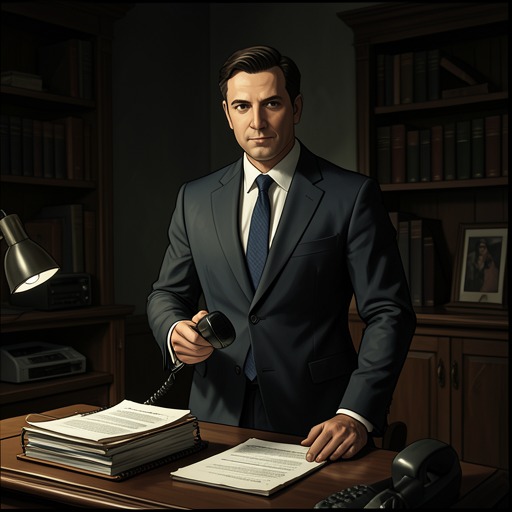
Clark MacGregor
All the President's MenClark MacGregor was John Mitchell’s successor as manager of Richard Nixon’s campaign and later its director, a position that placed him between a deteriorating Watergate defense and reporters pressing for answers about the campaign’s money and political operations. He initially presented himself as removed from decisions made before he arrived, then publicly attributed a clandestine fund to Gordon Liddy’s initiative. By October, he acknowledged that the Committee for the Re-election of the President had maintained a cash fund and named five people who had authorized or received payments. The sequence made his changing account a measure of how quickly the campaign’s denials were being overtaken by disclosures.
Position and First Defenses
Six weeks after John Mitchell had affirmed the committee’s commitment to the traditional electoral process, Bob Woodward told MacGregor what The Washington Post had learned about Watergate. MacGregor answered that he knew nothing about it and said the events had taken place before he joined the campaign. Mitchell and Maurice Stans, he suggested, would presumably know more. His response placed distance between himself and the earlier campaign leadership even as the committee’s public protestations of non-involvement were beginning to disintegrate.
The distinction between what MacGregor claimed to know and what he was responsible for managing became harder to sustain as reporters traced money through the campaign. Investigators described a cash pool of at least $100,000, including money associated with the account into which a check from Kenneth Dahlberg had been deposited. A former administration official told Carl Bernstein that Gordon Liddy supervised the fund and that Liddy was expected to take the blame for others. The proposed public explanation, the source said, would describe the money as convention security funds. These were reports MacGregor had to answer as the campaign’s new manager, though the evidence did not establish that he had created the fund or directed its earlier uses.
On August 16, MacGregor made the first public effort to place responsibility on Liddy. Speaking to selected White House reporters, he said that Liddy, while serving as the committee’s finance counsel, had spent campaign funds on his own initiative to prepare for a possible attack on the President at the Republican convention. Later that day, pressed by Woodward for a fuller explanation, MacGregor said he had no idea why Liddy wanted cash, had never met him, and did not know what was happening. When Woodward suggested this made him sound out of touch with the campaign he was supposed to run, MacGregor warned that printing the implication would end their relationship, while adding that he was not threatening the reporter.
A Friendly Press Contact Under Pressure
MacGregor had a reputation as one of the few Nixon administration officials friendly with the press, which sharpened the contrast between that standing and his increasingly defensive dealings with The Washington Post. He also objected to Woodward and Bernstein’s evening visits to Committee for the Re-election of the President employees. People they approached described intense pressure: one pleaded with Bernstein to leave before others saw him, while another began to cry. The reporters were trying to understand what employees knew about the operation and the apparent destruction of records after the break-in; their visits also became a point of conflict between MacGregor and the newspaper’s leadership.
MacGregor called the paper’s executive editor, Ben Bradlee, to complain. He sought a meeting with Bradlee and publisher Katharine Graham, alleging that five women at the committee had been harassed by the reporters. As Bradlee later recalled the exchange, MacGregor described the conduct as knocking on apartment doors late at night and telephoning from building lobbies. Bradlee asked how that amounted to harassment and dismissed the complaint. The episode revealed a second front in MacGregor’s role: alongside disputing the reporters’ accounts, he sought to challenge the methods by which they were gathering information from frightened campaign employees.
Public Confrontation with the Press
As reporting broadened from the Watergate break-in to allegations of political espionage and sabotage, MacGregor faced a large press conference at committee headquarters. Bernstein attended because he wanted to see whether MacGregor’s reputation for openness would hold. About one hundred reporters were present. MacGregor entered from the rear, walked up the center aisle, gripped both sides of the lectern, and said that unusual developments meant he could not answer questions. When the investigative reporter Clark Mollenhoff demanded to know what documents MacGregor had seen and what credibility he could claim, MacGregor replied that the audience should decide in consultation with its editors.
He then read a prepared statement attacking George McGovern and The Washington Post. He portrayed the newspaper’s reporting as hearsay, innuendo, anonymous accusation, and an attempt to imply a direct White House connection to Watergate; he also accused it of hypocrisy and of giving allegations about disruptions to McGovern’s campaign more attention than disruptions affecting Nixon’s. When Bernstein shouted a question about whether MacGregor would deny the report concerning Dwight Chapin, MacGregor looked at him without answering and left. At The Washington Post, Bradlee noted that MacGregor’s attack, Ronald Ziegler’s denunciations, and Robert Dole’s remarks used similar language. The paper’s leadership took this as evidence that the attacks were coordinated, whether or not Richard Nixon had personally ordered them.
The campaign’s effort to frame the dispute as a question of journalistic credibility collided with the accumulating financial evidence. Ziegler called the newspaper’s reporting shabby and absurd, rejected the phrase “secret fund,” and said that John Dean had told him no such fund existed. On the following afternoon, October 26, MacGregor appeared in a television interview at the National Public Affairs Center for Television. The timing offered the administration a chance to adjust its public position after Henry Kissinger’s announcement that peace was at hand in Southeast Asia had drawn attention elsewhere.
Acknowledgment and Limits
In the interview, MacGregor confirmed that the Committee for the Re-election of the President had maintained a cash fund for clandestine activities. He disputed calling it secret and insisted that its money had not knowingly been spent illegally. He said that cash found in Maurice Stans’s safe had been used to determine whether organized efforts were under way to sabotage Nixon’s primary campaign. He also identified five people who had authorized or received payments: John Mitchell, Maurice Stans, Jeb Magruder, Porter, and Liddy.
The admission partially restored the reporters’ credibility after the earlier controversy over a report linking H. R. Haldeman to the fund, but it also stood in direct contrast to Ziegler’s denial the previous day. MacGregor’s qualification—that illegal spending had not been knowingly authorized—did not settle what the fund had financed or who had approved particular expenditures. Bob Woodward wanted the admission on the front page; Bradlee kept it off, reasoning that prominent placement would look like the newspaper was exploiting Kissinger’s announcement. The exchange underscores MacGregor’s changing place in the story: he could acknowledge the fund and name those connected to its payments, but his account continued to narrow what that acknowledgment meant.
The Boundary Between Loyalty and Disclosure
MacGregor’s shifting public posture unfolded against a campaign in which employees were urged to hold together and avoid disclosures. Hugh Sloan later described the message as “Hold ranks,” or “Keep the ship together.” Other committee employees feared the pressure around them; one told Bernstein that people had already lied to the grand jury. These accounts do not show that MacGregor personally instructed employees to lie. They do, however, illuminate the organization in which his public defenses operated: information was withheld, responsibility was disputed, and a former ally of the press could become an enforcer of the campaign’s preferred account.
The later disclosures further exposed the limitations of that account. Donald Segretti told Bernstein that he had not understood the larger operation and had learned what it was about by reading newspapers, identifying the White House as the source of direction above his own role. After James McCord disclosed that payments to the Watergate conspirators came from the campaign, a Committee for the Re-election of the President official condemned how the White House had handled the crisis. These developments do not establish MacGregor’s participation in the underlying operation; rather, they show how the public explanations he delivered were repeatedly tested by accounts from people with closer knowledge of the fund, the operation, and the effort to contain its consequences. In that progression, MacGregor appears less as the architect of the original scheme than as a campaign manager whose credibility and room for maneuver contracted as the evidence became harder to deny.