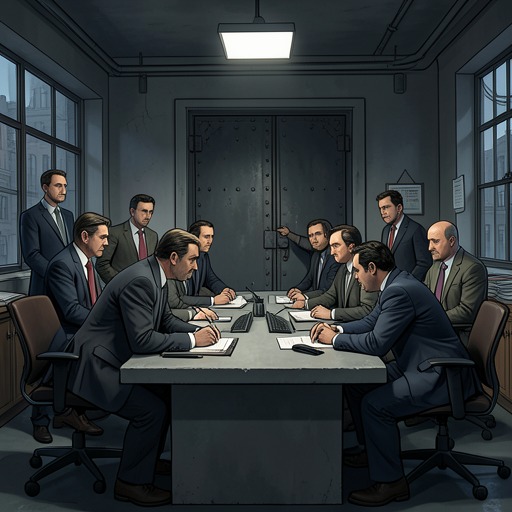
Howard Simons
All the President's MenHoward Simons was The Washington Post’s managing editor and a central editorial counterweight in its Watergate investigation. A prize-winning science reporter who had become the paper’s number-two editor the year before, he encouraged reporters to follow promising leads but pressed them to distinguish a compelling theory from a publishable, verified account. His role was not simply to accelerate the investigation: he helped determine when uncertainty called for more reporting, when a story was ready, and when the risks of proceeding required a pause.
Editorial Role and Temperament
Simons’s position placed him between the reporters developing stories and the editors responsible for what appeared in the paper. The account describes him as intent and sensitive, skillful with fragile egos, and a counterpoint to executive editor Ben Bradlee. Bradlee wanted hard information and was impatient with theories; Simons, by contrast, shared Barry Bernstein’s willingness to reason from incomplete information, while remaining cautious about what the newspaper ultimately printed. That combination made him an advocate for inquiry without making speculation a substitute for evidence.
His editorial approach was expressed most plainly in his instruction to Bob Woodward and Bernstein: “I don’t care if it’s a word, a phrase, a sentence, a paragraph, a whole story or an entire series of stories,” he said. “When in doubt, leave it out.” The maxim applied at every scale, from a disputed detail to an entire investigation. It did not mean that reporters should abandon a lead at the first uncertainty; it meant they should keep uncertainty visible in the newsroom’s decisions and refuse to publish material they could not responsibly support.
Encouraging Leads, Controlling Publication
When Bernstein presented a sketchy account suggesting that the Watergate bugging might have belonged to a wider political-intelligence operation, Simons was interested. The bugging seemed difficult to explain as an isolated act, Bernstein argued, given the Nixon campaign’s strength at the time. He pointed to disparate indications of political intelligence and interference, including attempts involving George McGovern’s headquarters, investigations of Edmund Muskie and Edward Kennedy, and efforts to infiltrate the Vietnam Veterans Against the War. Simons urged Bernstein to get to Alex Shipley quickly. He was willing to treat scattered reports as a reason to investigate further, not as proof that the broader theory was already established.
That distinction also shaped Simons’s response to the proposed reporting method. The reporters and editors considered approaching members of the Watergate grand jury, a venture that raised serious doubts within the newsroom. Simons openly questioned whether it was right to do so; Bradlee was troubled but proceeded after consulting the paper’s lawyers, while Harry Rosenfeld worried about the practical risk of the reporters being caught and Barry Sussman feared Bernstein might press too far and violate the law. Their stated procedure was to identify themselves and leave unless a juror volunteered information without prompting. Simons’s misgiving mattered because the plan tested not only what reporters could learn, but what they should do to learn it.
At the final editorial meeting on the Canuck Letter and the political sabotage reporting, Simons was among those reviewing the stories with Bradlee, Bernstein, and Woodward. The reporters had moved away from an earlier plan for three separate articles: Woodward was writing about the Canuck Letter and Clark MacGregor’s alleged role, while Bernstein was preparing a story about Donald Segretti and espionage and sabotage. The resulting national coverage was broad, but the publication decision had required the editors to weigh the scope of the claims against the form and evidentiary strength of the stories they could actually put before readers.
Caution Under Pressure
Simons’s caution did not disappear when the reporting appeared persuasive. After Woodward told the editors that he had obtained another confirmation for a story, Simons remained uneasy. Smoking a cigarette, he crossed the newsroom and sat opposite Woodward’s typewriter. He asked what Woodward thought and pointed out that they could hold the story for another day if there were grounds to do so. Woodward said he believed the story was solid. The exchange shows Simons treating delay as an active editorial option: publication was not inevitable merely because a story had reached the final stage of preparation.
That instinct also informed his reaction to new allegations about presidential involvement in the cover-up. When Bernstein and Woodward reported what they had learned from a Deep Throat memorandum, the material included an account that President Richard Nixon had discussed the cost of silence with John Dean, as well as claims that Howard Hunt was blackmailing the White House. At an editorial meeting, the information was recognized as the most concrete evidence so far that Nixon knew about the cover-up and was participating in it. Simons and Bradlee were nervous. Simons later explained that the reporters had been warned their offices might be bugged and that lives could be at risk; someone capable of such actions might also deliberately set the newspaper up with a false story. “There was no reason to rush,” he said. The editors waited while the reporters sought confirmation, and the account notes that the allegations appeared in print only after further reporting.
The Newsroom in Crisis
Simons’s role became especially visible when the investigation produced abrupt developments. When Woodward returned to the newsroom with the text of James McCord’s letter to Judge John Sirica, Simons stood near the national desk, waving a wire-service dispatch and shouting that McCord was alleging perjury and pressure to keep silent. The letter said that members of McCord’s family feared for his life if he disclosed what he knew; it also charged that defendants had been pressured to plead guilty and remain quiet, that perjury had occurred at trial, and that testimony had failed to identify others involved. Simons’s dramatic announcement marked a sudden shift from the reporters’ search for scattered confirmations to a disclosure that directly challenged the integrity of the proceedings.
The response to news of possible evidence destruction brought a different kind of urgency. After Bernstein learned that John Ehrlichman had wanted files destroyed, Howard Simons ordered the front page remade for the second edition. The decision reflected the immediate significance of the information, but the reporters’ reaction registered its deeper implication: an allegation about destroying files implicated the institutions charged with investigating the scandal. Simons’s newsroom action converted a developing report into a prominent, time-sensitive story while the editors confronted the possibility that the investigation itself had reached beyond campaign misconduct.
As the reporting’s stakes widened, Simons joined Bradlee in meetings where new information was assessed not only as journalism but as a matter touching the country’s future. The editors heard that presidential aides might be in danger and considered whether the paper could be deliberately misled; they also had to decide how to pursue a report that suggested the President was involved in the cover-up. Simons neither dismissed the danger nor treated it as a reason to stop. His contribution was to make caution part of the newsroom’s method: test the account, consider the consequences of publication, and do not mistake urgency for confirmation.
Significance
Simons’s importance lies in the balance he maintained between two forms of editorial responsibility. He helped keep the investigation moving when its clues were incomplete, as in his direction to pursue Shipley, but resisted turning an emerging pattern into a settled claim before it could be supported. He questioned the ethics of contacting grand jurors, considered holding a story for another day, and remained wary of disinformation even when the allegations carried extraordinary significance. At the same time, when McCord’s letter or the report about file destruction changed the news, he acted quickly to bring those developments to the paper’s readers.
This balance distinguishes Simons from both simple caution and simple aggressiveness. His standard did not require reporters to know the whole story before beginning to investigate it; it required the newsroom to keep inquiry and publication separate. A lead could justify pursuit while still falling short of what the paper could responsibly print. In the Watergate investigation, where claims about secret funds, political operations, and presidential knowledge accumulated unevenly, that distinction gave investigative ambition a discipline—and made editorial hesitation part of the reporting rather than its opposite.