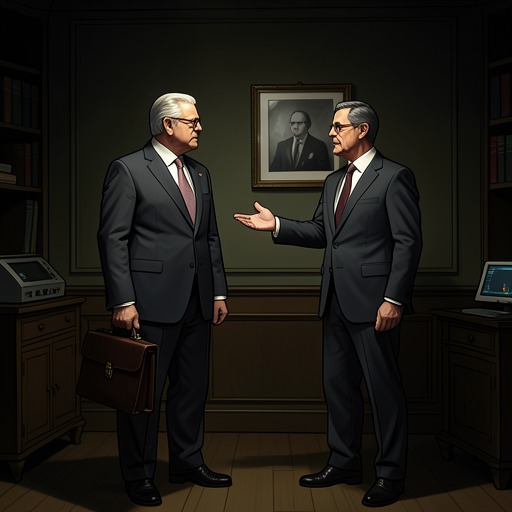
Insulation of senior officials from responsibility
All the President's MenInsulation of senior officials from responsibility describes a structure in which consequential actions could be carried out through subordinates and intermediaries, while those above them remained removed from direct instructions and documentary proof. In the Committee for the Re-election of the President, it shaped both the handling of information and the flow of campaign money: investigators and reporters encountered signs pointing upward, but an organized distance between decision-makers and execution made responsibility harder to establish.
A system of distance and controlled information
The committee’s internal arrangements made information difficult to obtain and potentially dangerous to share. Since June 17, visitors were screened by a uniformed guard, cleared by press or security staff, escorted to appointments, and led back out. A one-page telephone roster containing more than 100 campaign officials was treated as classified. A researcher who acquired a copy through a friend was warned that the source could lose a job if discovered. The list could still be studied for clues: floor numbers suggested who worked near whom, while the sequence of telephone extensions helped reveal reporting relationships. The very effort to reconstruct the organization from such fragments showed how much useful knowledge was kept inside it.
When Bob Woodward and Carl Bernstein visited employees at home, fear itself became evidence of the pressures surrounding disclosure. One employee was trembling and pleaded with Carl Bernstein to leave before others saw him; another said she wanted to help and then burst into tears. The reporters heard allegations that records had been destroyed after the Watergate break-in, but the employees who repeated them said they knew the claims only secondhand. Those reactions did not establish what had happened, yet they persuaded the reporters that the stakes reached beyond the burglary itself.
The investigators’ access to employees was also constrained. The FBI conducted interviews at the committee’s headquarters, rather than employees’ homes, and a committee lawyer or Robert Mardian was present. Some staff members said they had been told not to volunteer information unless agents asked a question they could not evade, particularly about committee finances. The same environment made silence look less like a private choice than an organizational expectation. Hugh Sloan later said that no one had expressly ordered him not to speak, but that the message had been clear: people were urged to hold ranks and keep the organization together. The pressure could operate without a written prohibition because employees understood the consequences of stepping outside the line.
The separation of authority from money
The fund’s payment structure offered a concrete example of insulation. Hugh Sloan said that Bob Woodward had run the committee through Jeb Magruder until John Mitchell and Maurice Stans arrived in early 1972. Jeb Magruder authorized the first payments to G. Gordon Liddy, who Sloan believed was still working at the White House in the summer of 1971. Sloan placed H. R. Haldeman behind four recipients of bulk payments: Herbert Kalmbach, G. Gordon Liddy, Jeb Magruder, and Porter.
Yet Sloan also stressed that H. R. Haldeman had been insulated from the fund. Jeb Magruder, Herbert Kalmbach, Maurice Stans, and even John Mitchell had effectively acted on his behalf; H. R. Haldeman had never personally instructed Sloan to make a payment. That distance mattered. Sloan said spending money belonged to the province of the White House chief, while Maurice Stans often complained that too much was being paid out. The evidence therefore suggested influence and responsibility operating through a chain of people, without the simplest kind of proof: a direct order from the senior official to the person disbursing the cash.
The reporters’ account of the secret fund also shows why intermediaries were consequential. Sloan had told them that the fund continued to exist after the Watergate arrests and that money had moved from Maurice Stans’s safe to Fred LaRue. They initially could not publish that information because they could not confirm it or determine how the money had been used. Later, James McCord’s testimony connected cash payments to the conspirators directly to the committee. He identified Kenneth Parkinson and Dorothy Hunt as conduits for payments. The new information made the earlier account of transferred funds newly significant: an intermediary could carry money through the organization while leaving the source and ultimate responsibility less immediately visible.
Inference without direct proof
Deep Throat described insulation as the reason evidence against John Mitchell and Charles Colson could remain weak in formal terms even when officials in the White House and FBI believed they were involved. He pointed to four kinds of evidence: their personalities and past conduct; meetings and telephone calls at crucial times, which they attributed to other matters; John Mitchell’s close control of spending details; and the seven defendants’ apparent confidence that they would be taken care of. That last assurance, Deep Throat reasoned, could be made convincing only by someone high up. Taken together, the circumstances pointed toward senior involvement, but Deep Throat cautioned that the case remained unproved and that the evidence could not be developed because responsibility had been insulated.
The distinction between a persuasive pattern and provable participation is central to the concept. Meetings and calls could have innocent explanations; money could be administered by subordinates; and the people closest to an operation could be questioned or managed without producing a direct link to those above them. Deep Throat described a much wider intelligence operation, including routine gathering that had expanded beyond its initial bounds, and urged the reporters to check each part rather than treat the whole operation as established fact. His account framed insulation not as proof of a particular order, but as an explanation for why multiple traces might converge without yielding a simple, conclusive document.
The method beyond the Watergate operation
The same pattern appeared in the handling of the Dita Beard memorandum. The administration and ITT tried to discredit Beard and the reporting about her memo. Intertel examined the document and concluded that it was probably typed on a machine in Beard’s Washington office, but that this would be almost impossible to prove. The finding allowed the memo to be labeled a forgery without resolving its authorship. Charles Colson sent E. Howard Hunt to Denver; Beard then issued a denial, which traveled through E. Howard Hunt, Robert Bennett, and Charles Colson before reaching Hugh Scott, who read it on the Senate floor. The account presents a chain of transmission in which each participant could be separated from the next act, while the denial gained institutional force. Beard’s son described a visit by a mysterious man in a cheap wig and makeup, but said he could not identify the visitor as E. Howard Hunt. That uncertainty, too, marks the limit of what the evidence established.
A disaffected committee official described the practical logic behind other deceptive campaign tactics: when an honest and a dishonest method promised the same result, the dishonest one had been chosen. In the campaign to manufacture support for mining Haiphong, $8,400 went to false telegrams and advertisements, including a phony advertisement in The New York Times. The operation also rigged a WTTG poll. The press office directed employees to fill out fifteen postcards each; workers bought different stamps and cards, varied their handwriting, and clipped ballots from thousands of newspapers purchased at newsstands. At least 4,000 ballots supporting Richard Nixon’s decision were sent from the committee. WTTG reported 5,157 in favor and 1,158 opposed, a result that would have been nearly tied against the President without the committee ballots. Afterward, newspapers were destroyed in a shredder room, where James McCord was in charge of the shredder. A campaign operation could thus produce a public appearance of popular support, then destroy material that might expose how that appearance had been manufactured.
Meaning and limits
Insulation did not mean that senior officials left no trace. It meant that their possible roles had to be reconstructed from relationships, financial pathways, timing, testimony, and repeated patterns of conduct. The committee roster could reveal who was positioned near whom; accounts of payments could show how money moved; and employees’ fear or later disclosures could indicate the pressure surrounding those channels. None of those clues alone necessarily established a direct order. Their force lay in accumulation, and their weakness lay in the very distance the organization’s arrangements preserved.
The concept also clarifies why disclosure mattered so much within the account. Employees were urged to maintain unity, some witnesses had already lied to investigators, and insiders feared the consequences of speaking. Donald Segretti said he wanted to tell the whole story but had not been told what the broader enterprise was about; he said he had learned more by reading the newspapers than from those who directed him. Such testimony illustrates a further kind of separation: people could be assigned a limited role without being given a full account of the operation. Across finances, information, and political tactics, the organization’s layers made actions possible while obscuring who knew, authorized, or could ultimately be held responsible.