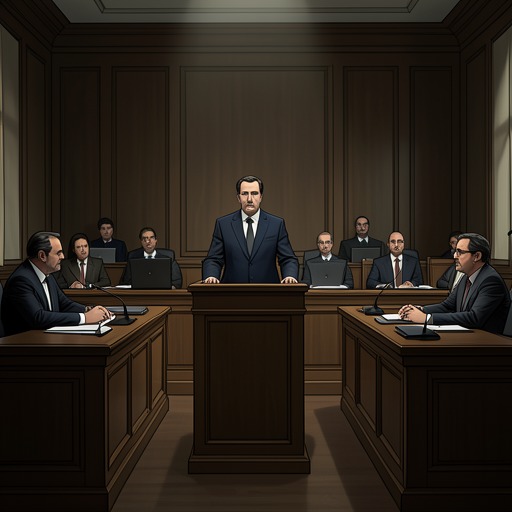
John Sirica
All the President's MenJohn Sirica was the chief judge who assigned himself the Watergate case and refused to treat its trial as a mere formality. As the proceedings exposed how much remained unanswered, he pressed for evidence about who had initiated the break-in, what its purpose was, and where the money had gone. His stern questioning, public dissatisfaction with the trial’s omissions, and later place in the transfer of the grand jury’s report to Congress made him a consequential figure in the widening investigation.
Identity and Reputation
Sirica presided as chief judge of the United States District Court and took personal charge of the Watergate case. At 68, with wavy black hair that made him look younger, he sat high on the bench as the trial approached. The book presents his public manner through a striking contrast: a physically composed figure in court whose frown could make his displeasure unmistakable. The reporters had encountered his reputation for toughness before seeing him act on it themselves; one of the names associated with that reputation was “Maximum John.”
His standing did not mean that his role was beyond dispute. Critics in legal circles, including prosecutors, argued that a trial was not the place to conduct an investigation and that this work belonged to the grand jury. Sirica’s approach placed that disagreement in the open. He was not content merely to preside over the narrow case as presented; he made the missing questions part of the courtroom’s business.
Taking Charge of the Case
On December 19, Sirica required Bob Woodward and Carl Bernstein to appear in his courtroom at 10:00 a.m. A hearing on a separate dispute involving the press was already scheduled for that hour: the defense sought to compel the Los Angeles Times to surrender tapes and notes from its interview with Alfred C. Baldwin. The courtroom was crowded with media observers expecting that confrontation. Sirica instead made the reporters’ matter the first order of business, and the grand jurors entered as the audience rose.
The court appearance conveyed the weight that his authority carried for the reporters, but his more consequential intervention came in defining what the Watergate trial ought to establish. At a pretrial hearing, he identified the questions he expected jurors to confront: “What did these men go into that headquarters for? Was their sole purpose political espionage? Were they paid? Was there financial gain? Who hired them? Who started this?” The questions ranged beyond the act of breaking into Democratic National Committee headquarters. They pointed toward purpose, payment, recruitment, and the chain of responsibility—the very matters that the prosecution’s account would leave unsettled.
The Trial and Its Unanswered Questions
The trial opened with a two-hour statement by chief prosecutor Earl Silbert. Silbert said he could account for only $50,000 of the $235,000 in presidential campaign funds handed to G. Gordon Liddy in $100 bills. Relying chiefly on statements by Jeb Stuart Magruder and Herbert L. Porter, he argued that Liddy had received the money for legitimate intelligence gathering, then acted on his own in planning and carrying out the illegal operation. That account resembled the cover story campaign workers had previously given the reporters.
After the 16-day trial, Bob Woodward and Carl Bernstein described a proceeding marked by questions not asked, answers not given, witnesses not called, and lapses of memory. They did not believe the prosecutors had deliberately thrown the case. They considered it more likely that prosecutors had been lied to, subjected to subtle pressure from the White House and the Justice Department, and failed to understand the workings of the Committee for the Re-election of the President and the White House. Sirica’s own response made clear that he, too, thought the record was incomplete.
Three days after the verdict, he set bond for Liddy and James McCord at $100,000 each and sternly criticized Silbert. “I have not been satisfied, and I am still not satisfied that all the pertinent facts that might be available—I say might be available—have been produced before an American jury.” The qualification mattered: Sirica did not claim to know that every missing fact could be obtained, but he insisted that the possibility of pertinent evidence could not simply be ignored.
He also defended his decision to question witnesses. Sirica said that he had doubts that Hugh Sloan had told the whole truth and noted that neither the government nor the defense had questioned him. He asserted his right as judge to ask questions so that the facts could be brought out. This was more than a rebuke over a single omission: it was a direct challenge to the idea that the trial’s limited presentation should set the limits of what the courtroom tried to learn.
From the Courtroom to Congress
Sirica’s role continued beyond the verdict. The Watergate grand jury handed him a briefcase containing its report and accompanying evidence concerning the case against Richard Nixon. Because prosecutors had argued that the Constitution precluded indicting an incumbent president, the grand jurors recommended that the material be turned over to the House Judiciary Committee. The committee had begun the first investigation in more than a century into possible action against a president, acting under the House of Representatives’ sole power to impeach. Sirica was thus a judicial recipient at the point where evidence gathered in the criminal investigation was directed toward congressional scrutiny.
Richard Nixon later included Sirica among those he credited for bringing the facts to light. In his April 30 address, Nixon referred to a determined grand jury, honest prosecutors, “a courageous judge, John Sirica,” and a vigorous free press. The acknowledgment sat within a speech in which Nixon accepted responsibility as the man at the top while announcing the resignations of H. R. Haldeman and John Ehrlichman. Sirica’s mention placed the judge among the institutions and people Nixon publicly identified as having helped expose the facts.
Narrative Role and Significance
Sirica’s importance in the account comes less from a private biography than from the questions he made the public record confront. The trial’s narrow explanation—that Liddy had gone off on his own—stood against the unresolved issues of who hired the burglars, who financed them, and what the operation was meant to accomplish. By asking those questions before trial and criticizing the proceedings afterward, Sirica helped reveal the distance between a verdict and a full explanation of the conspiracy.
The book also gives his authority a visible institutional consequence. A trial judge could not settle every dispute about responsibility, and critics questioned whether investigation belonged in the courtroom at all. Yet the briefcase passed to him by the grand jury became part of a route toward Congress, where the constitutional question of presidential accountability would be considered. Sirica’s role therefore joined courtroom scrutiny to a larger process: he pressed for facts the trial had not produced, and he occupied a pivotal point in the transfer of investigative material beyond the criminal case.