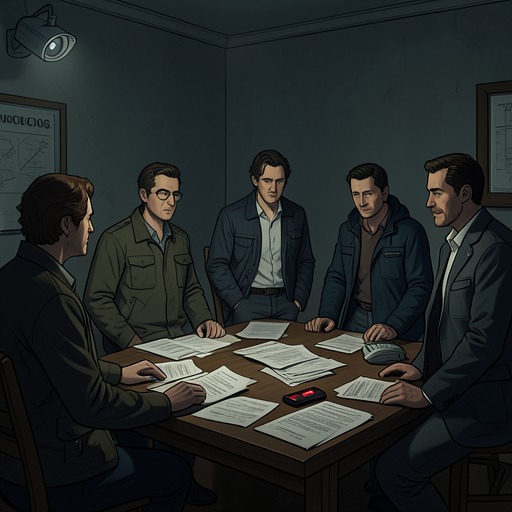
National-security policy permitting warrantless electronic surveillance
All the President's MenThe National-security policy permitting warrantless electronic surveillance, known as the Mitchell Doctrine, was the Nixon administration’s claimed authority to conduct electronic surveillance without court authorization against people suspected of domestic subversive activity. In the book’s account, it was not merely a legal position: it provided the public justification for a surveillance campaign whose targets shifted over time, while a separate, off-the-books operation carried wiretap information toward the political campaign. The Supreme Court declared the policy illegal on June 19, 1972, but the Watergate investigation would uncover records and testimony suggesting that surveillance had reached beyond the administration’s stated security rationale.
Claimed Authority and Legal Limit
Under the administration’s national-security wiretap policy, officials claimed unprecedented authority to use electronic surveillance without obtaining court approval. The stated category was domestic subversive activity. Radicals and civil libertarians had long argued that the term could be used to describe people who dissented vigorously from the administration’s policies, making the policy’s reach—and who had the power to define a security threat—central to the controversy.
The policy’s legal limit arrived on June 19, 1972, when the Supreme Court declared warrantless electronic eavesdropping of this kind illegal. The timing gave the ruling particular weight in the emerging Watergate story: it came two days after the arrests at the Watergate complex. The book presents the decision not as the end of the surveillance question but as a dividing line between the administration’s asserted authority and the activity investigators and reporters were still trying to reconstruct.
Targets and Changing Purpose
The account given to Bob Woodward by Deep Throat described the surveillance effort as changing its emphasis over several years. In 1969, the first targets of aggressive wiretapping were reporters and administration officials suspected of disloyalty. The focus then shifted toward radical political opposition during antiwar protests. As the election approached, Deep Throat said, attention turned naturally toward Democrats. This chronology places political opponents and the press within a program that had begun under the language of national security.
A detailed account published by Time magazine added scale and institutional context. It reported that the Federal Bureau of Investigation had tapped the telephones of about half a dozen reporters and twice as many White House and government aides for domestic security reasons. The taps began in 1969 under J. Edgar Hoover, who was described as reluctant, and continued under acting director L. Patrick Gray III until the Supreme Court ruling. According to the account, Hoover had allowed the taps only after John Mitchell authorized each one in writing. When the administration tried to force Hoover to retire in 1971, he resisted by threatening to reveal details of the wiretapping campaign.
This reported chain of written approvals made Mitchell’s role more than a general association with the policy: each tap, the Time account said, required his authorization. Yet the investigation also encountered another layer of surveillance that did not follow ordinary channels. Deep Throat described an out-of-channels group of former Federal Bureau of Investigation and Central Intelligence Agency agents hired to conduct wiretapping. The records were supposedly destroyed. The book thus distinguishes the administration’s claimed national-security authority from a clandestine operation whose organization and documentation were themselves in dispute.
From White House Surveillance to Campaign Operations
The investigation followed a possible route by which wiretap material moved from government surveillance into the political operation. A former and a current White House staff member gave the reporters matching accounts that David Young, a former appointments secretary to Henry Kissinger and a deputy on the Plumbers’ project, had regularly routed transcripts of tapped conversations to E. Howard Hunt and G. Gordon Liddy in 1971 and 1972. Both sources believed that reporters—and people suspected of leaking information to them—might also have been tapped. When Woodward asked the Plumbers’ former secretary Kathleen Chenow about the data Young had forwarded, she declined to discuss it.
Woodward’s article reported the narrow, traceable connection: Hunt and Liddy had received information from national-security wiretaps, and Young had routed it to them. It also identified the Plumbers as an operation concerned with investigating news leaks. The White House answered that, after checking, it could find no basis for the report; the article noted that the response was not a flat denial. The reporters had encountered refusals, unconvincing denials, and suspicions from officials, but had not established the full scope of surveillance through their inquiries alone.
Deep Throat later connected the clandestine surveillance operation directly to campaign planning. At an election strategy session, he said, H. R. Haldeman pressed John Mitchell to establish a wiretapping operation for the campaign. Mitchell was reluctant, but Haldeman insisted that part of the vigilante operation be moved from the White House to the campaign. The account identified Hunt and Liddy as the people associated with that transfer. In this telling, the shift did not mark the start of surveillance; it relocated part of an existing operation into a campaign setting, creating a bridge between national-security monitoring and political intelligence.
Exposure and Significance
The Watergate arrests threatened to expose more than the break-in. Deep Throat said the arrests sent the administration into alarm because the investigation could uncover the wider program. That warning gives the surveillance policy a larger narrative consequence: a break-in investigated as a discrete criminal act could lead backward through campaign operations to the White House’s earlier wiretapping and its treatment of reporters, officials, and political opponents.
The account also leaves distinctions intact. The Mitchell Doctrine was the administration’s claimed basis for warrantless surveillance; the off-the-books vigilante operation was described as operating outside normal channels; and the campaign’s receipt of transcripts supplied a further link between government monitoring and political use. The evidence presented in the book builds those connections through reported accounts, matching sources, and the movement of transcripts, rather than treating every allegation as equally established. Together, the policy’s changing targets, Mitchell’s reported written authorizations, and the transfer of surveillance material to Hunt and Liddy show how a security rationale could expand into political monitoring—and why the Watergate inquiry threatened to reveal a system larger than the burglary itself.