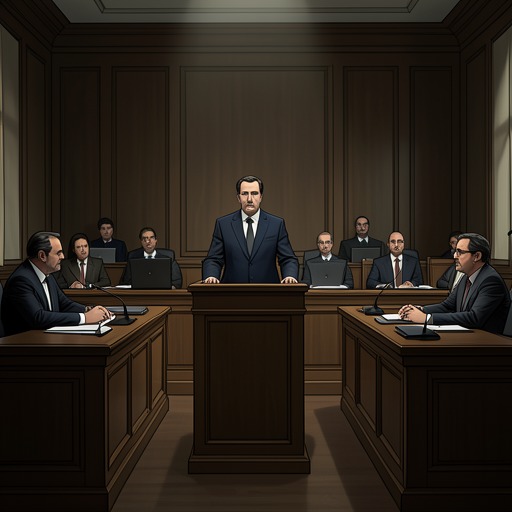
Senate Select Committee on Presidential Campaign Activities
All the President's MenThe Senate Select Committee on Presidential Campaign Activities was the Senate body established to investigate the Watergate break-in and related allegations about the 1972 presidential campaign. Under Sam Ervin, it gave congressional scrutiny a formal investigative platform beyond the preliminary inquiry already under way, and its interviews with James McCord helped bring allegations about advance knowledge, campaign money, and the handling of the case into public view. Its work also exposed the difficulty of turning dramatic accusations into verifiable evidence: some of McCord’s most consequential claims were hearsay, and the committee’s disclosures had to be weighed against the risks of premature leaks.
Formation and mandate
On January 11, Sam Ervin agreed to preside over a thorough investigation of Watergate and the 1972 campaign. The step promised investigative machinery beyond the preliminary inquiry that Edward M. Kennedy’s Judiciary Subcommittee on Administrative Practice and Procedure had conducted since October 1972. Kennedy had warned that unless a congressional subcommittee quickly used subpoena power to obtain records and documents in areas federal investigators appeared to be ignoring, the chance for a comprehensive inquiry could be lost. His warning made the committee’s purpose more than a response to the break-in alone: it was also an effort to widen the reach of an investigation whose existing boundaries were seen as inadequate.
On February 5, Ervin introduced a resolution allocating $500,000 for a Senate Select Committee on Presidential Campaign Activities to investigate the break-in and related allegations. The Senate Democratic Policy Committee gave the resolution unqualified support, but the account described a possible last-minute White House-Republican maneuver as the remaining impediment. On the day of the vote, February 7, Bob Woodward went to Capitol Hill to see whether such a maneuver was developing. A Republican senator’s aide told him that an amendment would broaden the inquiry to include the 1964 and 1968 campaigns. The episode showed that the proposed committee’s scope was itself contested as the Senate considered authorizing the investigation.
McCord’s disclosures and the problem of leaks
The committee’s investigative role came into sharp focus after James McCord began speaking with its chief counsel, Samuel Dash. In two long, tape-recorded sessions over a weekend, McCord spoke with Dash about the Watergate operation. Dash then held a press conference and said McCord had named names and begun supplying a full and honest account. He did not provide concrete details, instead raising expectations about what McCord might disclose in public testimony. Bernstein questioned the value of announcing unsubstantiated material before the committee hearings, since leaks could damage the inquiry if allegations escaped without proof.
The danger was not abstract. As reporters waited for McCord’s first sworn testimony, they recognized that reporting leaks from a closed hearing would differ from assembling an investigative story: they would be trying to learn in advance what a witness would eventually say in public, while judging whether each allegation was hearsay, firsthand knowledge, or a claim planted by an interested party. The committee’s proceedings thus created a tension between disclosure and verification. Public attention could increase pressure for answers, but circulating an untested charge could compromise the very process meant to establish what had happened.
McCord’s first closed-door testimony to the committee’s seven senators lasted four and a half hours. Afterward, Howard Baker, the committee’s Republican vice chairman, said McCord had provided significant information covering a lot of territory. A senator told Bob Woodward that McCord had testified that G. Gordon Liddy said the Watergate operation’s plans and budget had been approved by John Mitchell in February, when Mitchell was still attorney general, and that Charles Colson knew about Watergate in advance. But the senator also made clear that McCord’s allegations on these points were secondhand, as were his earlier accusations that John Dean and Jeb Magruder had prior knowledge. The senator found McCord convincing; Ben Bradlee obtained corroboration from a second senator, and Bernstein heard the same account from a staff member. The resulting report called attention to the hearsay character of the testimony rather than presenting those claims as firsthand proof.
Testimony, campaign money, and public consequences
McCord appeared again on Thursday, and reporters once more tried to establish what had been said through separate sources. According to the accounts they obtained, McCord testified that Liddy had told him charts outlining the Watergate operation were shown to Mitchell in February. Three sources supplied identical versions. The repetition strengthened the report that this was the substance of the testimony, but it did not change the underlying qualification: the allegation reached McCord through what Liddy had told him, rather than through McCord’s own observation.
Another disclosure connected the Watergate defendants’ payoffs to the Committee for the Re-election of the President. Seymour Hersh’s report that McCord had testified the cash came directly from the campaign committee supplied an inside account of a connection that had been suspected since January but had not previously been confirmed by such testimony. Earlier, Hugh Sloan had told the reporters that the secret fund continued to exist after the arrests and that the money had been transferred from Maurice Stans’s safe to Fred LaRue. Sloan had not said how much money was involved or how it had been spent, and the reporters had not published the information because they could not confirm it. McCord’s account appeared to make it possible that the surviving fund had financed silence, but that interpretation emerged through the reporting rather than as an established conclusion of the committee.
McCord’s testimony also identified Kenneth Parkinson and Dorothy Hunt as conduits for payments to the conspirators. The disclosures sharpened the inquiry’s central questions: how campaign resources had been used, who authorized or administered their use, and whether money continued to flow after the arrests. The evidence described in these accounts was uneven—some material came through testimony reported by others, and earlier information about the fund had remained unpublishable for lack of confirmation. The committee’s significance lay partly in making those claims investigable and publicly consequential, while the qualifications attached to them remained essential to understanding what the evidence did and did not establish.