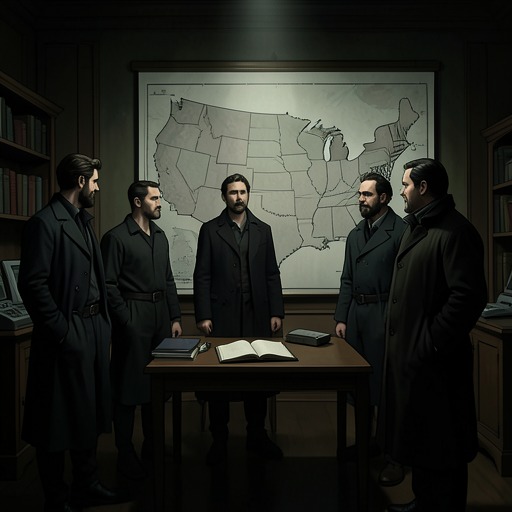
White House deniability
All the President's MenWhite House deniability was a method of separating senior officials from controversial actions by having others implement decisions and keeping direct lines of contact difficult to trace. In the reporters’ account, it was more than an individual’s evasion: it operated through a staff system that placed intermediaries between decision-makers and covert work, while secrecy and pressure discouraged employees from supplying evidence. The method could obscure responsibility, but the same gaps and fragments that protected it also gave investigators and reporters clues to follow.
Definition and operating method
H. R. Haldeman’s deniability was described as a way to insulate himself from controversial decisions by implementing them through others, so that he could later deny involvement. The reporters applied this model to possible links between senior White House figures and covert political activity. They considered it unlikely that Haldeman would directly hire E. Howard Hunt as a White House consultant; Charles Colson or John Ehrlichman, they reasoned, would instead be the employer of record. If Haldeman stood behind Donald Segretti’s operation, they expected that he would avoid direct contact with Segretti.
This reasoning made the absence of a direct trace ambiguous. The reporters knew that Haldeman rarely dealt directly with the Committee for the Re-election of the President; Gordon Strachan handled that connection. They understood the White House staff system as one in which bosses remained behind an insulating layer of intermediaries. That structure could explain why investigators might find evidence of actions and contacts below the senior level without finding an order bearing the highest official’s name. But it did not, by itself, prove who had authorized any particular operation.
Secrecy and pressure inside the committee
The Committee for the Re-election of the President presented itself to outsiders as exceptionally difficult to penetrate. Visitors encountered a uniformed guard, were screened by press or security staff, escorted to appointments, and led back out. Its telephone roster—one sheet with more than one hundred names—was treated as classified. A researcher who obtained a copy was warned that the person who provided it could lose their job. The roster’s floor numbers, extensions, and secretaries’ listings nevertheless let the reporters infer who worked near whom and, by arranging extensions in sequence, who worked for whom.
That paperwork offered a map of organizational relationships, but not an easy route to testimony. In mid-August, Carl Bernstein and Bob Woodward began visiting committee employees at home after work, following the first-edition deadline. Some employees were visibly frightened: one pleaded with Bernstein to leave before others saw him, while another said she wanted to help and burst into tears. Their reactions persuaded the reporters that the stakes extended beyond what they had initially understood. Employees also described pressure around what they could tell investigators. The Federal Bureau of Investigation interviewed campaign personnel at committee headquarters, in the presence of a committee lawyer or Robert Mardian; some employees said they had been told not to volunteer information unless agents asked a question they could not evade, especially about committee finances.
The pattern extended beyond a formal instruction to remain silent. Hugh Sloan said that no one had explicitly ordered him not to talk, but that the message had been clear: “Hold ranks,” or “Keep the ship together.” Sloan had left because he suspected the situation was worse than the public account suggested, yet he hesitated to speak publicly after lawyers warned him that his words could be used in a civil suit. His experience shows how deniability could be reinforced by organizational loyalty and personal legal exposure as well as by an explicit command.
Delegation, money, and intermediaries
The campaign fund provided a concrete example of authority moving through intermediaries. Sloan described receiving requests for money and telephoning John Mitchell at the Department of Justice. Mitchell would tell him to distribute the funds; the calls had begun in 1971. At first, Sloan said, Mitchell alone authorized expenditures. Authority was later passed to others, including Jeb Stuart Magruder, who eventually could approve payments himself. In a campaign with a budget exceeding $50 million, the procedure had seemed routine and the sums insignificant to Sloan at the time. For the reporters, however, the calls connected campaign money to decisions made while Mitchell was Attorney General and showed how authorization could be conveyed without a visible paper trail.
The evidence about Segretti supplied another chain of delegated roles. Segretti said he had been recruited by Dwight Chapin, that Strachan had also discussed the work with him, and that Herbert Kalmbach had paid him. He said he had not sought the job and had been told only about his own role, learning more from newspaper accounts. These details established contacts and payment routes, but did not settle what each intermediary knew about the more serious activities. Segretti himself distinguished Chapin from the possibility that sinister actions had occurred, saying he did not think Chapin knew of them and believed Chapin had simply done what he was told. The structure left room for higher-level direction to be alleged while making the knowledge and responsibility of individual links matters requiring separate proof.
What the gaps revealed—and concealed
The committee’s internal atmosphere made the distinction between action and knowledge especially difficult to resolve. Employees spoke of extensive destruction of records in the days after the Watergate break-in, though those who mentioned it said they had heard about it secondhand and could offer no specifics. A committee bookkeeper told Bernstein that she had been called before the grand jury early, when, in her view, people had already lied and investigators did not yet know what questions to ask. She said that Sally Harmony and others had lied, but did not provide a complete account of what had been concealed. Such testimony pointed toward coordinated silence without supplying a complete map of its authors or instructions.
Later reporting sharpened the question of who had authorized the cover-up. After learning of James McCord’s testimony that payments to the conspirators came directly from the committee, Woodward contacted a committee official who was furious about the handling of the affair. A CRP official with firsthand knowledge of some allegations told the reporters that John Dean had described the same matters, that Dean had been only a runner in the cover-up, and that Haldeman had approved virtually everything about it, including payments to the conspirators. The official also said Dean wanted to tell the grand jury everything if he could reach a deal with prosecutors. The reporters sought another account of Dean’s statements before pressing the story, and Ben Bradlee remained uneasy because Dean was not yet publicly confirming the allegations himself.
That distinction is central to White House deniability as the book presents it. An intermediary’s account, an authorization call, a payment, an employee’s fear, or a missing record could expose part of an operating chain without independently proving the full chain of command. The method’s protective power lay in separating senior figures from direct contact and leaving subordinates to carry the visible work; its vulnerability lay in the relationships among those subordinates, the instructions they recalled, and the money that passed through them. The investigation’s accumulating fragments made that insulation harder to maintain, even when they did not immediately erase the evidentiary distance between suspicion and proof.