Woodward–Bernstein reporting partnership
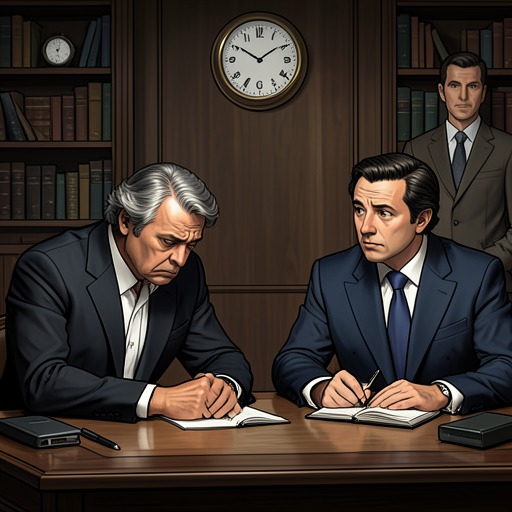
All the President's MenThe Woodward–Bernstein reporting partnership joined Bob Woodward and Carl Bernstein in an investigation whose most consequential claims were often built from scattered, uncertain clues. Its defining feature was not simply that they reported together, but that they divided the work while acting as each other’s check: when either doubted whether the evidence could bear the implications, the reporting could wait. Their collaboration helped move the Watergate inquiry from isolated leads toward a broader account of political espionage and sabotage, without making certainty a substitute for proof.
A partnership formed under pressure
By the time the investigation had been underway for nearly four months, Woodward and Bernstein had developed what the narrative describes as a kind of spiritual affinity. Colleagues sometimes joked that the two were out to get the President. Bernstein, remembering Richard Nixon’s insistence that the candidate ran the campaign, confronted the more serious possibility that their reporting might lead toward presidential involvement. He tried to think as Woodward would, testing what they actually had against what they suspected: approaches by Donald Segretti, circumstantial travel records, and no established proof that a law had been broken. The partnership’s shared ambition therefore existed alongside an insistence on distinguishing a troubling pattern from a proven charge.
The work also had a physical routine. In mid-August, after the first-edition deadline, the reporters began visiting Committee for the Re-election of the President employees at home in the evenings. Sometimes they went separately; sometimes they traveled together in Woodward’s 1970 Karmann Ghia. Bernstein sometimes went alone by company car or bicycle. These visits brought them into contact with employees who feared the pressure surrounding the investigation: one pleaded with Bernstein to leave before others saw him, while another began to cry. The atmosphere made information-gathering difficult, and the partnership’s inquiry depended on patient returns to leads rather than a single open conversation.
Shared inquiry, distinct assignments
Their collaboration did not erase individual responsibilities. When Deep Throat’s information prompted a three-story package, Bernstein and Woodward jointly outlined the general program of political espionage and sabotage by at least fifty agents. Bernstein took the story on Segretti; Woodward worked on the White House’s involvement in the Canuck Letter episode. The division let the reporting develop several specific lines alongside the larger account, even as Bernstein struggled to write that broader story without relying on generalizations whose strongest details belonged in the companion pieces.
The same combination of shared purpose and separate reporting appears in their pursuit of financial evidence. Bernstein copied a fifth check, a $25,000 cashier’s check payable to Kenneth H. Dahlberg, while investigating the Mexican checks. The deposit record showed that it had been deposited with the four Mexican checks, bringing the total to $114,000; four days later, $25,000 was withdrawn, with the remaining $89,000 withdrawn separately. The check offered a concrete lead in a larger inquiry into campaign funds, but its discovery did not itself settle who Dahlberg was or what the money had financed.
Mutual restraint and verification
The partnership’s most important discipline was its capacity to stop. Bernstein and Woodward sometimes reversed roles: Woodward had initially been considered the more cautious of the two, but over the months each served as a brake on the other. If one had doubts, they told the editors they agreed to hold off, even when they privately disagreed; at other times, they said nothing and simply waited. This was not an abstract preference for caution. Their reporting rested on evidence largely invisible to readers, and they repeatedly had to judge whether that underlying foundation could support the public implications.
That discipline came into sharp focus as they prepared a story identifying H. R. Haldeman as the fifth person who controlled the campaign funds for political espionage and sabotage. Bernstein arrived at the office sleep-starved and full of doubts. Before telling Barry Sussman that the Haldeman connection was solid, the reporters reviewed their bases again. Only after that check did they write the story, whose central new fact was Haldeman’s position in control of the funds. Their shared decision-making thus shaped not only how they worked, but when an allegation was ready to be printed.
Sources, silence, and the limits of access
Much of the partnership’s evidence came through individual encounters, not joint interviews. Bernstein heard from the campaign’s bookkeeper that people had already lied to the grand jury and that Sally Harmony and others had lied, while the bookkeeper declined to specify what the lies concerned. Later, Hugh Sloan told Bernstein that matters were worse than he had suspected when he left. Sloan said he wanted to tell what he knew, but his lawyers had advised against public statements that could be used against him in a civil suit. He also described the pressure to hold ranks and keep the committee together. These conversations supplied important testimony about silence and fear, but left gaps the reporters could not fill by inference alone.
The division of reporting continued in later interviews. Bernstein spoke with Donald Segretti, who said he wanted to tell the whole story but had not understood the larger operation and had learned about it from newspapers; when Bernstein asked who had kept him uninformed, Segretti identified the White House. Woodward, in a separate call to a Committee for the Re-election of the President official after James McCord’s disclosures, encountered anger about the way the White House had handled the affair. Together, such separate contacts broadened the inquiry, but neither reporter’s access made every source’s account independently conclusive.
Publication and public response
The partnership’s reporting did not receive a uniform response. After an earlier secret-fund story, the major national outlets largely ignored it, and the reporters waited in the newsroom for the Washington Star-News; its only Watergate item concerned a law professor’s request for a special prosecutor. A later story on the wider espionage and sabotage campaign traveled over the Washington Post–Los Angeles Times News Service wire at about 7:00 p.m. More than half of its 220 domestic subscribers used it, and coverage also appeared beyond the subscriber network. The contrast shows how the reach of their reporting could change as separate leads accumulated into a more specific, publishable account.
The reports also met a coordinated politics of denial and attack. Most major outlets either ignored one story or concentrated on denials by Robert Mardian, while the White House strategy, as analyzed in The New York Times, was to denounce newspapers carrying the allegations without directly discussing them. One White House aide explained that the administration believed the public viewed the Eastern press as elitist, anti-Nixon, and ultimately pro-McGovern. Against that background, Woodward and Bernstein’s partnership was both a reporting arrangement and a method of persistence: separate assignments expanded the evidence, repeated checks limited what they claimed, and their combined stories made it harder to treat the developing allegations as disconnected incidents.