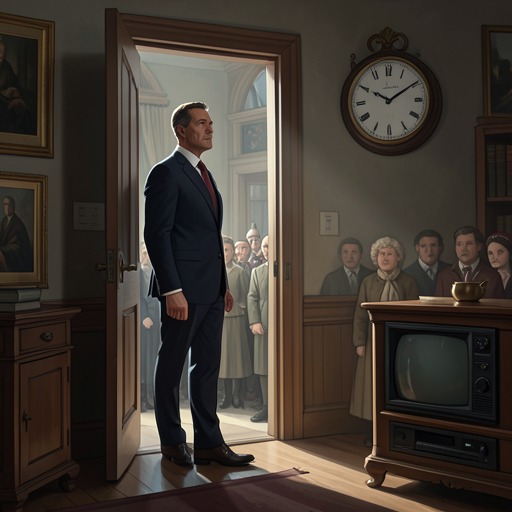
CRP's climate of fear and enforced silence
All the President's MenCRP's climate of fear and enforced silence turned the Committee for the Re-election of the President into a place where employees feared being watched, questioned, or punished for speaking. The atmosphere was not conveyed through a single official order so much as through repeated constraints: interviews conducted in the presence of committee representatives, warnings to volunteer nothing, reluctance to use telephones, and staff members’ accounts of being followed. For reporters, that fear was itself evidence of how difficult it would be to establish what had happened after the Watergate break-in—and of how much their sources risked by helping them find out.
Silence as an Organizational Practice
In mid-August, Bob Woodward and Carl Bernstein used a staff roster to identify people working inside the committee, then began calling at employees’ homes after the newspaper’s first-edition deadline. Some of their earliest encounters showed the pressure before the reporters had obtained substantive information. One employee was trembling and asked them to leave before others saw them; another said she wanted to help, then burst into tears. The reporters were told that employees felt under pressure, but the details of that pressure initially arrived as fragments rather than a coherent account.
The conditions surrounding official interviews offered a more concrete explanation for why those fragments were hard to assemble. The Federal Bureau of Investigation interviewed campaign personnel at committee headquarters, not in their homes, and did so in the presence of a committee lawyer or Robert Mardian, the committee’s political coordinator and a former Justice Department official. Some employees said that Mardian and others had instructed them not to volunteer information unless an agent asked a specific question they could not evade, particularly on committee finances. People in positions that might have given them knowledge of the bugging operation—including secretaries—appeared not to have been interviewed at all. The combination of constrained questioning and guarded answers left reporters with a record of what employees said they had not been asked, as well as what they could disclose.
The phrase Hugh Sloan used for the pressure on employees was notably indirect. He said nobody had told staff in so many words not to talk, but the message was always “Hold ranks,” or “Keep the ship together.” When Carl Bernstein asked whether that meant lying, Sloan said Bernstein could draw his own conclusions and that the assumption was not unreasonable. Sloan had left because he suspected the worst, but his lawyers warned him that public statements could be used against him in civil litigation. His account joined organizational pressure to personal legal risk: even a source willing to speak could be held back by the possible consequences of speaking publicly.
Being Watched
The fear was not merely a general mood. In early September, Bernstein invited a committee employee he recognized from an expenditure report to lunch. Although he suggested places where they could avoid being seen, she insisted on a sandwich shop crowded with campaign workers, explaining that an open setting would make it appear she was not hiding anything. She said she was being followed and that people would not talk on the telephone. When Bernstein initially thought she was exaggerating, she answered, “I wish I was.” She believed the committee knew the timing and number of impending indictments and described an employee who had returned to the district attorney’s office after the Federal Bureau of Investigation had failed to ask the right questions; according to her, that employee’s boss knew about the visit that same night.
The woman also said the committee press office had asked who inside the organization had a connection to Bernstein and Woodward. She had herself spoken to the district attorney, yet feared that the whole truth would never emerge. Her account of the FBI was a personal reversal: she had once trusted the institution and no longer did. She said agents had never asked whether she was at the committee during the weekend of the break-in, although she had been there much of the time. She further alleged that Robert Odle had removed records, while carefully distinguishing what she had personally seen from what she could not establish: she did not know whether he had destroyed them, and acknowledged that the rest of what she knew was hearsay.
The episode also shows how quickly contact with reporters could become visible inside the committee. After the woman spoke with Bernstein at lunch, she telephoned him from a phone booth and said she had been summoned and confronted about meeting a Washington Post reporter. She asked him not to call or visit again. Bernstein went to her apartment that night with Bob Woodward; she told them to go away, and they moved on to other doors. The attempt to secure a source had brought the reporters a vivid account of surveillance, but had also confirmed the source’s fear that speaking to them could expose her.
Fragments, Hearsay, and the Hidden Record
The reporters’ method had to accommodate that risk. To get a conversation started, they identified themselves as Washington Post reporters and tried to enter employees’ homes, where a discussion could continue without using a telephone. They sometimes explained that a committee colleague had suggested the person might be troubled by what was happening and would be willing to talk. Once inside, the reporters did not use notebooks. They reassured employees that they would protect confidential sources, and worked gradually through questions about the FBI interviews, committee finances, records, and possible other bugging operations.
What emerged was suggestive but uneven. Employees relayed claims that records had been destroyed after the break-in, that the FBI had asked about a “top copy” of wiretap logs going to the White House, and that someone in finance had said the books had been burned. One person reported that Sally Harmony had said she and G. Gordon Liddy would not talk and that she had a bad memory. Another source warned that people were being watched and pleaded that the reporters not call, even at home. These statements were not all firsthand knowledge; the distinction mattered. The fear made sources more willing to disclose fragments in private, but also made those fragments difficult to verify and dangerous to publish as established fact.
The Bookkeeper offered another glimpse of the organization’s compromised testimony. She said the Watergate Grand Jury had called her early, but that people had already lied before anyone knew what questions to ask. She said Sally Harmony and others had lied, while making clear that she and Harmony had not discussed the matter. The Bookkeeper had worked for Hugh Sloan and, after he resigned, was promoted to work for Maurice Stans. Her account connected her own work history to a wider concern that some employees who might know something were promoted, but it did not establish that promotion itself proved complicity. As with other source conversations, the information was important precisely because it came with limits the reporters had to retain.
Silence Gives Way, Unevenly
Fear did not make every employee permanently silent. After James McCord’s disclosures about payments to Watergate defendants, a previously friendly CRP official who had avoided specifics spoke angrily to Woodward about the state of affairs. He said he had once mistaken John Mitchell’s silence for wisdom, but now saw it as ignorance, and said the White House’s handling of the affair had undermined the Presidency. His outburst marked a change in what he was willing to say, prompted by new disclosures and disillusionment; it did not erase the earlier culture of guardedness.
Donald Segretti, speaking about his own role, said he wanted to tell the whole story and claimed that he had not understood the larger operation, adding that he had learned what was happening by reading the papers. Asked who had kept him uninformed, he answered, “The White House.” That was Segretti’s account, not independent confirmation of what every participant knew. Its relevance to the climate of silence lies in the division between a person’s assigned role and the larger operation as he described it: restricted knowledge could coexist with an expectation that people remain quiet.
The Cost and Meaning of the Climate
The climate of fear shaped both the inquiry and the quality of the information available to it. Employees’ reluctance to speak, their reports of being monitored, and the controlled setting of FBI interviews helped explain why the reporters received information in pieces. At the same time, fear could not by itself prove a specific allegation. The woman who spoke to Bernstein distinguished direct experience from hearsay; the reporters had to make the same distinction when deciding what the fragments could support. The effort to penetrate the silence therefore depended not only on finding people willing to talk, but on corroborating what they said.
The narrative’s repeated small signals—an employee trembling at a doorway, a source choosing a public lunchroom because she believed she was followed, a call from a phone booth, an instruction to “Hold ranks”—make pressure legible without reducing it to a single command. The committee’s silence was reinforced by surveillance fears, legal exposure, guarded interviews, and employees’ concern for their jobs and colleagues. Yet those pressures also help explain why the reporters’ persistent conversations eventually elicited disclosures that formal questioning had not produced. The result was neither a complete account from any one source nor an uncomplicated breakthrough, but a widening body of evidence assembled from people who believed that speaking could make them targets.