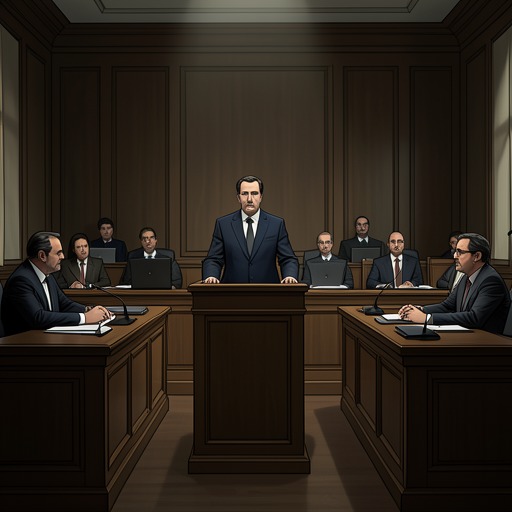
Earl Silbert
All the President's MenEarl Silbert, the chief prosecutor in the Watergate trial, presented a case that attributed the illegal break-in to Gordon Liddy acting on his own rather than to a broader campaign conspiracy. His courtroom approach was notably restrained: while he offered a low-level account of the operation and questioned Hugh Sloan without pursuing who had authorized the cash, Judge John Sirica pressed Sloan on that chain of responsibility.
Role in the Watergate Trial
Silbert presented a two-hour opening statement on the first day of the trial, attended by Bob Woodward and Carl Bernstein. He said he could account for only $50,000 of the $235,000 in presidential campaign funds handed to Liddy in $100 bills. That shortfall framed the limits of the prosecution’s account as well as the scale of the money whose use was in dispute.
The Prosecution’s Account
Basing his theory primarily on statements by Jeb Magruder and Herbert L. Porter, Silbert argued that Liddy had received the funds for legitimate intelligence-gathering activities, then gone off on his own to plan and carry out the illegal Watergate operation. The story placed the crime at the bottom of the chain: campaign money had been provided for an ostensibly proper purpose, while the break-in was presented as Liddy’s independent act. To the reporters, this was the same cover story they had heard months earlier during their evening visits.
Questioning Hugh Sloan
When former Nixon campaign treasurer Hugh Sloan testified, he said he had paid about $199,000 in cash to Liddy. Silbert’s questioning was perfunctory, cold, and distant; he did not ask who had ordered Sloan to hand over the money. The omission mattered because Sloan had worried about the large disbursements and had checked them with Maurice Stans, who in turn had verified them with John Mitchell, before Mitchell said Liddy should receive the cash.
After Silbert finished, Sirica sent the jury out and questioned Sloan himself, asking 41 questions. The contrast between the prosecutor’s limited examination and the judge’s sustained inquiry brought the authorization trail into the courtroom. Silbert’s presentation thus left a consequential gap between accounting for the money and establishing who had approved its distribution.
Narrative Significance
Silbert’s trial theory represented the prosecution’s low-level-conspiracy account: the campaign funds could be acknowledged, but the illegal operation was assigned to Liddy as a breakaway act. The testimony and questioning exposed the tension within that explanation. Sloan’s account connected the cash to decisions by Stans and Mitchell, while the opening statement emphasized Liddy’s independence and Silbert did not pursue the order behind Sloan’s payments. In the book’s account, that contrast makes Silbert’s restrained courtroom role part of the larger struggle over whether Watergate would be treated as an isolated burglary or traced through the people who authorized and financed the operation.