“the elevator”
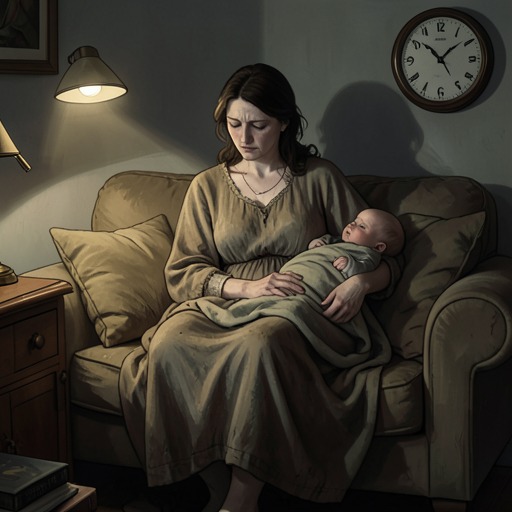
Along for the Ride“the elevator” is Auden’s name for a soothing motion she uses with Thisbe: holding the baby securely at the waist, she bends and straightens her knees to move her up and down until Thisbe quiets. More than a memorable label for a caretaking technique, the expression gives shape to the novel’s recognition that comfort can be learned, physical, and shared in more than one way.
Definition and Method
The technique is described through its action rather than through an explanation of why it works. When Thisbe begins to whimper, Auden unbuckles her from the stroller and lifts her into her arms. Thisbe’s skin is warm, and her cries are beginning to grow louder. Auden locks her hands around the baby’s waist, bends her knees, and moves her up and down. By the third round, Thisbe is quiet. Auden calls the motion “the elevator” and adds, “Works every time.”
The name turns a repeated bodily movement into an easily recognized procedure. Its apparent simplicity matters: the scene gives no special equipment or elaborate instructions, only Auden’s grip, bent knees, and repeated motion. The reader sees the result arrive within the action itself. The phrase is therefore practical shorthand, attached to a specific gesture and to Auden’s confidence in using it, rather than a general claim about babies or a promise that every instance of distress can be solved in the same way.
The Department-Store Demonstration
Auden performs the elevator in the midst of a conversation about a pink onesie and the expectations attached to femininity. She has just challenged the idea that girls should be “sugar and spice and everything nice,” connecting that expectation to diminished assertiveness and its possible consequences. Leah remarks on the breadth of Auden’s argument; then Thisbe’s whimper interrupts the discussion. The transition from debate to care is immediate: Auden stops speaking, pushes the stroller, and, when that does not settle the baby, takes Thisbe into her arms.
The others watch the practical demonstration. Maggie tells Auden, “You’ve got the touch, huh?” Auden answers by naming the maneuver, as if giving the group a usable term for what they have just seen. The scene does not present her care as a performance or a theory: her success is measured in Thisbe’s quiet. At the same time, the moment changes the group’s attention. After the baby settles, Esther says that the black outfit under discussion is not so strange but “kind of radical, actually.” The conversation about gendered appearance resumes, but Auden’s competence with Thisbe has become part of the immediate context in which the women respond to one another.
Comfort in Different Forms
The elevator sits within a broader pattern of the novel noticing how people soothe Thisbe. Earlier, Auden watches Robert take the crying baby from Heidi and cradle her in a rocking chair, patting her back while Heidi leaves to shower. Auden had expected Robert to pass Thisbe straight to her, but he continues rocking the baby himself. She wonders whether he had cared for her and Hollis in the same way and recognizes that the scene offers evidence that people may change, even if she is not yet convinced. Robert’s rocking and Auden’s repeated up-and-down movement are distinct acts of care; the narration does not suggest that one replaces the other.
Auden also thinks about comfort while watching Eli pick Thisbe up easily on the pier. His example prompts her to recognize that there are many ways to comfort someone, and that the elevator is only one of the unexpected ones. This thought widens the significance of the expression: it names Auden’s own method without making it the sole or definitive form of care. The word belongs to a practical act, while the surrounding reflection places that act among different people’s responses to another person’s need.
Infancy and the Scene’s Afterimage
The motion continues after Thisbe has quieted. Auden is still doing the elevator while the others watch the baby move up and down, now in a kind of trance. The pause extends the moment beyond the immediate problem of crying: the women look at Thisbe and consider their own childhoods. Maggie finds it strange to think that they were all once so little; Leah calls Thisbe a clean slate, with no mistakes yet; Esther calls her lucky and offers a warning about the goth phase. The scene does not claim that childhood is literally free of difficulty. Instead, its talk makes the baby a focus for their memories and for the contrast between infancy and the selves they have since become.
The elevator’s role in that exchange is quiet but concrete. Auden keeps moving while conversation gathers around the baby, so care is not merely discussed; it continues as a visible, repeated gesture. The expression captures that combination of ordinary motion and emotional attention. It also recalls the wider narrative idea that comfort is not a single inherited script: people can approach it differently, and Auden, who recognizes the elevator as one of the unexpected ways, has become someone able to offer it herself.