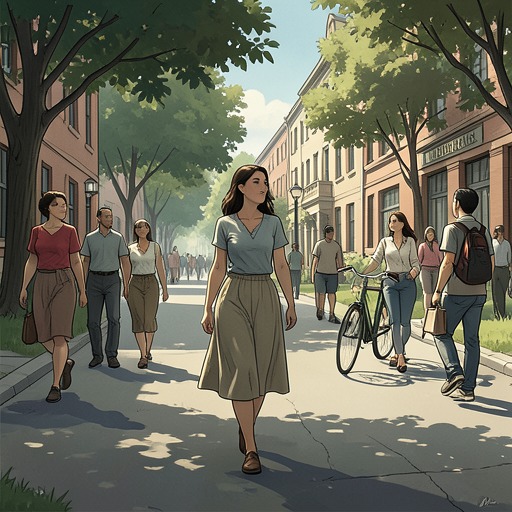
Auden
Along for the RideAuden’s defining conflict is between her practiced self-sufficiency and a growing wish to take part in life rather than observe it from the edges. A perceptive narrator shaped by family estrangement, late-night wakefulness, and an academic routine, she arrives in Colby expecting to tolerate her stepmother and keep her distance. The summer unsettles that plan: caring relationships and the repeated invitation to try again make her recognize how much she has avoided, and eventually get back on a bicycle despite her own fear of failure.
Identity and Background
Auden is the daughter of Robert and Auden’s mother, and the younger sibling of Hollis. By the time Auden was growing up, Hollis’s demanding childhood had already exhausted their parents; as an adult, he is abroad in Europe, sending occasional emails about new plans and asking for money to pursue them. Auden’s account suggests that the family’s attention and energy were already strained before her own adolescence. She does not describe herself as having received the sort of shared attention that might have made childhood feel like a secure, uncomplicated period.
Her parents’ separation makes that absence newly visible. The announcement comes across the kitchen table, with Auden’s mother delivering the news in a flat, businesslike tone while Robert stands nearby, looking tired and fiddling with his hands. Auden is neither surprised nor overcome by the familiar reactions of relief or crushing disappointment. Instead, she feels unexpectedly small, as if the scale of the moment has brought a delayed wave of childhood back to her. The mismatch between the event’s magnitude and her muted response becomes one of her clearest insights into herself.
Auden has also learned to stay awake around conflict. Her parents’ arguments often began over dinner, appeared to settle, and then resumed around ten or eleven, after they thought she had gone to sleep. She deliberately kept her door open and light on, made conspicuous trips to the bathroom, and washed her hands loudly in an effort to delay the arguments. When the tactic stopped working, her body had already adapted to staying up late; she was then awake for every word. Her insomnia is thus not only a private habit but also an early form of watchfulness, tied to a household whose tensions she could hear but could not resolve.
Life in Colby
Auden agrees to spend eight weeks with Robert and Heidi before college, partly because she has hardly seen her father since his marriage and wants time with him before school ends and adult life begins. The decision is a qualified risk. On the drive to their white house with green shutters, a wide porch, and a ceramic pineapple on the door, she imagines the summer with Heidi as a string of forced bonding rituals. She worries about matching clothes, manicures, and tanning, but reminds herself that being alone at home had become its own kind of boredom. At the door, she prepares to smile and go along with Heidi’s plans, at least until she can retreat to her room.
Her irritation has a history in small details. Heidi’s emails begin with an exuberant extra exclamation point that Auden finds annoying. Heidi describes the baby kicking, the pink-and-brown nursery, and Robert working late on his book; the cheerful domestic picture only sharpens Auden’s sense of distance from her stepmother. That distance is not simply dislike of Heidi’s manner. Auden is arriving in a family already assembled around a new baby, while trying to recover a connection with a father she feels she has barely seen.
The summer draws her into work and social experiences that challenge her preference for control. At Clementine’s, she takes receipts and invoices into the office and can lose herself in the check register. When Heidi’s departure from the household leaves Auden unsettled, the late-afternoon bustle of the shop gives her something definite to do. She even considers, then rejects, answering a call from Auden’s mother. Because her mother had hung up on her the previous day, Auden decides that distance is her right, although the hesitation before she lets the call go shows that the relationship remains emotionally present.
Relationships and Conflict
Auden’s relationship with Heidi is wary and uneven, complicated by the fact that Heidi is not her mother but is part of the family Auden has chosen to visit. When Heidi assumes that Auden and Eli are friends, Auden corrects her: they do not really know each other. Heidi then points out that Eli’s brother, Jake, is around Auden’s age and tells her that Jake’s breakup with Maggie has left Maggie reeling. The information makes Auden flush; in the closely connected town, even an apparently casual conversation can reveal how little she knows about the people around her.
Her bond with Eli becomes more consequential than that first awkward exchange suggests. After a period of closeness, Auden remembers waking up happy with him, but she also recalls telling him he was slacking off and seeing him walk away hurt. As their contact dwindles, she cannot honestly explain the silence as mere busyness: she recognizes it as the result of her own choice. Eli has become the closest person she has had who matters to her, and the thought that closeness alone does not guarantee belonging exposes the all-or-nothing rule she applies to relationships.
Maggie offers a different kind of companionship. She holds on or follows behind as Auden practices riding, teaching her over the course of several weeks. In conversation, Auden initially finds the fast exchange of feeling and talk overwhelming; rather than withdrawing, she decides to relax into its unsettled rhythm. She also declines Tallyho, and Maggie responds with a shoulder bump and visible delight. These exchanges show Auden beginning to accept friendship without needing to master every social cue or match every plan.
Change and Narrative Significance
Auden’s nighttime quest begins as something she regards as a game, a way to pass the hours. In retrospect, she understands that its tasks have brought her back toward her own past and given her second chances. Eli has helped make those chances possible, but she believes she has one fewer than she needs; riding around the jump park with Maggie, she wants Eli to see what she can do, while knowing that the demonstration cannot undo what she said. The bicycle becomes both a practical skill and a measure of her willingness to enter an experience before certainty arrives.
That change culminates in a choice between driving and riding. Dressed in a black beaded dress, with her keys already in hand, Auden sees the bicycle beside the steps and climbs onto it instead. She raises herself on the pedals, recalls what Maggie has taught her, and pushes off before she can change her mind. She wobbles but remains upright as she starts down the walk. The attempt comes after she has admitted that she, too, can be a quitter and after she urges Eli to work out how to begin again. Its significance lies not in a guaranteed success but in the decision to try once more.
Auden’s story is narrated from within her own changing understanding. Early scenes are filtered through sarcasm, apprehension, and the habit of staying outside other people’s lives; later, the same attentiveness lets her notice the cost of distance and the possibility of choosing differently. She does not become instantly confident or resolve every strained relationship. Instead, her movement is from waiting for life to pass—awake in the dark, working through numbers, watching others talk—to taking a small, visible risk of her own.