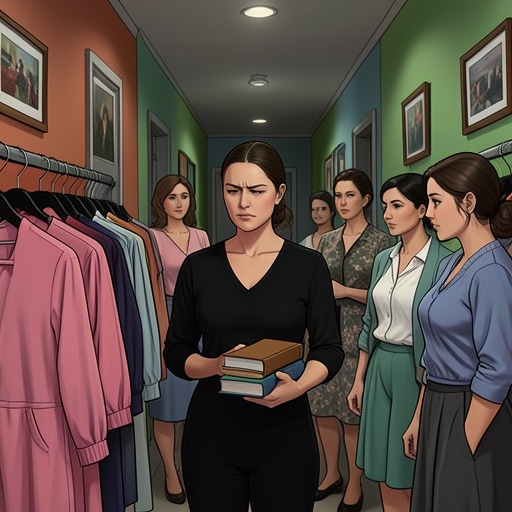
Auden's insomnia
Along for the RideAuden's insomnia is both a habit formed in childhood and a way of living around the fear that her family's conflicts might erupt when she was not listening. It first keeps her awake to monitor her parents' arguments; later, it carries her through solitary hours in diners and around Colby. Its eventual interruption is modest but consequential: after years of associating night with vigilance, Auden sleeps beside Eli and, later, unexpectedly falls asleep while studying.
Origins in the Family Home
The insomnia begins about three years before Auden's parents separate, as their marriage grows more troubled. Their arguments often start over dinner with a small remark, a sharp response, or a banged pot lid, then appear to subside. Around ten or eleven, however, the same dispute begins again. Auden realizes that her parents have been waiting for her to fall asleep before resuming the fight, and responds by trying to stay awake: she leaves her bedroom door open and her light on, makes conspicuous trips to the bathroom, and washes her hands loudly. For a time, the performance seems to work. Then the arguments return, while her body has become accustomed to staying up late. What began as a deliberate effort to interrupt conflict turns into an enduring pattern of wakefulness.
Her parents' separation does not arrive as a surprise. When her mother announces it across the kitchen table, with her father nearby, Auden is struck not by relief or crushing disappointment but by how little she feels. The revelation instead makes her feel small, like a child, as though a long-delayed childhood has suddenly washed over her. That reaction gives the insomnia a deeper context: the sleeplessness has not simply kept her physically awake but has made her an alert witness to the family's instability, while her own feelings remain difficult to recognize or express.
The Diner and the Solitary Night
Auden's first refuge from the household is Ray’s Diner, the only place in town open twenty-four hours a day, every day of the year. After her parents' separation, her father moves into an apartment near campus, while her mother fills the house with students and dinner parties. Neither home provides the middle ground Auden wants. She has passed Ray’s many times before stopping there one night around two in the morning, on the way back to her mother's house. The neon-lit diner feels warm and almost safe; she orders coffee and apple pie, then stays until sunrise.
The diner becomes a regular setting for nights spent reading or studying in a booth. Auden tips a dollar for each hour she stays, and values the brief, limited interactions: nobody demands more attention than she wants to give, and she knows exactly what her role is. In this refuge, solitude feels manageable because it has clear terms. Her academic work also offers escape, letting her inhabit other lives through reading and study, even as achievement fails to win the kind of parental attention she wants.
A Colby Routine, Then a Different Night
In Colby, Auden initially rebuilds her sleepless routine by moving through the town alone. She works at Clementine’s, usually eating a sandwich there, walks the boardwalk for about an hour, then gets her car and drives for another three or four hours. The Wheelhouse, roughly thirty-five miles away, is a poor substitute for Ray’s: its narrow booths smell of bleach, its coffee is watery, and its waitresses give lingering customers dirty looks. More often, Auden buys a large coffee at the Gas/Gro and drinks it while driving. After two weeks, she knows Colby almost inch by inch. One night, by midnight, she has already walked the boardwalk and completed a full loop of town, yet still has hours before she wants to go home.
Her description of this wakefulness changes when Eli asks what she is doing out so late. Auden explains that she does not sleep at night; it used to be because her parents were awake fighting, but now she does not know why. Her answer marks a shift from a clear origin to an uncertain present. The old cause no longer accounts for the whole habit, which has continued even after the family circumstances that formed it have changed.
With Eli, the night also ceases to be only empty time to be endured. Auden recalls that driving alone to the Wheelhouse and around the neighborhoods had been like treading water. Their chance encounters lead instead to coffee and pie with Clyde at the laundromat, errands at Park Mart, late pizza on the boardwalk, and fishing on the pier to watch phosphorescence in the water. Auden leaves Clementine’s after closing, spends time with the other workers, and then heads off alone; fifteen minutes, half an hour, or an hour later, she may cross paths with Eli at the Gas/Gro or Beach Beans. The encounters open the night into a series of shared excursions. The contrast is not between sleeplessness and a suddenly conventional schedule, but between solitary hours that seem to go nowhere and a nocturnal life made vivid by company and discovery.
Vigilance, Intimacy, and Sleep
Auden's old vigilance returns when she overhears her father and Heidi arguing. The conflict brings back her childhood dinners, the small disputes, the unsettled house, and the hours stretching toward bedtime. She recognizes that she had kept herself awake and alert in an attempt to hold at bay the things she feared most, but that the strategy had failed in childhood and fails again in the present. After three years of stoicism, the memory breaks through in tears. The scene makes explicit what her account of the insomnia has implied: staying awake offered the feeling of watching over the danger, not the power to prevent it.
At Eli's, Auden remains awake until about four thirty, her usual time to head home. The voices from the argument continue through the wall. Instead of leaving, she lies beside Eli with her head on his chest, listening as the raised and level voices carry on in the background. She tells Eli that he is not to blame, and he answers that she is not either. The exchange redirects the language of fault away from the children who had tried, in different ways, to bear the consequences of adults' conflicts. Auden knows she should get up and leave, and part of her is frightened by the heavy feeling of sleep approaching because she has not allowed herself to do this in so long. This time, she does not fight it. She presses closer to Eli and falls asleep.
When Auden wakes at seven thirty, Eli is still asleep with an arm around her waist. She leaves without waking him, unable to find a note that could express her gratitude, and instead refills his coffeemaker, puts fresh grounds in a filter, and turns it on. The gesture does not erase her insomnia, but the night has given her a concrete experience of resting in another person's presence rather than remaining on watch. Sleep arrives not through a declared cure but through the relinquishing of vigilance, while the argument she had been listening to remains unresolved beyond the wall.
An Unsettled Change
Later, after Eli has walked away from her, Auden returns to the academic work that has long felt safe and familiar. She comes home around midnight intending only to collect a few things, notices her suitcase and economics textbook, and begins reading with a yellow legal pad beside her. Instead of driving through the night, she stays in her room, studying as the waves crash below. She still wonders what Eli might be doing and glances at her watch during breaks, so the return to schoolwork does not mean that her attachment to their nights has vanished.
At seven in the morning, Auden jerks awake with her head on the legal pad, an aching neck, and ink on her cheek. More startling than the discomfort is that she has slept at night for the second time in a row. The change continues over the next three nights, leaving her awake and lucid in the morning for the first time in recent memory. She initially tries to keep studying, then goes to Clementine’s on the third day. The narrative treats this altered schedule as unexpected and disorienting, not as proof that the insomnia is permanently over. Across these episodes, sleep remains uncertain, but it is no longer imaginable only as something she must resist: the nights that once organized her around fear can also hold companionship, unguarded rest, and a return to morning.