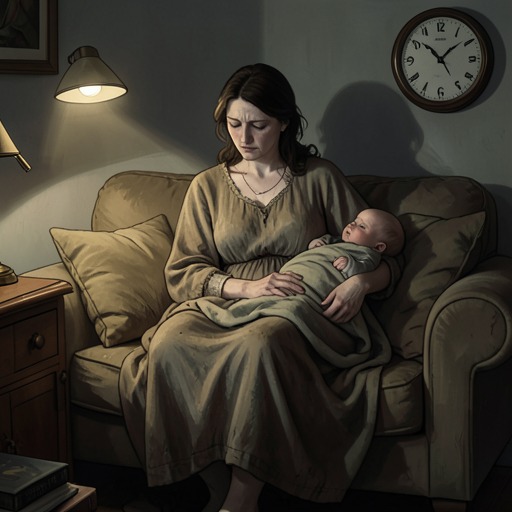
Auden’s first night caring for Thisbe
Along for the RideAuden’s first night caring for Thisbe marks a turn from observing the strain of a newborn’s care to assuming part of it herself. After hours of crying, Auden offers to take her sister from an exhausted Heidi, then walks her through the house and out toward the boardwalk. The baby’s eventual sleep is a modest but consequential success: care becomes something Auden does, not merely something she watches others struggle to provide.
The Crying and the Offer
The episode follows a night already unsettled for Auden. In her room, she is trying to study, but her tears have blurred the page; then Thisbe starts crying again, and Auden hears Heidi come down the hall and open and close a door. The sounds connect the two women’s distress without explaining it away. Auden’s own tears have stopped by the time the baby continues, but she remains awake and attentive to the household around her.
After an hour, Auden leaves her room and goes to Thisbe’s. Heidi is in the rocking chair, her face streaked with tears. Auden holds out her arms and offers to take the baby so Heidi can rest. Heidi hesitates even though she is visibly exhausted; Auden steps closer and urges her on, and Heidi finally lets Thisbe go. The pause matters: the handoff is not automatic, but Auden’s persistence makes relief possible. Holding her small, writhing sister, Auden is surprised by the tenderness of her own response.
Heidi says she does not know what Thisbe needs and cannot listen to her cry any longer. Auden tells her to go. The instruction comes out sharply, but it works: Heidi leaves for her room, and Auden is left alone with the still-screaming baby. The scene makes the limits of reassurance plain. Heidi cannot soothe Thisbe in that moment; Auden does not yet know what will help either, but takes responsibility for trying.
A Walk at Dawn
Auden first carries Thisbe around the house, walking through the baby’s room, downstairs, around the kitchen island, and back into the living room. The movement quiets her only a little. At about five, Auden notices the stroller by the door, straps Thisbe in, and pushes her down the driveway. By the mailbox, about twenty feet away, the crying stops. When Auden pauses, Thisbe draws breath and starts up again, louder; Auden resumes pushing, and after a few turns of the wheels the silence returns. She picks up her pace and heads out onto the street.
The stroller turns the care problem into a rhythm Auden can sustain: when she stops, Thisbe cries; when she moves again, the baby settles. By the time they reach the business district, Thisbe is asleep beneath her blanket, her face relaxed. The boardwalk is deserted. Auden hears the ocean and the stroller wheels, and the walk extends all the way to the Last Chance Café before they see another person at a distance. This is not a planned cure or a confident solution; Auden has no assurance that a sunrise walk will help. Its effectiveness emerges through trial, attention, and the decision to keep moving.
Motion and Recognition
Near the orange awning of Clementine’s, Auden sees a cyclist performing fluid tricks where the boardwalk opens onto the beach. The rider balances on the front wheel, hops, spins the handlebars, pedals backward, zigzags, and banks off a bench. Auden watches the motion as she thinks of Heidi in the rocking chair and Thisbe sleeping in the stroller. The comparison links two very different forms of movement: the strained rocking that has failed to console Heidi, and the repeated forward motion that has finally settled Thisbe. Auden is absorbed enough in watching the cyclist that she does not recognize him until she is close.
This moment places the night’s practical discovery within a wider pattern in the story: movement can change the feel of an otherwise stuck situation. Here, though, the point remains immediate and bodily. The baby stops crying while the stroller rolls; Auden responds to the change rather than relying on a rule or formula. Her attention to what Thisbe needs is a new kind of engagement with family life, built from small observations and action rather than from certainty.
Recurrence and Significance
Later scenes give this first handoff a wider context without making the night a permanent solution. Auden again finds Heidi crying silently with Thisbe in her arms, a more private distress that Auden recognizes she cannot simply leave undisturbed. When Karen Stock arrives, she directs Eli to take the baby upstairs and swaddle her while she attends to Heidi. Care in the household is shared among different people, but it takes intervention to make that support happen.
Heidi later tells Auden that she has realized she needs time for herself and has discussed it with Karen Stock. At another point, a gathering in the kitchen brings Heidi together with Maggie, Leah, and Esther while Thisbe watches from her stroller; Heidi calls Auden to join them. These later moments contrast with the desolate, solitary hours of the first walk. They show Heidi making space for herself and connecting with others, though the evidence does not present that change as a simple consequence of Auden’s one night of care.
The episode’s significance lies in its small shift of responsibility and perception. Auden does not solve Thisbe’s crying or Heidi’s exhaustion; she gives Heidi a chance to rest and discovers one workable way to comfort the baby. The remembered pattern of sound—crying, wheels, then quiet—makes the change concrete. Auden’s first sustained care for Thisbe is not a declaration of instant closeness but an action that begins to make closeness possible.