Auden’s parents’ divorce
Along for the RideAuden’s parents’ divorce emerged from a family rupture that had been building in view and out of earshot: her parents’ professional fortunes diverged, their dinner-table disagreements returned late at night, and Auden learned to stay awake for them. When her mother finally announced their separation, Auden felt neither relief nor the crushing disappointment she had expected. Instead, the moment made her feel suddenly, belatedly like a child, a response she revisited years later when she asked her mother whether the marriage had been given a real chance.
Background and Fracture
Auden’s parents had come to the U straight out of graduate school. Her father received an assistant professorship while his first novel, The Narwhal Horn, found a publisher; her mother was pregnant with Hollis and trying to finish her dissertation. By the time Auden was born, her father had become a celebrated novelist and was leading the creative writing program, while her mother described herself as lost in the demands of diapers and self-doubt.
When Auden entered kindergarten, her mother returned to academic life. She secured a visiting lectureship and a publisher for her dissertation, became a popular professor, gained a full-time position, and published two more books. Her father joked that she was the family’s breadwinner, but the balance changed further when she received an endowed chair and he lost his publisher. The narrative places this professional reversal alongside the worsening tension between them, without reducing their conflict to a single cause.
Their arguments often began over dinner with a small remark and an offended response. A sharp exchange or a banged pot lid could make the disagreement seem finished, only for the same issue to erupt again around ten or eleven at night. Auden realized that her parents were waiting for her to fall asleep before resuming their fights. She tried to delay that moment by leaving her bedroom door open, keeping the light on, making conspicuous trips to the bathroom, and washing her hands loudly. The tactic worked for a while; when it stopped working, the late hours had already become routine, and Auden was awake for every word.
The Announcement and Auden’s Response
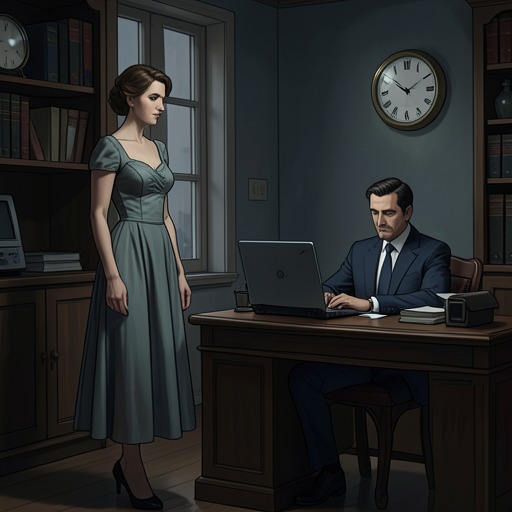
Auden knew other children whose parents had separated and expected that such a decision would bring discussion of the feelings it caused, whether with both parents, one parent at a time, or a therapist. Her own family’s announcement offered no such conversation. Her mother told her across the kitchen table that she and Auden’s father were separating, speaking in the flat, businesslike manner Auden associated with her mother’s critiques of students’ work. Her father leaned against a nearby counter, fiddling with his hands and looking tired.
The announcement did not arrive as a surprise, but Auden could not identify her reaction as either relief or devastating disappointment. What she noticed instead was how little she felt. Sitting with both parents in the kitchen, she felt small, like a child; the scale of the news seemed to bring on a childhood feeling that had been long delayed. The scene makes the separation significant not only as a change in the family but as a moment when Auden recognizes an unexpected vulnerability in herself.
Revisiting the Decision
Much later, Auden asked her mother whether she and Auden’s father had separated immediately or tried to work things out first. The long silence that followed suggested the question was unexpected. Her mother answered that they had tried very hard to stay together and that divorce had not been a decision they made lightly. Auden could not say exactly why she had asked; she looked down at her book and lined-up pad, apologized, and began to retreat from the question.
Her mother did not let the exchange end as a simple apology. She asked what was happening and why Auden was thinking about the past then. Auden began to cry and, looking out at the ocean, said she wished she had done some things differently. Her mother responded as if she understood the feeling even though Auden had given it little explanation. The conversation remained indirect and imperfect: Auden described the distance between them as reaching for a hand and missing, yet holding on anyway. That tentative contact gives the old decision a different dimension. The parents’ effort to remain together becomes something Auden can ask about, while her own regret becomes something she can share, however incompletely, with her mother.
Later Echoes and Significance
The divorce remains part of the emotional background against which Auden encounters conflict in her father’s later household. During an argument between Robert and Heidi, Robert suggests that Auden was invited to visit so she could babysit, and Auden feels the remark physically, as though slapped. On another night, she and Eli approach the house near three in the morning and hear Robert asking what he wants while Heidi shakily asks whether he does not want the baby. These are conflicts in Robert and Heidi’s relationship, not scenes from Auden’s parents’ marriage, but they place Auden once more within the reach of adults’ intimate disagreements.
In a later dispute with Robert, Auden urges him to recognize that he has an opportunity for a second chance rather than simply quit. The episode does not establish that her parents’ divorce determines what she says; it does show her addressing the possibility of trying again from a position shaped by having lived through a separation whose full history she only later asked her mother to explain. The divorce’s lasting importance lies in this unresolved combination: Auden had long heard the conflict, yet the announcement itself made her feel newly young, and years afterward she was still testing what the decision had meant and what might have been done differently.