Cycling and the opportunity to try
Along for the RideCycling in Auden’s summer is more than a local pastime: it is a visible form of possibility, one she first encounters as an observer and eventually takes up herself. Bikes carry the energy of Colby’s boardwalk and jump park, offer a fleeting image of calm amid the demands of caring for Thisbe, and give shape to the question of whether a missed experience can still be attempted. Auden’s movement from saying she has not ridden in ages to cycling across campus makes trying—not effortless success—the idea’s decisive measure.
A summer of waiting, a town in motion
Auden begins the summer between high school and college feeling unmoored. She has been focused on her final school year and the start of Defriese University, and now, with preparations largely made and little work at her tutoring job, the intervening weeks seem like time spent waiting for her real life to resume. Her former friends’ invitations do not resolve that feeling: their conversations about summer jobs and boyfriends leave her feeling out of place, and she gradually withdraws from their outings. At home, her mother’s research work and crowded dinners provide another reason to seek quiet elsewhere. Against this suspended, inward routine, Colby’s streets are full of bicycles and riders.
On the boardwalk, Auden first registers the bikes as part of the town’s social landscape. Outside a bike shop near the Last Chance Café, young men gather on a bench, arguing about the name for something associated with the shop. Later, at the Tip, riders burst out of the dark path and race over the sand. A short, stocky rider pedals past Auden at speed; two more riders follow, laughing as they zoom by. The scene makes cycling immediate and physical before Auden knows what place it will have in her own life: she has to jump aside, catch her breath, and take in a world moving at a pace she has not joined.
Motion as spectacle and respite
During an early-morning walk with Thisbe, Auden sees a rider performing tricks near Clementine’s. The cyclist lifts the front wheel, hops forward, spins the handlebars, pedals backward, and banks off a bench. Auden watches the movements as fluid and almost hypnotic. The motion recalls Heidi rocking Thisbe and the baby asleep in her stroller: in both cases, movement has a subtle calming power. The bicycle is thus not only a sign of daring or speed. For Auden, watching it also connects motion with a form of soothing, at a time when Thisbe’s colic makes care exhausting and unpredictable.
At the jump park, cycling becomes a whole environment rather than a passing glimpse. Auden follows bikes to a large lot near the beach, where lights illuminate log-and-sand jumps, an oval track with berms, and two curved ramps facing each other. From her car she watches a rider move back and forth across the ramps, mesmerized. Elsewhere, she observes the riders from a dimmer spot beside a bike rack, beyond the bright lights near the bleachers. Each rider initially seems much like the next, but closer attention reveals different approaches: some keep low and cautious, while others rise higher on successive jumps. Tires rasp on gravel; brief silences mark the moments when riders are airborne. The scene makes trying legible as a range of choices, not a single display of fearlessness.
Watching others take the chance
Maggie, whom Auden spots alone in the bleachers, provides the clearest example of an opportunity taken. After Adam gestures for her to join the boys, Maggie pulls back her curls, takes a helmet from her bag, and walks down. Adam gets off his bike and offers it to her. She puts on the helmet, rolls back about twenty feet, rises onto the pedals, and approaches the jumps. She clears them with increasing height; by the third, the bike appears to float beneath her. Her landings are smooth, and afterward she returns to the waiting riders, accepts a Pringle from Wallace, and flips up her visor to eat it.
Auden has been watching Maggie as well as the jumps. Maggie’s decision surprises her, in part because Auden had assumed she was only looking for someone among the riders. The change from spectator to participant happens through concrete gestures: taking the helmet, accepting the offered bicycle, and setting off. Cycling here is not an abstract promise that everyone will succeed. The scene shows one person accepting an opening and discovering, in motion, an ability that Auden can recognize even from her limited experience.
The invitation and the refusal
Eli’s presence at the jump park turns the spectacle into a question directed at Auden. When she admits she has not ridden a bike in ages, Eli points out that they are at a jump park and that, if she is looking for an opportunity, this is her chance. Auden understands the logic but feels unnerved by it. She insists that she will not ride merely to prove she can and then declines. The refusal matters because the opening is real: the obstacle in this moment is not an absence of access but Auden’s reluctance to act on the possibility now in front of her.
The exchange does not make her refusal a permanent verdict. Earlier, Auden has thought that there would be many ways to spend one’s days, none inherently right or wrong, but that she would accept a genuine do-over. The bicycle gives that idea a physical form. It offers no guarantee that trying will erase what was missed, and Auden does not take Eli up on it at once. Instead, the invitation remains available as a contrast between the life she has watched and the life she might enter. Maggie’s ride demonstrates one response; Auden’s decision to pass reveals how difficult it can be to move from recognizing an opportunity to accepting it.
From the jump park to the campus
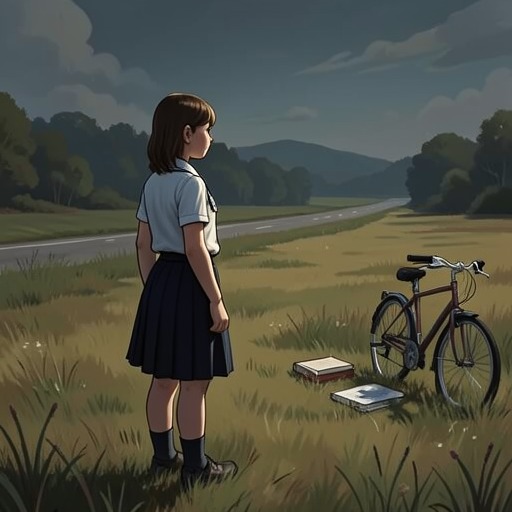
By October, the contrast has changed. Auden is at Defriese, where she has learned to make peace with the cafeteria coffee because it is included in her meal plan and the cups are bottomless. She takes a travel lid for her large cup, shoulders her backpack, and rides her bike across the empty campus toward her dorm as the weather turns cold and a light drizzle begins. The action is ordinary and practical, not a performance before a crowd. Yet it carries a clear difference from her admission at the jump park that she had not ridden in ages.
The campus ride gives the concept its quiet consequence: the bicycle has moved from something Auden watches other people command to something she uses to get herself home. It does not turn every missed experience into a recoverable one, nor does the story equate growth with constant boldness. The earlier refusal remains part of the pattern. But by setting that hesitation beside Auden’s later, unremarkable ride, the narrative makes room for change to appear as a practice: an opportunity can be declined, revisited, and eventually folded into daily life. Cycling links the summer’s theme of a do-over to the small, embodied fact of getting on and going.