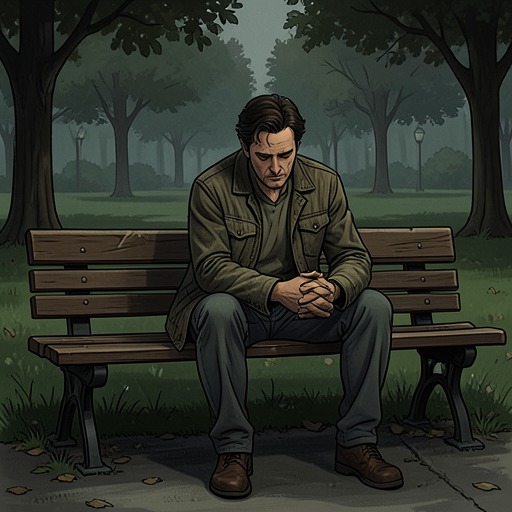
Eli's survivor guilt over Abe's death
Along for the RideEli’s survivor guilt over Abe’s death is the conviction that surviving the accident has left him answerable for a loss he could not control. He knows the crash was an accident, but that knowledge cannot dislodge the stark fact he returns to: he is alive and Abe is not. The grief also makes remembrance painful. Stories about Abe preserve his presence, yet for Eli they repeatedly lead back to the same ending, while imagined changes to the past offer the tormenting possibility that the ending might have been different.
The Loss and the Stories Told About It
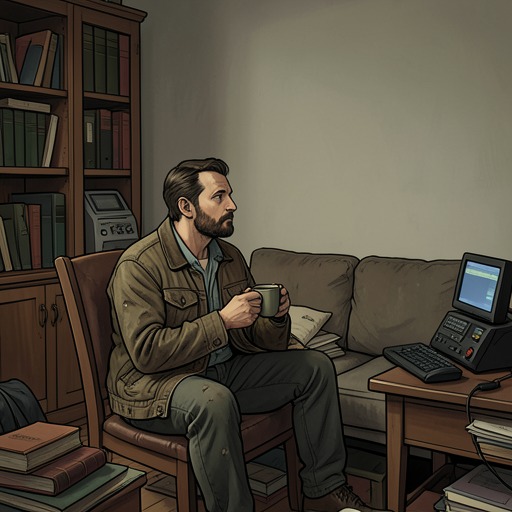
Eli explains his grief to Auden during a conversation over mugs, after telling her about Abe’s stubborn attachment to a water bed. Even when it leaked and gave Abe a backache, Abe would not admit it had been a mistake. Eli’s humorous recollection ends abruptly when Auden asks whether Abe eventually gave it up: “No,” Eli says. “He died.” The shift from a domestic anecdote to the fact of death makes the loss present again, even though Auden already knows what happened. Hearing it in the middle of an ordinary story shocks her anew, and she begins to offer condolences.
For Eli, the difficulty is not that Abe has been forgotten. He resists the repeated work of telling stories about him because, as he sees it, every story reaches the same fixed conclusion: Abe dies. At the funeral and afterward, people wanted to recall one memory after another. Auden suggests that remembering through stories can keep the dead close; Eli quietly answers that he does not have trouble remembering. His response distinguishes his grief from a need to recover Abe through recollection. Abe is already persistently present in Eli’s mind, and recounting memories does not relieve him of the ending attached to them.
Survival and Responsibility
Eli identifies his own survival as the sharpest source of guilt. Looking directly at Auden, he frames the question of failure through the position of the person who was driving and lived. Auden tells him the accident was not his fault. Eli does not claim certainty that he caused the crash; instead, he returns to the imbalance that cannot be undone: “I’m here and he’s not.” The distinction matters. His anguish is not presented as proof of responsibility, but as a burden produced by having survived when Abe did not.
That burden is intensified, in Eli’s account, by the people connected to Abe. He thinks of Abe’s parents, girlfriend, and friends as people who see Eli and know that he lived while Abe died. He says they do not need to blame him for the fact to hurt. Auden reassures him that they do not hold the accident against him, but her reassurance does not answer the feeling he describes: that his continued presence is inseparable from the absence of someone those people loved. The guilt persists even without an accusation from them.
The Do-Over and Its Variables
Eli says that since the accident he has kept thinking about the possibility of a do-over. He imagines leaving the party earlier or later, noticing the car sooner, or having Abe drive instead. These alternatives differ in their details, but each gives the past a point at which it might have turned another way. Eli gathers them into the image of a million variables: if even one had been different, perhaps everything would have been different too. The thought offers no definite account of what would have happened; its force lies in the unanswerable possibility that the loss might have been prevented.
Auden warns that thinking this way will make him miserable, and Eli answers with a wry smile that the warning is familiar. The exchange does not resolve his guilt or establish that he has stopped revisiting the alternatives. Instead, it shows how clearly he recognizes the cost of the thought while remaining caught in it. His dark humor and the small smile soften the moment without undoing the conflict: intellectually, he can hear that the counterfactuals are harmful; emotionally, he continues to return to them.
Narrative Significance
The scene sets two ways of speaking about loss against each other. Auden offers memory as a form of closeness, while Eli experiences stories as repetitions whose ending is already known. He does not reject Abe’s importance; the insistence that he has no problem remembering makes the opposite clear. What he cannot escape is the relationship between that memory and his own survival. The ordinary conversation, beginning with a ridiculous water-bed story, makes the shift into grief abrupt rather than ceremonious, echoing how a remembered detail can lead directly back to death.
Eli’s account also places certainty and uncertainty side by side. The death and his survival are fixed facts; the imagined alternatives remain unknowable. He treats that uncertainty not as comfort but as an opening for relentless revision, searching the party, the timing, the approaching car, and who was driving for a different outcome. The scene therefore gives the do-over idea a painful personal meaning: it is not simply a wish to repeat the past, but Eli’s attempt to locate a choice or circumstance that might explain why he is here and Abe is not.