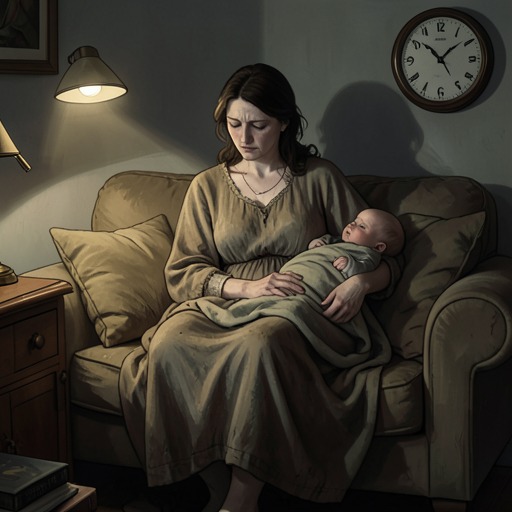
Heidi's postpartum distress
Along for the RideHeidi's postpartum distress shapes the household after Thisbe's birth, appearing not as a single breakdown but as an accumulating strain: disrupted rest, persistent crying, emotional volatility, forgetfulness, and the pressure of caring for the baby while trying to manage work and family life. Through Auden's observations, the novel connects Heidi's private exhaustion to the practical arrangements around her, including Robert's limited availability and Auden's growing role in childcare.
Signs of Distress and Early Response
When Auden first encounters Heidi at home, she is holding the sleeping baby beside a white-noise machine playing the sound of ocean waves. Heidi appears so changed from Auden's previous image of her that Auden initially struggles to recognize her. After reacting sharply to the possibility of waking Thisbe, Heidi notices Auden, is startled, and begins to cry. Her apology gives way to tears, and Auden registers visible signs of fatigue. Heidi insists that she is all right, but the scene makes that reassurance difficult to accept.
Robert describes the baby as waking frequently at night and explains that his own sleep condition requires him to get nine hours of sleep. He says he is not much help and has tried to persuade Heidi to get assistance, but she will not. His account attributes some of her reluctance to a desire to do everything herself and do it perfectly. He recalls that Auden's mother was also overwhelmed when Hollis was a colicky infant, treating the early months as a difficult period that would pass. The comparison offers family context, but it also shows how readily Heidi's present distress is framed as a familiar, temporary burden rather than a problem requiring a change in care.
The Burden of Care and Auden's Involvement
Auden's involvement deepens during a night when Thisbe cries for an extended period. After Auden has returned to her room upset by her own choices that evening, the baby's renewed crying draws her into the hallway. She finds Heidi exhausted in the nursery and offers to take Thisbe so Heidi can rest. Heidi hesitates before allowing Auden to hold the baby, then admits that she does not know what Thisbe needs and cannot keep listening to her cry. Auden's offer is a practical response to a moment when Heidi's capacity has been worn down by repeated caregiving.
The care burden also becomes visible in ordinary family plans. During a dinner outing, Robert and Heidi argue about whether he should stop working and spend time with the family, while Heidi is also trying to attend to work. Their disagreement echoes an earlier conflict in Auden's family, a resemblance Auden notices as they reach the boardwalk. At the restaurant, Thisbe's crying escalates, and Robert looks to Auden for help. Auden recognizes what he needs and intervenes, despite feeling that the responsibility should not automatically fall to her. The episode makes the family's reliance on Auden concrete: her summer visit increasingly includes unpaid infant care, not simply time with her father.
A Household That Reaches Auden
After two weeks, Auden recognizes that she has become closely entangled with the household she had hoped to keep separate from her own life. She knows that Robert's mood follows the progress of his writing and that Heidi's postpartum difficulties include forgetfulness, intense mood swings, and worries about many details of the baby's routine. Thisbe's continuing crying and hiccups shape the household's daily rhythms. The distress is therefore presented as an ongoing condition affecting the family, rather than as a single emotional scene.
The contrast with Auden's work at Clementine's clarifies what caregiving demands of her. The store gives her tasks with clear beginnings and endings, unlike the unpredictable emotional needs at home. From the office, she hears Maggie talking customers through clothing choices. Auden privately dismisses that knowledge as frivolous and sees Maggie as resembling Heidi in her enthusiasm for traditionally feminine interests. Her judgment reflects Auden's own distance from this kind of social and emotional fluency; it does not make Heidi's distress a simple matter of personality. Instead, the contrast places the work of attending to others—at home and in customer service—alongside Auden's preference for bounded, measurable tasks.
Seeking Space and Reorganizing Care
Heidi's distress becomes especially stark when Auden returns home and finds her silently weeping while holding the baby. Auden approaches rather than leaving her alone, and offers to take Thisbe. This moment differs from the earlier encounter in which Heidi was crying after startling Auden: here the grief is quiet, and Auden recognizes that Heidi needs support even though Heidi does not readily accept it. The scene reinforces how much of the strain remains private until someone else notices and offers practical help.
A later conversation reveals a change in Heidi's approach. As Thisbe cries nearby, Heidi tells Auden that over the previous couple of weeks she has realized she needs time for herself, and that she has discussed this with Karen Stock. The change is not presented as a sudden cure; it is a recognition that constant availability to the baby cannot be the only arrangement. Heidi subsequently appears among a group of women gathered at the house, with food on the table and music playing. She invites Auden to join them. The gathering offers a glimpse of Heidi participating in company rather than being alone with the demands of infant care, though Auden remains uncertain about stepping into the social space.
Shared Arrangements and Significance
The eventual adjustment is practical and gradual. Heidi returns to Clementine's part-time, while Robert reduces his teaching to one course so that both parents can work and still spend time with Thisbe. When neither can be home, Karen Stock or Weymar students who welcome the clothing benefit from Clementine's provide childcare. Robert continues trying to sell his novel and starts another book, writing late at night; despite getting less than his preferred nine hours of sleep, the schedule seems to suit him. These arrangements redistribute time and care rather than suggesting that Heidi's distress simply disappears.
Heidi's postpartum distress thus reveals the limits of a family structure that depends on one exhausted parent and treats the other parent's sleep, work, or writing as fixed constraints. Auden's repeated interventions make the cost of that imbalance visible, while Heidi's conversations with Karen Stock and the family's later negotiations point toward support that is shared among family, friends, and childcare providers. The narrative gives weight both to the emotional strain and to the ordinary logistics that can either intensify it or make room for recovery.