No-More-Pictures Agreement
Along for the RideThe No-More-Pictures Agreement is a boundary Maggie, Wallace, and Leah establish with Adam after years of being photographed for the school yearbook. They agree to tolerate his camera until the yearbook is finished, but not beyond it. When Adam later raises the camera during a charged moment between Auden and Eli, the pact’s importance shifts: a photograph may preserve that the moment happened, but it cannot contain everything it meant to Auden.
Terms and Background
The agreement arises from Adam’s role as yearbook editor for the previous two years. Maggie explains that he was relentless with the camera, while Adam protests that he had only one person on staff and had to take the pictures. Their exchange gives the pact a practical history: the others have not objected to every photograph as it was taken, but have endured them as part of the work of producing the yearbook.
The boundary is tied to that work’s completion. Wallace recounts that the group told Adam they would tolerate the photography until the yearbook was done; after that, the arrangement would end. Maggie states the new rule as “No more pictures,” and Leah makes its reach explicit with “Ever.” The agreement is therefore not simply a request to put the camera away for a particular gathering. It sets a lasting limit on Adam’s habit of documenting the group.
Negotiation and Enforcement
The pact is made collectively, with Maggie and Leah supplying its decisive terms while Wallace explains the original deal. Their different roles make the exchange feel less like a formal contract than a shared boundary finally stated aloud. Adam’s account of the understaffed yearbook explains why he took so many pictures, but it does not cancel the others’ demand that the practice stop once the assignment is over.
Adam puts the camera back on the kitchen island with a glum expression and accepts the decision. He warns that years later, the group may feel nostalgic for the summer but have too little documentation to reminisce about it. Maggie counters that the yearbook candids have already documented them extensively. Their disagreement is about what photographs will mean in the future: Adam treats them as a safeguard against forgetting, while Maggie points out that the existing record is already full of images of the group.
The Camera Returns
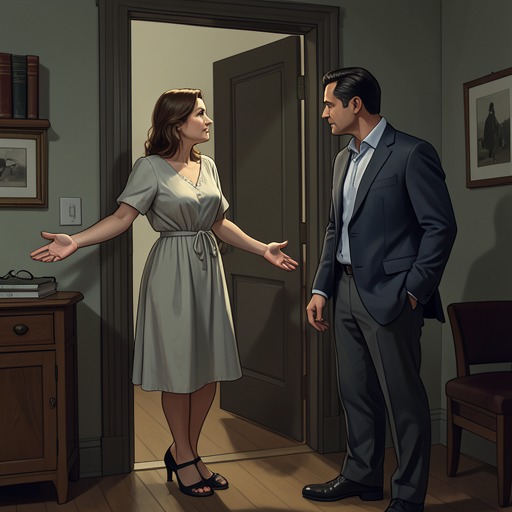
Later, during a quiet moment in the bright kitchen, Auden and Eli look at one another and Auden imagines reaching out to brush his hair from his face. The moment is still an inward possibility, not an action she has taken, when Adam appears at the door holding up the camera. He calls, “Smile!” and the shutter snaps. The scene does not show anyone restating the agreement or responding to the photograph, but Adam’s action plainly recalls the rule the group had just established.
The timing gives the camera a particular force. The earlier dispute concerned a summer’s worth of pictures and the prospect of future nostalgia; this photograph arrives at the threshold of an intimate moment, before Auden and Eli have acted on what Auden imagines. The camera records an instant, but not the movement of feeling that precedes it. Auden expects she may never see the picture, and even if she does, she knows it will not come close to capturing everything she feels.
Memory and Significance
Auden’s response does not simply repeat Maggie’s confidence that the group has already been documented, or Adam’s concern that it may later lack records. She allows that a copy of this particular photograph might matter to her, imagining it in a blue frame with a few words etched beneath: “The best of times.” The thought gives the image a possible place in her memory without treating it as a complete account of the experience.
The agreement thus sets the limits of photography against the limits of memory. Adam’s camera can preserve visible evidence of a summer and its people, but Auden’s imagined caption belongs to the feeling the photograph cannot show. The final image neither resolves the pact nor erases its terms: it leaves the reader with both the recorded instant and the irreducible experience beyond the frame.