Robert's writer's block
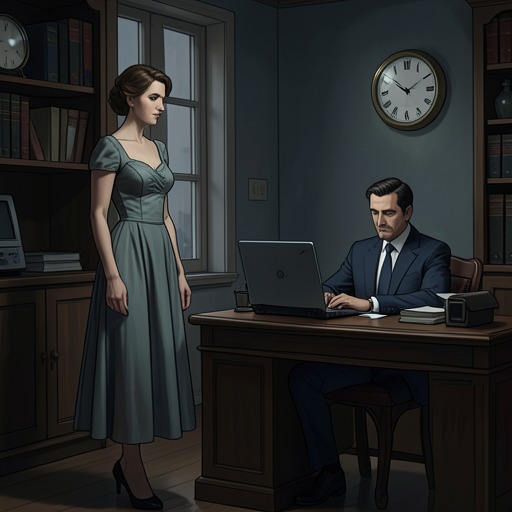
Along for the RideRobert's writer's block centers on the troubled progress of the novel he has been trying to write after the success of his first book. Its delay shadows his professional reversal and the strain in his marriage to Victoria West, while his later conversation with Auden reveals that the manuscript is not simply abandoned: Robert has removed a middle section that was not working and believes the replacement material is much better. The book-in-progress remains, for him, a possible turning point for his new family as well as a measure of his own creative future.
Career Before the Stalled Novel
Robert's first novel, The Narwhal Horn, established him as a successful writer while he and Victoria West were building their academic careers. They had come to the U directly after graduate school, when Robert was offered an assistant professorship. Around that time, he found a publisher for the novel; by the time Auden was born, it had become a critical and commercial success. Robert was then leading the creative writing program.
The family’s professional balance changed over the years. While Auden was young, Victoria West returned to academia, earned a publisher for her dissertation, secured a full-time position, and published further books. Robert joked that she was the family’s breadwinner and presented himself as proud of her success. But her endowed chair coincided with his being dropped by his publisher. The contrast is not described as the sole cause of the marriage’s deterioration, but it marks a consequential reversal: Victoria West’s academic standing rose as Robert’s literary career lost momentum.
By the time Auden considers visiting Robert in Colby, his public identity is no longer defined only by the success of The Narwhal Horn. He is now known more for interdepartmental feuds than for the follow-up novel that has remained in progress. The novel’s protracted state makes the block visible as a career condition: a second book has not appeared, and the first book’s achievement has become a difficult point of comparison.
The Stalled Follow-Up and Its Revision
Robert’s difficulty concerns a specific work, not a stated inability to write at all. During dinner with Auden, he describes the new novel as an intricate study of a man trying to escape his family’s past. He has had to tear out the middle because it was not working, but says the new material is much better. The account presents revision as an active, if disruptive, response to a structural problem in the manuscript.
That distinction matters to the shape of Robert’s block. The novel has been delayed, and a substantial portion has failed to satisfy him, yet he is still working on it and can explain its central character’s inner conflict in detail. The evidence therefore shows both frustration and renewed movement: the book has not reached completion, but Robert has made a consequential change to its design and believes the altered draft has improved.
The account gives no date for when he began the follow-up, no estimate of how much he has written, and no final outcome for the manuscript. Its progress is conveyed through Robert’s description at this particular stage: a middle section removed, new pages judged better, and the work still in development. That limited but concrete update complicates the label of writer’s block, placing stalled progress alongside continuing craft and revision.
Family and Professional Stakes
The novel’s importance is bound up with the family changes surrounding Robert. He has moved from being Victoria West’s husband and the author of a successful book to a new husband, a father-to-be, and the head of the creative writing department at Weymar College. Those changes make the unfinished book part of a broader new life, but they do not erase the career setback that preceded it. Auden is unsure whether she still has a place in that changed family, and Robert’s stalled writing belongs to the same unsettled landscape as her hesitation about returning.
When Robert and Auden discuss the manuscript over shrimp at a restaurant on the pier, their conversation offers a temporary way back into closeness. At first the meal is stiff. They talk about Auden’s studies at Defriese University and her plans for a major before she asks about his book. As Robert explains the revision and its central conflict, Auden recognizes his passion for his work and the absorption with which he speaks about it. Her renewed admiration does not resolve the family’s tensions, but the discussion lets her encounter a part of her father she still loves.
Robert links the book directly to his hopes for Heidi and the baby. He believes its success could change their lives as The Narwhal Horn once changed the family’s circumstances. At the same time, he wishes Heidi understood the importance he attaches to the work. His explanation frames the manuscript not merely as an artistic project but as a hoped-for source of security and possibility for his new household. The hope is Robert’s; the evidence does not establish whether the book will achieve that result.
Auden, Heidi, and the Meaning of the Book
Robert’s conversation with Auden also reveals how he seeks recognition for the novel. He tells her that she understands its importance because she was present when The Narwhal Horn succeeded and saw how that success altered their lives. The appeal makes Auden more than a listener: in Robert’s account, she is someone who can connect his present ambition with the family’s shared past. Her response is encouraging, and she tells him she looks forward to reading the book.
That exchange sits beside Robert’s disagreement with Heidi over the value of his work. He describes her strength as business and results, contrasting it with the outlook of academics and writers. This is Robert’s characterization, not an objective account of Heidi’s capacities; it shows how he interprets their difference and why he feels unseen. The book thus becomes a point where professional frustration and marital conflict meet. Robert hopes the novel will matter to his family, while also feeling that Heidi does not share his understanding of what it could mean.
The narrative does not confirm that Robert has overcome his writer’s block, completed the novel, or regained the success of his first book. Instead, it leaves the manuscript in a provisional state: its middle has been discarded, its new direction seems promising to him, and its future carries emotional and practical hopes that remain unresolved. The tension between stalled publication and renewed work gives the block its significance. It is not only an absence of a finished book; it is an unfinished possibility that reconnects Robert to his past achievement, tests his present relationships, and gives Auden a moment of renewed connection with her father.