The possibility of change
Along for the RideThe possibility of change is not presented as a settled promise but as a claim tested against what people have done before. Through Auden’s observations of Robert and Eli, the idea gathers force in modest, visible actions: a father continuing to rock a crying baby, and a young man riding a bicycle after others assume he has stopped. Each moment offers evidence, but not certainty. The distinction matters to Auden, whose hope grows when change is happening in front of her and retreats when memory makes repetition seem just as likely.
Evidence in Small Gestures
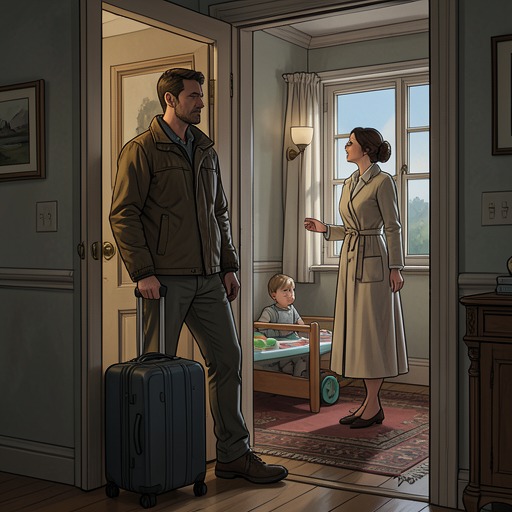
The first important test comes after Heidi leaves the room to shower. Robert has taken Thisbe from her, smiling at the baby before settling into a rocking chair. When Heidi is gone, Auden expects him to pass the infant to her; instead, he keeps holding and patting Thisbe’s back. Auden watches from the doorway, unsure whether Robert even notices her there. The action is quiet, but it unsettles her expectation that his attention will move elsewhere as soon as Heidi is gone.
Auden wonders whether Robert behaved this way with her and Hollis when they were babies. What she has heard from her mother makes her think probably not, and, only minutes earlier, she would not have expected this scene from him. The present gesture therefore does not erase the past; it stands beside it. Auden sees a possible difference in Robert’s conduct, while retaining enough doubt to avoid treating one tender interval as proof of a lasting transformation. The scene gives the idea its careful grammar: people may change, or at least try, but trying is not the same as having changed beyond question.
Possibility Between Auden and Eli
The same distinction appears in Auden’s growing closeness with Eli. After she tells him she is sorry about his friend, the two remain together in the bright kitchen while noisy conflicts continue outside. The setting recalls their earlier nights, yet Auden senses that the moment is different—not because either of them has already become someone else, but because they might. She imagines reaching toward him and the touch being returned, a closeness that feels almost present to her. Adam’s sudden arrival with a camera interrupts the moment before that imagined gesture becomes an action.
That interruption preserves the scene’s emphasis on possibility. Auden has not established what the intimacy means, and the encounter does not resolve the relationship between her and Eli. Instead, it makes a new response feel available where, moments earlier, the familiar pattern might have seemed fixed. The shift is first registered as an opening, not as a completed change. The scene’s contrast between the bright kitchen and the continuing commotion outside also keeps the intimacy local: something may be changing between these two even while the wider world remains noisy and unsettled.
Eli’s Bicycle and the Argument About People
Auden later encounters the idea directly while she and Eli are looking at merchandise in a store. Their conversation turns to Hollis and the woman he has chosen. Eli argues that relationships may not make sense to observers and that Hollis might have found the right person. His point challenges Auden’s certainty that Hollis has never taken anything seriously: a person’s past conduct does not necessarily settle what he can do next.
As he makes this argument, Eli pulls a midsize bicycle from the rack, balances it on its front tire, climbs on, and pedals slowly around Auden and the cart. The physical action gives the discussion an immediate counterexample. Auden has been told, or has come to believe, that Eli no longer rides; Eli himself says that he does not. Yet she is watching him ride. Their exchange does not explain why he has mounted the bike or establish what he will do afterward. Its force lies in the discrepancy between the fixed description and the act in front of them.
Auden connects Eli’s claim about people changing to her mother’s equally certain belief that they do not. She wants to keep believing change is possible, and recognizes that it is easier to do so while she is in the middle of witnessing it. As Eli circles her, each pass brings a slight breeze, like a wave. Motion becomes the scene’s concrete image of a belief that cannot be secured in advance: the bicycle is moving, but the moment alone cannot guarantee a destination or a permanent return to riding.
Hope Against Repetition
When Auden later reaches Eli in the middle of the night after hearing Robert and Heidi fight, the disagreement becomes more personal. Eli tries to reassure her that a quarrel does not necessarily mean a separation. His own parents used to argue, he tells her, and things were better afterward. Auden’s fear, however, is shaped by her knowledge of Robert; she has seen him behave this way before. The two are not debating change in the abstract. Eli speaks from a family pattern in which conflict could be followed by repair, while Auden sees a familiar action that may lead back to an earlier hurt.
Eli answers that people change; Auden replies that sometimes they do not. Her response neither dismisses his hope nor accepts reassurance as a guarantee. She looks at his face, which seems less haunted than it once did, a small visible alteration that complicates her resistance. Yet that change in Eli cannot tell her what Robert will do. The scene keeps separate the evidence she has for one person and the uncertainty she feels about another.
The late-night setting gives that uncertainty a further shape. In the small garage apartment, Auden imagines the two of them as one light beneath a passing plane, surrounded by other unseen lives unfolding hour by hour. The image does not supply an answer about whether the fight will be followed by change. Instead, it places Auden’s immediate fear within a larger world of private events, most of them invisible from above. Eli turns back to finish cooking, and their conversation remains grounded in ordinary activity rather than a decisive resolution.
An Unsettled Principle
Across these scenes, change is measured by conduct, not declared as a permanent quality. Robert’s care for Thisbe gives Auden reason to revise her expectations, but she cannot know from one scene whether the difference will endure. Eli’s ride contradicts the assumption that he never rides, while leaving open what the bicycle means for his future. His less-haunted expression suggests that change can be seen in a person without making every other outcome predictable.
Auden’s position therefore shifts between guarded skepticism and a hope strengthened by immediate experience. The book does not make the past irrelevant: it is precisely what makes her cautious about Robert and what gives the possibility of change its stakes. Nor does the present settle the future. What Auden can recognize is that people may act differently from the roles others have assigned them, and that such action can make another course imaginable. Possibility, in this account, is neither proof nor empty optimism; it is an opening that must be witnessed, tested, and lived through before it can become trust.