New York City
Alpha Wolf Mate Mega Bundle (Paranormal BBW Werewolf Erotic Romance 7-Pack)New York City is not merely a backdrop but the narrative’s principal mechanism of transformation. Its familiar avenues and institutions conceal predatory violence, supernatural bodies, and new forms of intimacy, turning modern urban life into a chain of dangerous thresholds. In the city, a walk home can lead into Central Park, a subway ride can descend into a werewolf’s underground lair, and elite apartments or corporate rooftops can become stages for revelations that permanently alter human relationships.
Urban Setting and Atmosphere
New York City first appears through rain, exhaustion, and isolation. After leaving a crowded bar, Maggie finds every passing cab occupied during a night of heavy rain on Columbus Avenue. With her cellphone reduced to one blinking bar of battery, she chooses the dangerous shortcut through Central Park rather than walking around it to the Upper East Side. The city’s brightly lit streets give way to a dark gravel path, sporadic lampposts, cold rain, and a distant howl. Urban infrastructure offers no real security once Maggie leaves the public street; the metropolis quickly becomes a landscape of pursuit.
The city’s weather repeatedly reinforces this instability. Carol arrives at a restaurant after nearly three days of storms, pays her cab driver, and runs through the rain into a warm lobby without an umbrella. The contrast between soaked bodies outside and controlled luxury inside gives New York City a divided character: exposure and comfort exist only a few steps apart, separated by money, doors, and social access. The city’s polished interiors do not eliminate danger; they merely relocate it behind more elegant walls.
Subways and Underground Thresholds
The New York City subway converts ordinary travel into gothic descent. Maggie boards a train and initially treats the strange man beside her as an unsettling but still human passenger. When she reaches her stop, he follows her from the second-to-last car through an empty station. Before she can reach the stairs, she hears fabric tearing, growls, and the sounds of a body undergoing a horrific transformation. The man becomes a gigantic wolf, seizes her, and carries her four feet down onto the tracks.
Maggie later awakens in a dark underground cavern where water drips and a train passes roughly thirty yards away. The vibrations make the subway seem physically present inside the hidden space, linking the city’s public transportation system to a secret werewolf territory beneath it. Silas transforms there to confront the attacking wolf, and the two creatures fight across the open underground passage before landing on the tracks. The subway therefore functions as more than a setting for suspense: it is a passage beneath the visible city, a place where human identity gives way to animal power and where the city’s everyday movement continues almost unaware above the violence.
Wealth, Romance, and Hidden Predators
New York City’s affluent districts provide another version of the same threshold. After dinner, Lucas drives Carol in a black AMG Mercedes coupe up the West Side Highway and brings her to a luxurious building on 77th Street on the Upper West Side. Carol interprets the apartment visit as an intimate and potentially transformative romantic step, while Lucas presents the encounter as controlled and reassuring. Yet the city’s luxury does not protect her from the supernatural. On the nearly abandoned street outside, a gigantic grey wolf attacks a strange armed man, knocking him unconscious after he reaches for a pistol. The wolf then transforms back into Lucas and calmly calls Carol to him, forcing her to reconsider the apparent sophistication and safety of their date.
The same pattern appears in Miami, where Jack’s hotel suite overlooks the blazing city and the seemingly endless Atlantic Ocean. Even from the fifteenth floor of the Hilton Bentley, the urban panorama cannot contain the threat. Jack transforms into a wolf before Natasha, while another wolf crashes through the skylight to confront him. The elevated suite, with its view over the city, becomes an arena rather than a refuge. Across these scenes, metropolitan luxury amplifies the contrast between civilized surfaces and concealed violence.
Corporate and Academic City Spaces
New York City also houses institutions organized around ambition, expertise, and authority. Wallace-Anderson Investment Group presents itself through emerging-market analysis, proprietary trading strategies, and the promise of outsized returns. Its financial world is concerned with risk, capital, and control, yet the broader narrative places such modern systems beside the older, more bodily danger of the werewolf world. The city’s corporate language of markets and opportunity thus coexists with transformations that cannot be quantified or publicly acknowledged.
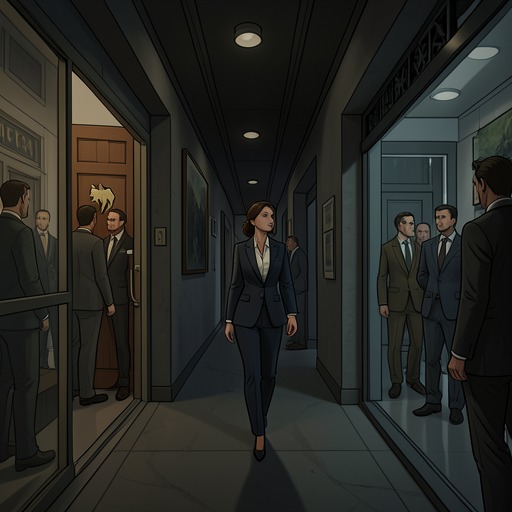
A rooftop connected to Thomas Anderson’s workplace offers a particularly concentrated example. An elevator opens directly onto the roof, where a fire pit and a bar stocked with champagne, Bordeaux, and Woodford Reserve create an atmosphere of private privilege. The rooftop rises above the ordinary city while remaining physically embedded in it. What seems to be a romantic evening between an employer and an employee becomes a space charged with concealed desire and supernatural possibility, showing how vertical urban architecture separates privileged encounters from the streets below without removing them from the same dangerous city.
The university provides a contrasting but related setting. After fleeing Garrett and the wolf that attacked him, Jillian crosses the campus and reaches Culbert Hall, where she runs to Floyd’s studio shortly before 2:45 AM. The unlocked doors, long hallway, and perpetually lit studio make the academic building feel open yet strangely unprotected. Later, Jillian understands that Floyd is a werewolf and reinterprets his knowledge of Garrett and his intervention on her behalf. The campus therefore becomes a place where education, mentorship, bodily attraction, and hidden supernatural identity converge.
Narrative Significance
New York City’s defining feature is its ability to make the extraordinary appear adjacent to the routine. A restaurant reservation, a car ride, a hotel room, a work presentation, a rooftop drink, a subway stop, or a walk across campus can all become the opening movement of a revelation. The city’s density creates repeated encounters, while its tunnels, towers, private rooms, and institutional corridors provide spaces in which secrets can remain concealed until a body changes before a witness’s eyes.
The werewolves’ presence transforms the meaning of the city without replacing its recognizable geography. Central Park becomes a perilous shortcut; the subway becomes an underground lair; the Upper West Side becomes the approach to a hidden predator; a hotel suite becomes a battleground; a corporate roof becomes a private threshold; and Culbert Hall becomes a sanctuary sought by someone who does not yet understand why she needs it. New York City is consequently both modern and archaic, a network of technology, commerce, education, and luxury crossed by animal instincts, pack loyalties, and supernatural bonds. Its decisive narrative role lies in making concealment and revelation possible at the same time: the city can hide the werewolf world, but its crowded systems and layered spaces also carry characters directly into it.