Central Park Wolf Attack
Alpha Wolf Mate Mega Bundle (Paranormal BBW Werewolf Erotic Romance 7-Pack)The Central Park wolf attack is the book’s foundational encounter between vulnerable human life and the hidden werewolf world. It begins as a threat of sexual violence against Maggie and becomes a supernatural intervention when a large grey wolf seizes one attacker, knocks down another, and leaves the third paralyzed with terror. Maggie’s escape does not restore ordinary safety: the same pattern of darkness, pursuit, transformation, and uncertain protection recurs through the stories of Silas, Lucas Wilde, Greyson, Mr. Adams, and Floyd Meriwether, making the attack both a self-contained crisis and a template for the novel’s wider mythology.
Causes and Setting
Maggie enters Central Park after a painful breakup with Travis. Already drinking in an effort to blunt the humiliation and grief, she leaves her friends at the bar and seeks the quickest route to her apartment on the Upper East Side. Hard, cold rain has soaked her clothing, and the prospect of walking around the park seems unbearable; crossing through it promises to save roughly half an hour. The decision is therefore shaped by exhaustion, cold, loneliness, and the desire for the immediate refuge of a warm bed rather than by recklessness alone.
The park converts the familiar city into a disorienting Gothic landscape. Maggie leaves brightly lit streets for a gravel path marked only by sporadic lamps, while rain obscures her surroundings and the branches conceal the city’s landmarks. A distant howl makes the darkness feel inhabited before any attacker appears. As the path seems to lengthen and she loses her sense of direction, the urban environment ceases to provide its usual assurances of visibility, public order, and escape.
Human Threat and Supernatural Intervention
Three men approach Maggie on the path, and the loudest blocks her way. Their first remarks reduce her to an object of sexual appraisal, while the second man mocks her curvy body and calls her “a little cutie pie.” Their taunts escalate into explicit demands and sexual humiliation. Maggie’s tears and trembling show that the immediate danger is not merely verbal: she feels physically overpowered and regrets choosing the shortcut.
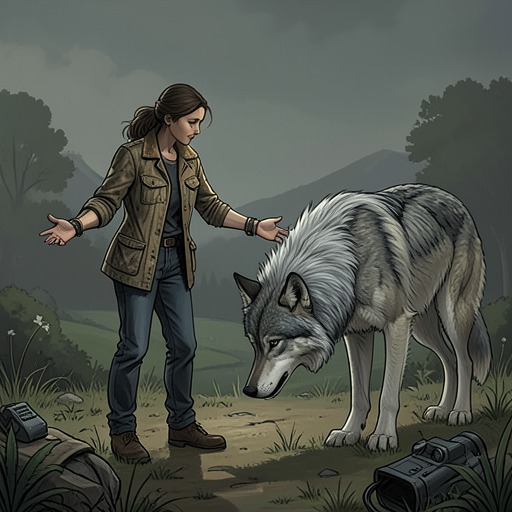
The interruption comes from the trees. A rustling of dead leaves precedes the sudden appearance of a large grey beast, which crosses the path with extraordinary speed and carries the first man into the woods. His scream is followed by an unnatural silence, freezing Maggie and the surviving men in place. The shorter man reacts with panic, but no explanation is available to any of them; Maggie can only question what she has seen and how much of the scene may be distorted by alcohol and fear.
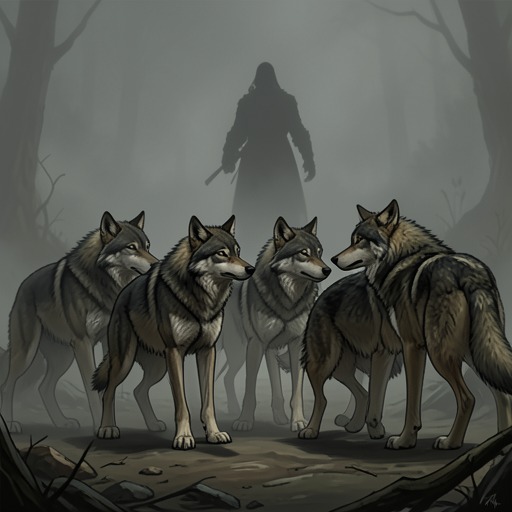
A second grey blur knocks the other attacker to the ground. Growling paws then advance toward the third man, whose body shakes in terror as he is rendered helpless by the creature’s presence. The attack reverses the power arrangement of the scene: the men who had controlled the path through numbers, sexual aggression, and intimidation are themselves hunted and immobilized. Yet the reversal does not make the wolf reassuring. Its size, speed, and bestial sounds leave Maggie facing a different form of violence whose intentions she cannot read.
Escape Through the City
Maggie runs as soon as the wolf turns its attention to the men. She screams while following the barely visible path, driven by adrenaline toward a hollow where streetlights finally appear. Once outside the park, she discovers that she is on 67th Street and almost twenty blocks from home, evidence that her attempt to take a shortcut has instead deepened her disorientation and danger.
She hurries toward the subway in completely wet clothes, still out of breath from both running and panic. The empty street offers little comfort, and when she looks back she finds no visible pursuer, only passing cars. The subway promises heat and other people, so Maggie enters it as a refuge from the park. That refuge proves temporary. At her stop, an unfamiliar dark man leaves the train just before the doors close and follows her through the nearly empty station.
The underground pursuit repeats the park’s attack in a more intimate form. Behind Maggie come the sounds of fabric ripping and growls of pain and fury. When she turns, the stranger is undergoing a horrific transformation: fur spreads over his face, a snout pushes outward, and his head becomes the gigantic head of a wolf. He pursues her across the station, catches her dress in his jaws, and carries her four feet down onto the tracks into a dark passageway. Maggie imagines her own death and a newspaper report identifying her as a missing young woman before she blacks out.
Revelation and Repeated Pattern
Maggie awakens in an underground cavern where water drips and the vibrations of a train pass through the space. The setting links the attack to the city’s hidden infrastructure: the supernatural world is not outside New York but beneath and within it. The dark man appears beside her and addresses her by name, confirming that the pursuit was deliberate and personal rather than an accidental encounter with a wild animal.
The later confrontation reveals that the grey wolf is Silas. When an enormous dark wolf attacks Maggie, Silas transforms before her eyes, his muscular human body swelling and contorting until he becomes the luminous grey wolf she had seen earlier. The two wolves circle, snap at Maggie, and fight across the open underground space. Silas knocks the stranger onto the subway tracks and pins him, though the other wolf kicks him away and prepares to kill him. The scene therefore clarifies the attack’s double structure: a wolf can be the source of terror, while another wolf can become the force standing between the threatened woman and death.
Silas’s later transformation back into human form makes the supernatural impossible to dismiss as intoxication or hallucination. He tells Maggie that she is his mate, asks for her trust, and promises safety among his brothers and pack. She eventually accepts his protection, embracing his furry neck as he carries her through the subway tunnels. The original attack thus ends not with a return to the public city but with movement deeper into a concealed community.
Narrative Significance
The attack establishes a recurring werewolf grammar for the novel: a woman is isolated in an exposed urban space, male danger closes around her, a wolf arrives with overwhelming physical force, and a transformation converts the monster into a man whose protection is inseparable from possession and intimacy. The pattern later appears when Lucas Wilde protects Carol on a city street, when Greyson transforms in his apartment, when Mr. Adams reveals himself to Liza after a brutal fight, and when Floyd Meriwether’s identity explains his intervention in Jillian’s danger.
Its central ambiguity remains unresolved within the scene. The wolves rescue women from human or supernatural attackers, but they also abduct, pursue, overpower, or claim them. Maggie’s passage from the rain-soaked park to the underground cavern is consequently both an escape from one danger and an initiation into another order of power. The attack’s lasting consequence is not simply that Maggie survives; it is that the boundaries separating violence from protection, monster from lover, and urban reality from werewolf society become impossible to restore.