Culbert Hall
Alpha Wolf Mate Mega Bundle (Paranormal BBW Werewolf Erotic Romance 7-Pack)Culbert Hall is the newly constructed center of the art department, identified specifically through room 233 and later revisited through Floyd Meriwether’s studio. It first appears as a luminous place of education and artistic possibility, then returns after a werewolf attack as a desperate refuge whose unlocked doors and darkened corridors cannot guarantee safety. The building’s decisive significance lies in this transformation: a space designed for clarity and artistic vision becomes a threshold between ordinary campus life and the hidden supernatural world.
Architecture and Academic Setting
Culbert Hall is described as a contemporary architectural wonder whose huge overhead windows flood the art department with light. That illumination gives working artists the clarity needed to realize their personal artistic visions, making the building an emblem of openness, discipline, and creative self-definition. The setting is not an anonymous classroom block; it is presented as the predominant building of the art department and as a place whose physical design appears to support the values of modern artistic practice.
Room 233 is where the first Sculpture 101 class gathers. The class is small, and the narrator is surprised to have been admitted as a first-semester freshman. The students sit nervously together while waiting for the instructor, establishing Culbert Hall as a space of initiation: the narrator is entering an unfamiliar artistic community, and the building gives that transition a concrete institutional setting.
Floyd Meriwether’s Classroom
Floyd Meriwether enters room 233 carrying a beat-up chestnut-brown leather attaché and wearing a sharp plaid blazer. He is about six feet tall, with shaggy dark hair and round tortoise-shell glasses. After placing the attaché down, he removes his blazer, rolls up his shirt sleeves, and confronts the class with the question, "Sculpture 101. What is sculpture?" His teaching immediately makes Culbert Hall more than a site for routine instruction: it becomes a place where artistic categories and assumptions are deliberately unsettled.
Floyd refuses to reduce sculpture to a simple definition. He explains that the question is more complex than students expect and redirects the class toward the more fundamental question of what art is. The discussion leaves the students perhaps more confused than before, but it is also more intellectually stimulating than the narrator’s other classes, which focus mainly on syllabi, requirements, and grading. Culbert Hall therefore represents a form of education based on inquiry rather than administrative compliance.
At the next class, Floyd requires every student to write a paper answering the question of what sculpture is. The paper may be as long or short as the student chooses, but no one may begin working with materials until Floyd receives a satisfactory answer. He dismisses the class early and sends the students to their dorms, the library, or a coffee shop to think and write. The building’s practical studios are thus temporarily withheld: before students can handle materials, they must confront the conceptual problem of the medium.
Refuge After the Werewolf Attack
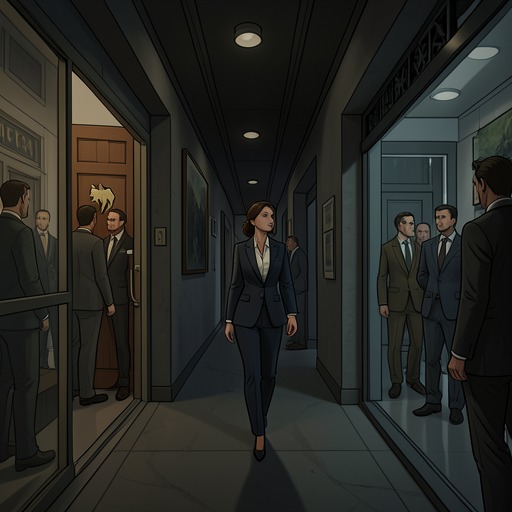
Culbert Hall later acquires a radically different meaning when the narrator runs there after witnessing a werewolf attack on Garrett. The narrator realizes that the building is only about a football field away and finds its doors unlocked. The route leads up the stairs and along the hallway toward Floyd’s studio, because the narrator feels an urgent, unexplained need to see Floyd. The same institution that had offered intellectual orientation now becomes the destination of someone fleeing a world that no longer makes sense.
The refuge is precarious rather than secure. The narrator enters Floyd’s studio, slams the door, and initially believes the wolf has not followed. The studio light is on, but this offers little reassurance because Floyd habitually leaves it on and often forgets to lock the door. At approximately 2:45 AM, Floyd is absent, and the narrator waits there only on the chance that he might appear before recognizing how unrealistic that expectation is. Culbert Hall’s openness has become vulnerability: an unlocked artistic workspace permits entry, but it cannot control who or what may cross the threshold.
Threshold Between Art and Hidden Violence
The building’s connection with Floyd’s studio gives it a further significance. The narrator’s movement through Culbert Hall is not simply a return to campus; it is a movement from the public world of classes into a more private artistic space associated with Floyd’s eccentricity and with the narrator’s need for protection. The ordinary academic building becomes a Gothic passageway, linking a recognizable college environment to the unexplained wolf attacks occurring beyond it.
This contrast is sharpened by the building’s changing light and spatial function. Its overhead windows initially provide ideal clarity for artists, while the later flight occurs through stairs and a long hallway at night. The text moves from visible, communal learning to solitary panic without changing the building itself. Culbert Hall consequently exposes how safety depends not only on architecture but also on time, access, knowledge, and the identities of those who occupy the space.
Culbert Hall also concentrates the novel’s tension between the material and the mysterious. Students are told to think carefully before working with physical materials, while the narrator later seeks shelter from a creature whose body visibly transforms through tearing fabric, fur, and animal form. The building that teaches the interpretation of bodies and objects becomes a place where the human body itself cannot be taken at face value. Its narrative role is therefore both institutional and symbolic: it houses the language of art while standing at the edge of truths that the academic setting cannot yet explain.