Liza
Alpha Wolf Mate Mega Bundle (Paranormal BBW Werewolf Erotic Romance 7-Pack)Liza’s decisive role is to show how the book’s werewolf mythology enters an apparently ordinary professional world. Introduced as a junior attorney whose career has consumed her life, she is drawn into Mr. Adams’s hidden identity when a late night at the office becomes a werewolf attack. Her arc combines economic insecurity, bodily exhaustion, supernatural terror, and a coercive language of mate selection that recasts a workplace relationship as an intimate destiny.
Identity and Background
Liza is a young lawyer working late in the New York office of Hobson, Kinney & Dwyer. At 9:00 PM on a Friday, she remains at work editing a legal contract draft that she has revised repeatedly for three weeks. The scene establishes not only the length of her working hours but also the narrowing of her life around professional obligation. Her body aches despite having stopped going to the gym, and she recognizes that the demands of her career have consumed nearly everything else.
Her professional insecurity is sharpened by the office hierarchy. Mr. Adams, a powerful senior figure, tells her that the firm hired her because it believed she was “Kinney & Dwyer material,” someone with the drive, intelligence, and endurance to survive the work. Yet after the board votes to scale back the New York office, he tells her that he may have to fire someone on his team and demands that she give him a reason it should not be her. Liza responds with an apology and an admission that she has not been herself, while he dismisses explanations and complains that he should be drinking expensive scotch rather than correcting the mistakes of a junior attorney. The exchange places her under both institutional and personal pressure before the supernatural crisis begins.
The Office Attack and Revelation
The immediate turning point comes when Mr. Adams suffers a violent episode in his office. He clutches the back of his neck, grimaces in pain, and convulses as though agony is passing through his entire body. Liza is unable to determine what is happening. When he orders her to leave immediately and close the door, she flees toward the elevator, fearing for her life.
From the twenty-eighth floor hallway, she hears fabric tearing, bottles crashing, and a howl that echoes through the building. A large dark-grey wolf with unnaturally yellow eyes advances toward her. The elevator offers no refuge: a second wolf waits inside, salivating and anticipating her as prey. Liza throws her purse at the animals and runs, but a third wolf tears the door from Mr. Adams’s office, sending plaster and dust through the corridor. She watches a brutal fight in silence, too frightened to make a sound, as the wolves turn the corporate workplace into an enclosed hunting ground.
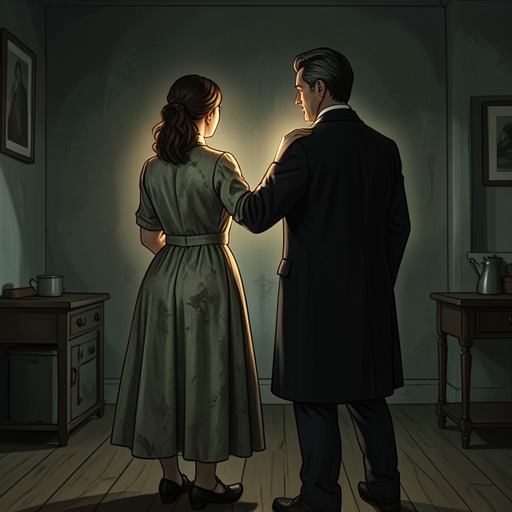
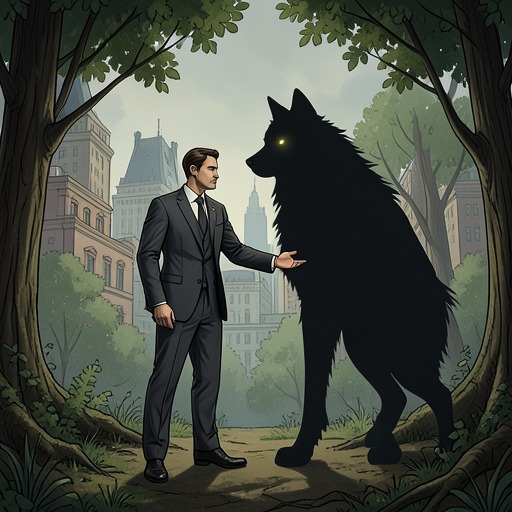
The revelation is made bodily rather than through an explanation. The enormous wolf approaches Liza and changes shape: its muscles contract, fur gives way to shining skin, and a human face emerges from the beast’s head. The man is Mr. Adams, drenched in sweat and breathing heavily, yet retaining the creature’s otherworldly ice-blue eyes. His transformation confirms that the threatening employer and the powerful wolf are the same person. His first concern is not to explain the attack but to tell Liza that she should not have seen it, making her accidental knowledge of his secret the basis of their new relationship.
Mate Selection and Power
Mr. Adams presents Liza’s discovery as part of a longer process of observation. He says that he has been looking for a mate, has watched her around the office, and initially considered her a possible candidate when she was hired. He claims that he needed to see what she was made of before deciding, and that the night’s events have convinced him. His choice is therefore framed as deliberate evaluation rather than sudden attraction.
The qualities he names are a mixture of character, sexuality, and reproductive usefulness. He describes Liza as passionate, strong, intelligent, and cunning, but also emphasizes her “fertile body.” He tells her that he wants her to help raise his young and nurture his pack. The language turns her professional qualities into evidence of suitability for a private social order, while her body becomes part of the future of that pack. Her career identity is not discarded so much as absorbed into a system in which endurance, intelligence, and physical fertility all serve the werewolf leader’s objectives.
Liza’s position remains deeply conflicted. She is frightened by Mr. Adams’s transformation and considers pushing him away, escaping, or calling the police. At the same time, the narrative records her physical desire and her uncertainty about what that desire means. Her response cannot be separated from the circumstances: she has just witnessed violence, remains inside the workplace controlled by a powerful superior, and is confronted by a man who possesses both institutional authority and supernatural force. The story repeatedly places her apparent attraction beside fear rather than presenting the two as equivalent forms of consent.
The Larger Werewolf Pattern
Liza’s experience belongs to a recurring structure in the book, in which ordinary women encounter men whose human identities conceal the Werewolf nature. Earlier scenes establish the pattern through abduction, rescue, transformation, and claiming. A strange man changes into a gigantic wolf in the subway, carries a terrified woman onto the tracks, and leaves her underground; Silas later transforms to defend her from another wolf. In another encounter, a gigantic grey wolf attacks a man in the street before transforming back into Lucas Wilde, who orders Carol to follow him and threatens to kill her and the doorman if she screams. These episodes make the wolf simultaneously a predator, a protector, and an instrument of male authority.
The same ambiguity appears in the experiences of Greyson and Jillian. Greyson’s transformation terrifies Celia before the wolf’s unexpected touch calms her, while Jillian realizes that Floyd is a werewolf after he prevents her from calling for help for a student injured in an attack. Liza’s story thus does not stand alone: it extends the book’s repeated movement from institutional or public space into secret werewolf intimacy. In her case, the threshold is an office elevator and a law firm corridor, spaces associated with discipline and legal order that are abruptly overtaken by animal violence.
Narrative Role and Significance
Liza functions as a particularly revealing figure because her vulnerability is layered. She is economically exposed by possible dismissal, subordinated to Mr. Adams in the firm, physically exhausted from overwork, and then trapped in a building with three wolves. Her body is described through both fatigue and the language of reproductive selection, creating a sharp contrast between the career she has sacrificed herself to build and the pack future Mr. Adams proposes for her.
Her story also exposes the gap between legal authority and actual power. As a lawyer, Liza belongs to an institution built around contracts, evidence, and enforceable rules, yet the crisis gives her no meaningful protection from the hidden supernatural order. Mr. Adams’s revelation is not accompanied by a legal remedy; instead, knowledge places her closer to him. The office that should represent rational procedure becomes the scene of an involuntary initiation into the Werewolf nature.
The supplied narrative ends with Liza still afraid and unsure what Mr. Adams means by making her his mate. She acknowledges desire but does not treat it as proof that the danger has disappeared. Her ending is therefore suspended rather than resolved: she has learned the truth about the man who employs her, but has not yet gained control over what that truth requires of her. Liza’s significance lies in that unresolved tension between recognition and freedom, attraction and coercion, and the professional self she has built and the pack identity being imposed upon her.