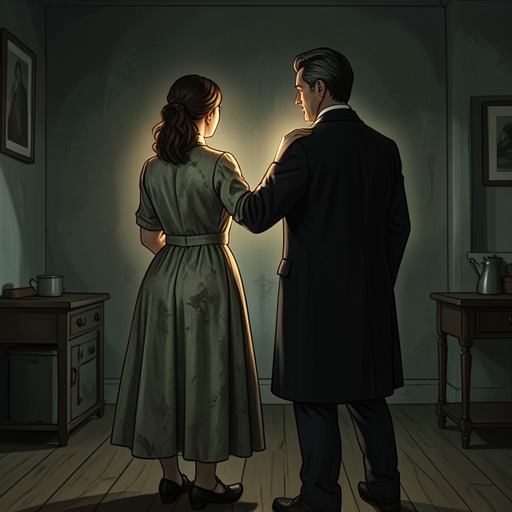
Mr. Adams
Alpha Wolf Mate Mega Bundle (Paranormal BBW Werewolf Erotic Romance 7-Pack)Mr. Adams is both Liza’s overbearing senior partner at Hobson, Kinney & Dwyer and a werewolf whose transformation turns an apparently ordinary workplace superior into a figure of supernatural power. His decisive role is to collapse the boundary between professional authority and hidden animal identity: the man who controls Liza’s working hours is also the wolf who claims that he will protect rather than harm her.
Identity and Professional Authority
Mr. Adams first appears through Liza’s exhausting professional life. After graduating at the top of her class from Brooklyn Law School, Liza becomes a junior attorney at Hobson, Kinney & Dwyer, where Adams imposes a punishing schedule: subordinates are expected in the office from 8:00 AM to 8:00 PM six days a week, with Sunday hours from nine to five. His demands have helped turn a prestigious legal career into a nearly total occupation of Liza’s time, leaving little room for friends, romance, or family.
His authority is conveyed through physical presence as much as through institutional rank. When Liza is daydreaming in her cramped office, a large figure darkens the doorway. Adams appears tall and muscular, wearing a grimace and speaking with utter indifference. He orders her to put the draft for the Donaldson account on his desk within an hour, even though the contract is not due until the following week. The arbitrary urgency reinforces Liza’s view of him as a slave driver whose power extends beyond formal necessity.
The contrast between Adams and Thomas Anderson, another powerful male executive in the wider narrative, clarifies the specific texture of his authority. Thomas Anderson is introduced as the brilliant investor who founded his investment fund five years after graduating from Harvard Business School and is rumored to possess a two-billion-dollar fortune. Adams’s power is less visibly glamorous: it operates through relentless schedules, abrupt commands, and the immediate control of an employee’s labor. Yet both figures are presented through imposing male silhouettes, linking economic and professional hierarchy to bodily force.
The Transformation and the Hidden Werewolf
Adams’s supernatural identity is revealed when Liza witnesses a brutal fight involving a gigantic grey wolf. The wolf’s appearance is not a minor disguise but a complete bodily metamorphosis: its shape contorts and shifts, powerful muscles contract, rough fur gives way to resilient, shining skin, and a human face emerges where the beast’s head had been. The man approaching Liza is Mr. Adams, drenched in sweat and breathing heavily, with the same otherworldly ice-blue eyes that seem to hold her in place.
The revelation reinterprets the authority Liza has already experienced. His muscular frame, intimidating doorway presence, and relentless control over her work now acquire a second meaning. The narrative makes his professional severity and his animal strength echo one another, though it does not state that the supernatural identity caused his behavior. Adams is a man who can move between polished social identity and monstrous embodiment, making the office persona a kind of surface mask over a more dangerous secret.
When Liza confronts the implication of what she has seen, Adams confirms that werewolves exist and admits that he is one. He distinguishes himself from the attackers by insisting that he is not like them and that he will not hurt her. This claim supplies the central moral qualification attached to his character: Adams is frightening, secretive, and capable of extreme violence, but he presents himself as a protective werewolf rather than a predatory one.
Power, Fear, and Protection
Liza’s response to Adams is structured by simultaneous terror and fascination. She has watched the fight without making a sound, too shocked to intervene and too frightened to become the creature’s next victim. When the wolf approaches her, its huge head and supernatural eyes make her feel immobilized, but the creature is also described as majestic and inexplicably compelling. The transformation therefore does not simply expose a monster; it converts violence into an ambiguous spectacle of fear and sublimity.
Adams’s statement that Liza should not have seen what happened confirms that secrecy governs the encounter. He does not meet her as an equal who can calmly evaluate a disclosure. Instead, she discovers his identity by accident, after witnessing the physical consequences of the hidden world. His reassurance that the wolves were not specifically after her but would have killed her if she got in the way places her safety within a violent environment where ordinary civilians remain expendable.
The larger pattern of werewolf transformations gives Adams a recognizable place within the book’s supernatural structure. Silas changes from a man into a luminous grey wolf in the subway tunnels to defend his mate from another wolf; a different grey wolf transforms back into a handsome man after attacking an armed assailant in the street; and Greyson’s transformation in his apartment reveals the same collision between erotic intimacy and animal terror. Adams belongs to this recurring family of shapeshifting men, but his particular version is filtered through the workplace: the hidden beast emerges behind the legal professional’s controlled public identity.
Connections to Liza and the Narrative Pattern
Adams’s relationship with Liza begins as an employer-subordinate relationship defined by asymmetry. He controls her schedule, assigns unreasonable deadlines, and speaks before she can formulate an answer. The later revelation adds secrecy, physical danger, and supernatural knowledge to that existing hierarchy. Their connection is therefore not introduced as a neutral romance; it grows out of a workplace in which Adams already possesses institutional authority over Liza.
The narrative repeatedly turns a crisis of exposure into a threshold between ordinary society and werewolf society. A woman encounters a threatening or overwhelming situation, a wolf appears, the creature’s identity is disclosed through transformation, and the human character is invited to reconceive danger as protection. Adams’s revelation follows this ritual pattern. Liza begins with fear of the wolf, receives the explanation that Adams is a werewolf, and is then asked to accept his assertion that his difference from the attackers lies in his refusal to hurt her.
This pattern also places Adams beside other werewolf figures who function as protectors, lovers, or pack leaders. Silas carries a vulnerable woman through the subway after transforming and asks for her trust; his grey wolf form becomes a vehicle of escape and safety. Greyson’s enormous wolf body initially terrifies Celia, but the creature’s touch pacifies her before he returns to human form. Floyd later identifies his difference as a werewolf and links that identity to protecting Jillian from Garrett. Adams’s role is consistent with this protective vocabulary, but the evidence surrounding him leaves the tension between protection and coercive power especially visible because Liza already depends on him professionally.
Narrative Significance
Mr. Adams embodies the book’s recurring conversion of masculine power into supernatural romance. His body is presented first as the body of a demanding employer, then as the body of an enormous wolf, and finally as the body of a man who claims ethical difference from other predators. The sequence does not erase the fear produced by his violence and secrecy; instead, it makes fear part of the attraction and part of the passage into the werewolf world.
His characterization also exposes how social status can conceal monstrosity without diminishing authority. The legal office does not protect Liza from the supernatural; it is the setting in which the supernatural is revealed. Adams’s command over labor and his command over his own transformation appear as parallel forms of discipline, while his promise not to hurt Liza offers a narrow moral boundary inside a broader structure of danger.
The available evidence does not establish Adams’s final fate or the completed development of his relationship with Liza. What it does establish is a powerful turning point: Liza learns that the man who has dominated her working life is also a werewolf, and Adams attempts to distinguish himself from the wolves who would kill without regard for her. His lasting narrative function lies in that unstable combination of boss, secret shapeshifter, threat, and would-be protector.