Werewolf nature
Alpha Wolf Mate Mega Bundle (Paranormal BBW Werewolf Erotic Romance 7-Pack)Werewolf nature is the supernatural condition that makes the book’s central mysteries possible. It is not merely a hidden species or a visual disguise. It is a volatile bodily state expressed through pain, shifting flesh, fur, claws, glowing eyes, heightened animal presence, and sudden violence. Because the condition can appear in hunters, attackers, protectors, employers, teachers, and prospective mates, it repeatedly forces human characters to reconsider whether the person before them is a man, a monster, or both.
Physical Manifestation
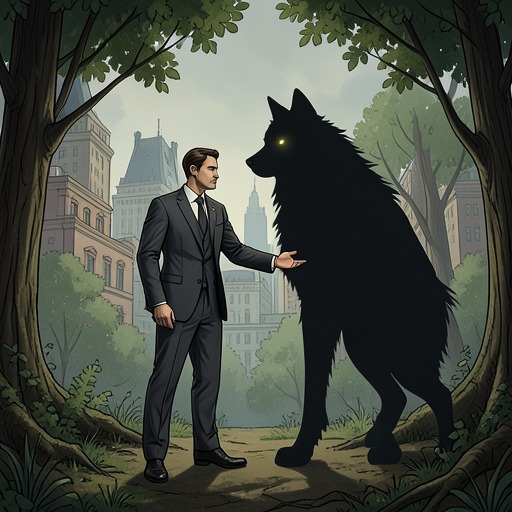
Werewolf nature first enters the narrative through transformation witnessed under conditions of terror. In the subway, a strange man’s sharp cheekbones disappear beneath engulfing fur while a snout extrudes from his face and his head becomes the enormous head of a wolf. His muscular human body then morphs into the powerful frame of a massive animal, which carries the terrified woman down onto the tracks. The change is presented as a process rather than an instantaneous costume change: fabric tears, the face loses its human structure, and the body acquires a feral strength that makes ordinary escape nearly impossible.
The transformation can also move in the opposite direction. After a gigantic grey wolf attacks a man in the street, the beast’s body writhes and convulses until it becomes the handsome acquaintance Carol Grey met only two hours earlier. The return to human form does not erase what Carol has seen; the man approaches calmly, as though the attack were unremarkable, while she recoils because the familiar face now carries an unanswerable question about motive and danger. In this pattern, human appearance is not proof of safety, and wolf form is not proof of simple evil.
The condition is accompanied by bodily symptoms that initially resemble illness or emotional crisis. Mr. Adams suffers an acute pain that makes him clutch his forehead, breathe deeply, and ask Liza to give him a moment. The pain returns through his neck and entire body; convulsions follow, and he orders her from the office. From behind the closed door come the shredding of fabric, crashing bottles, and a bone-chilling howl. The apparent medical episode is therefore a threshold into transformation, with pain functioning as the first visible sign that the human body is losing control of its ordinary shape.
Revelation and Recognition
The werewolves’ secret is often disclosed through action before it is explained in words. Greyson tells Celia that he and Alex were involved in the fight at the club and then states that they are the wolves. When Celia assumes he is joking, Greyson demonstrates the truth by setting down his scotch, walking to the window, and shifting into a gigantic grey wolf with huge blue eyes glowing through the dim apartment. His transformation changes the meaning of the earlier club conflict and makes his apparent confession impossible to dismiss as teasing.
Mr. Adams’s revelation follows the same structure of suspicion, spectacle, and confrontation. After three wolves attack Liza in the office corridor, one defeats the others and turns toward her with unexpectedly calming eyes. The huge animal advances, its muscles contracting as fur gives way to shining skin and a human face emerges. The transformed man is Mr. Adams, drenched in sweat and still marked by otherworldly ice-blue eyes. His quiet warning that Liza should not have seen what happened confirms that the danger lies not only in the wolf but in the secret surrounding it.
Floyd Meriwether’s identity is recognized through accumulated evidence rather than a single unexplained sighting. He tells Jillian that he is different and challenges her to put the pieces together. She realizes that he is a werewolf, which explains both his knowledge of Garrett and the wolf that appeared just in time to protect her from Garrett’s unwanted advances. Her retrospective understanding shows how werewolf nature alters memory: previous encounters remain the same in factual terms, but their significance changes once the hidden identity becomes legible.
The same logic reaches backward into Silas’s relationship with his mate. He says that he had been in the park and, for many weeks, had been watching and protecting her while deciding whether she was fit to be his mate. Her earlier sense of being followed by an empty street is therefore reclassified as the presence of a werewolf. What had seemed like an inexplicable aura becomes evidence of deliberate surveillance, protection, and selection.
Violence, Protection, and Pack Conflict
Werewolf nature produces spectacular violence, but the narrative repeatedly refuses to assign violence to one moral category. In the subway, Silas transforms to defend his mate when another enormous wolf attacks. He and the stranger circle, lunge, and crash across the tracks; Silas knocks the other wolf out of the air and pins it, while the opposing creature kicks him away and prepares to kill him. The scene makes the supernatural conflict a struggle for survival while also defining transformation as a protective response.
Silas explains that the danger is larger than the immediate attacker. He says that one wolf has been sent to find him, that more will follow, and that the war between them is an endless struggle for life and survival. His solution is to leave the subway and seek a place where his brothers and pack can provide safety in numbers. Werewolf nature therefore entails collective organization as well as solitary predation: the transformed body belongs to a continuing conflict between groups, and protection depends on pack membership.
The hotel confrontation involving Jack Ericson similarly shows the condition as a marker of pack warfare. A wolf falls through the penthouse skylight, and the transformed Jack faces it in the suite. The animals appear to communicate through hostile growls while sizing each other up. One wolf retreats toward the door, only for another to burst from the bathroom and tackle Jack from behind. The ambush turns transformation into a tactical language of territory, alliance, deception, and attack rather than a simple eruption of instinct.
Yet the wolf can also oppose human cruelty. A huge grey wolf stalks Garrett silently and intervenes after Garrett insults and assaults Jillian. The animal pounces, knocks him from the sidewalk, and stands over him growling. Floyd’s later human explanation confirms that the wolf’s intervention was connected to his protection of Jillian. The condition thus complicates the conventional monster image: its physical force is terrifying, but that force can be directed against a more immediate human threat.
Intimacy, Selection, and Control
Werewolf nature is inseparable from the book’s idea of the mate. Silas tells his chosen partner that she is his mate and asks for trust because he needs her. He promises protection, and after transforming to fight the attacking wolf, he returns to human intimacy with the assurance that he could never allow harm to come to her. The mate bond changes fear into dependence, but it does so within an unequal structure in which the werewolf observes, evaluates, selects, and claims.
His account makes the surveillance explicit: he has watched and protected her for weeks while deciding whether she was fit. The revelation gives the bond a double aspect. It offers safety and belonging, yet it also reveals that her entry into the relationship began with scrutiny conducted without her knowledge. Werewolf nature therefore turns romantic devotion into a form of power over access, information, and bodily security.
Floyd describes the mate in equally biological and intellectual terms. He is drawn to Jillian’s body, which he associates with fertility and bearing young, but he says that her first paper revealed cunning, understanding, and force of mind. He took her on as a protégé partly to learn more about her and to determine whether she could help him raise his pack. His attraction consequently joins sexuality, mentorship, reproduction, and pack administration. Even his refusal to take her while she posed for his sculpture is explained as a judgment that she was not ready and did not yet understand her own beauty.
The sexual scenes intensify the uncertainty produced by the hidden condition. Jillian knows that Floyd saved her, but she remains afraid that a werewolf may regard her as another victim. His touch and promise of safety compete with the knowledge that he possesses extraordinary physical power. Werewolf nature makes desire a threshold experience: the human partner is drawn toward the transformed man even while recognizing that attraction does not remove the danger of coercion or control.
Narrative Significance
The condition repeatedly collapses supposedly stable oppositions: human and animal, illness and transformation, violence and protection, secrecy and intimacy, individual desire and collective survival. A dark figure moving down an office hallway may be a co-worker, an employer, or the warning sign of imminent transformation; a migraine may be pain, or it may be the body’s passage into another form. The narrative builds suspense by making ordinary interpretation inadequate until fur, howls, glowing eyes, or a witnessed attack expose the hidden nature beneath it.
Werewolf nature also changes how characters read social authority. Thomas Anderson is introduced as a brilliant investor and enormously wealthy manager, while Mr. Adams is a powerful senior attorney; Floyd is a professor and sculptor. Their professional identities do not prevent animal transformation. Instead, the condition extends authority into a more primal register, allowing wealth, employment, teaching, physical dominance, and pack leadership to overlap. The werewolf is therefore not outside society but embedded in its institutions, carrying animal power through offices, classrooms, clubs, streets, and intimate relationships.
At the same time, the wolf body is given a degree of agency that exceeds human explanation. Growls can communicate hostility, a wolf can stalk nearly unheard, and its eyes can produce fear, calm, or entrancement before any human speech clarifies the situation. The body becomes a source of knowledge: Jillian recognizes Floyd through the connection between his identity and the rescue from Garrett; Liza understands Mr. Adams through the sequence of pain, howl, attack, and reversion; Celia’s disbelief collapses only when Greyson transforms in front of her.
The resulting image is neither a purely monstrous curse nor a harmless romantic fantasy. Werewolf nature is a condition of heightened capacity whose meaning depends on use and relation. It can make a person a killer, an ambushed defender, a protector of a mate, or a member of a threatened pack. Its decisive narrative function is to make the body itself a contested border: every transformation reveals that the apparently civilized world has been sharing space with another order of life, one governed by predation, loyalty, selection, and survival.