
The Chevalier Story and the Security State
American PrometheusThis thread traces how a rejected approach to share information became a disputed security narrative that followed Oppenheimer for a decade.
increasing Bearing strength in each event
 decreasing
Bearing strength in each eventdecreasingThe Suggestion
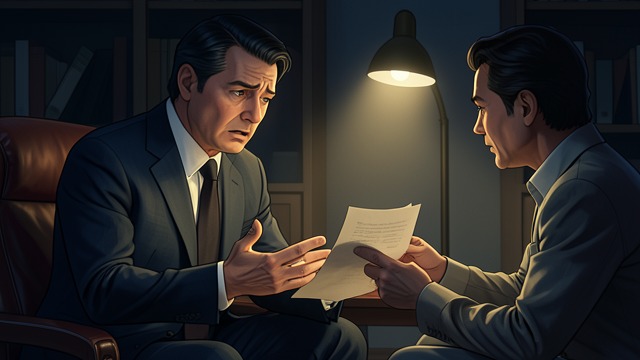
The Suggestion
An approach through friendship
Chevalier told Oppenheimer that Eltenton had proposed conveying scientific information to a Soviet contact. Oppenheimer rejected the plan and said it would be treason.
A choice not made
He did not immediately report the conversation. His judgment that the proposal was over and Chevalier innocent made him treat an emerging security matter as a private friendship problem.
Pash’s Investigation
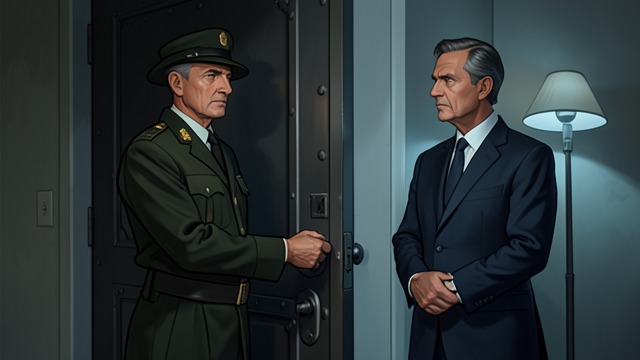
Pash’s Investigation
A security officer presses
Boris Pash questioned Oppenheimer about possible Soviet approaches. Oppenheimer tried to explain the context while refusing to name people he regarded as innocent.
The damaging version
He supplied details about several scientists and a consular channel that did not match his later account. The conversation was secretly recorded and preserved for future use against him.
The Groves Compromise
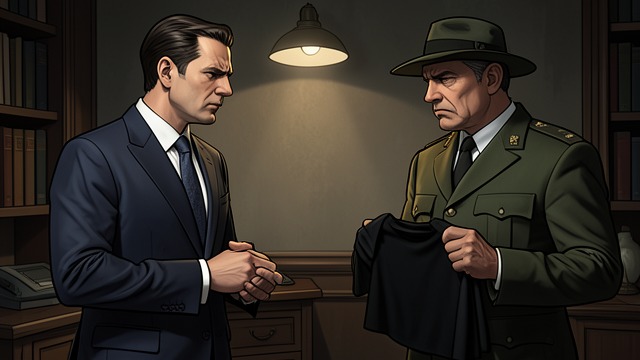
The Groves Compromise
Trust and pressure
Leslie Groves trusted Oppenheimer enough to keep him at Los Alamos, but wanted the intermediary’s name. Oppenheimer ultimately identified Chevalier while insisting he was not a spy.
A secret becomes official
The disclosure protected Oppenheimer’s position but damaged his closest political friendship. It also allowed the security apparatus to hold the affair in reserve.
The 1946 Reconciliation of Accounts
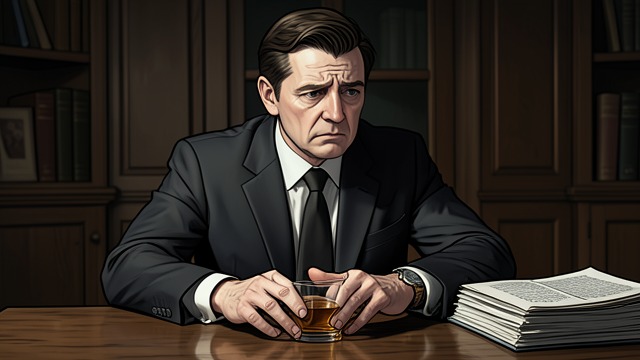
The 1946 Reconciliation of Accounts
Independent interviews
FBI agents questioned Chevalier and Eltenton separately. Both said Oppenheimer had rejected the proposal; neither account supported the later claim that he had facilitated espionage.
Oppenheimer changes his story
He told the FBI that he had invented the multiple approaches to protect Chevalier. The admission made his earlier conduct look like an elaborate lie, even if it was an attempt to shield a friend.
A Security Case Takes Shape
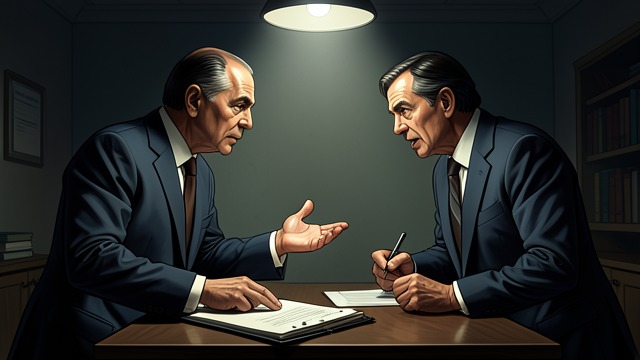
A Security Case Takes Shape
Old contradictions revived
William Borden and Lewis Strauss used the affair to argue that Oppenheimer had concealed an espionage approach. His recorded statements were brought into the hearing without giving his lawyers equal access to the file.
Credibility becomes the issue
The case did not prove that Oppenheimer passed secrets. It turned instead on his judgment, candor, and shifting recollections, producing a decision that ended his official service.
Winter 1942–1943, during a private Berkeley dinner
August 1943, at the Berkeley Radiation Laboratory
Late 1943, after Oppenheimer’s clearance was approved
June–September 1946, during FBI questioning
1953–1954, during Strauss’s investigation
