AEC's formal letter of charges against Oppenheimer
American PrometheusThe United States Atomic Energy Commission’s formal letter of charges against J. Robert Oppenheimer turned years of surveillance, political suspicion, and disagreement over nuclear policy into an official proceeding against one of the country’s most prominent scientists. Delivered on Christmas Eve 1953, it did more than question whether he could continue working for the government: it made his political past, his handling of an espionage approach, and his opposition to the hydrogen bomb parts of a single case about national security. The resulting hearing would expose both Oppenheimer’s complicated record and the reach of a security process in which dissent itself could be treated as evidence.
From suspicion to formal charges
During Oppenheimer’s absence in Europe, William L. Borden assembled a prosecutorial brief from material in Oppenheimer’s security file. Lewis Strauss had arranged for Borden to remove the file from the United States Atomic Energy Commission’s vault. Borden’s letter to J. Edgar Hoover, mailed on November 7, 1953, compressed its claims into three and a half single-spaced pages and concluded that Oppenheimer was more probably than not an agent of the Soviet Union. That conclusion was an accusation, not an established finding, but it shows the suspicions surrounding Oppenheimer hardening into a case for action.
On Christmas Eve, two FBI agents arrived at Olden Manor and took control of Oppenheimer’s remaining classified papers. The same day, he received the formal letter, dated December 23. It asked whether his continued employment on Atomic Energy Commission work endangered the common defense and security, and whether it was consistent with national security. The language presented the matter as a review of eligibility to serve, while placing Oppenheimer under the weight of an official allegation.
The letter gathered older allegations into one document: Oppenheimer’s associations with known and alleged Communists, his contributions to the Communist Party of California, and his account of the Chevalier affair. It also alleged that he had helped persuade other prominent scientists not to work on the hydrogen bomb and that his opposition had slowed the project’s development. That last charge brought policy disagreement directly inside the security case. The letter did not merely revisit whom Oppenheimer had known; it made his judgment about nuclear weapons part of the question of whether he could be trusted.
A record previously reviewed
The charges drew much of their force from facts the government had already examined. General Leslie Groves knew of the political associations and the Chevalier affair when he ordered the Army to grant Oppenheimer a security clearance in 1943. The Atomic Energy Commission later renewed that clearance, beginning in 1947 and continuing thereafter. The hydrogen-bomb accusation marked a new escalation: earlier material, previously reviewed and discounted, was now joined to the claim that Oppenheimer’s opposition had obstructed development of the weapon.
The book presents the document as a political indictment rather than a narrowly framed legal charge. Its inclusion of opposition to the hydrogen bomb reflected an atmosphere in which policy dissent could be recast as disloyalty. The Commission’s chairman, Strauss, appointed the security review panel that would judge the case. The letter thus initiated a proceeding whose terms already extended beyond whether Oppenheimer had violated a specific rule: the panel would assess his associations, his judgment, and his stance on national policy under the broad standard of security.
Oppenheimer’s response and the hearing
Oppenheimer initially had thirty days to answer. He consulted Herbert Marks and Joseph Volpe about legal representation, and eventually worked with Lloyd K. Garrison, a liberal lawyer and trustee of the Institute for Advanced Study. Garrison secured an extension and became lead counsel, despite his limited experience in trial work. In working out his response, Oppenheimer insisted that the allegations could not be understood fairly apart from the circumstances of his life and work.
On March 5, 1954, he delivered a forty-two-page response written in the form of an autobiography. It acknowledged some friendships and political associations while denying that they were nefarious; it also addressed the disputed account of his dealings with Haakon Chevalier. The contradictions surrounding that affair had accumulated over years. Oppenheimer’s 1943 conversation with Boris Pash had been recorded without his knowledge, and in 1946 he described the account of other approaches as fabricated to protect Chevalier. The letter brought those changing accounts back into the open. The record left unresolved why Oppenheimer had described events differently, a question that would become central to the hearing.
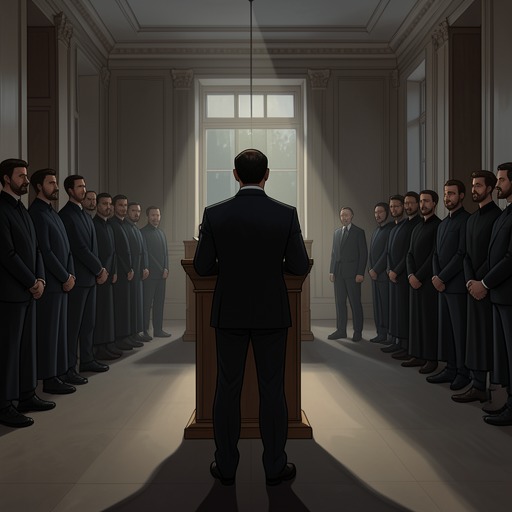
The review board convened on April 12 in Room 2022 of a wartime temporary building near the Washington Monument. The physical arrangement made the imbalance visible: the panel had black binders containing classified FBI documents before it, while Oppenheimer’s lawyers had not been given copies or an opportunity to challenge documents that were not introduced openly. Although the chairman repeatedly called the proceedings an inquiry rather than a trial, the formal charges were read aloud and Oppenheimer testified under oath. On April 13, the New York Times published both the Commission’s letter and Oppenheimer’s response, carrying the private record into public view.
Consequences and significance
The letter’s allegations shaped the hearing’s direction and the panel’s assessment. Gordon Gray later cited the Chevalier affair, Oppenheimer’s defense of Bernard Peters, the hydrogen-bomb debate, and other policy positions as evidence of a tendency to put his own judgment ahead of official judgment. The charges therefore connected personal associations and disputed statements to a broader critique of Oppenheimer’s independence. The case ended with the loss of his security clearance, and the published transcript made the process itself a lasting subject of controversy.
The consequences reached beyond Oppenheimer. Publication exposed intimate details of his political and private life, while the hearing’s use of secret material and its treatment of policy dissent prompted criticism of the proceeding. Some Los Alamos scientists and more than a thousand other scientists and academics protested the decision. In the longer view, the case marked a narrowing of the scientist’s public role: scientists serving the government could increasingly be expected to provide expertise on restricted technical questions without challenging policy. The formal letter was thus both a specific instrument in Oppenheimer’s security case and the opening document of a broader conflict over who could advise the state, what counted as loyalty, and whether disagreement over nuclear policy could remain a legitimate part of public service.