Atomic bombings of Hiroshima and Nagasaki
American PrometheusThe Atomic bombings of Hiroshima and Nagasaki were the first combat use of atomic weapons. Their immediate destruction and delayed radiation deaths transformed the bomb from a wartime project into a human and political crisis that J. Robert Oppenheimer and other scientists continued to confront after the war.
Causes and Background
The weapon used against Hiroshima, Little Boy, weighed 9,700 pounds and was dropped from the B-29 Enola Gay. The scale of the resulting human loss was stark: more than 95 percent of the roughly 225,000 people killed in Hiroshima and Nagasaki were civilians, mostly women and children. At least half of the victims died from radiation poisoning in the months following the initial blasts. Those figures make clear why the bombings could not be understood only as the successful culmination of a military and scientific undertaking: the deaths continued beyond the instant of detonation, and civilians bore the overwhelming share of them.
What the Observers Saw
The scale of the destruction became harder to hold at a distance when the first scientific observers returned from the ruined cities. Bob Serber described Nagasaki through a trail of telephone poles, their sides charred on the side facing the explosion; the pattern remained visible more than two miles from ground zero. Along that route he saw a horse still grazing, its coat burned away on one side while the other remained normal. When Serber remarked that the animal seemed to be happily grazing, J. Robert Oppenheimer scolded him for making the bomb sound benevolent. The exchange exposed a moral fault line: even a survivor’s apparently ordinary behavior could not make the weapon’s effects harmless, and a casual description risked turning devastation into reassurance. Phil Morrison’s account of Hiroshima likewise displaced any abstract language of military targets. He landed there thirty-one days after the bombing and reported that people for nearly a mile around had been severely burned by the heat. Some victims’ skin had been burned in stripes where their clothing had been striped; others crawled from ruined homes with injuries that seemed slight, only to die days or weeks later from radiation. In a radio summary, Morrison described circling low over a city reduced to flat, scorched ground: one bomber and one bomb had turned a city of three hundred thousand into a burning pyre in the time a rifle bullet took to cross it. The concise contrast—one aircraft, one weapon, a city destroyed—made the bomb’s novelty inseparable from the civilians’ suffering.
Aftermath and Moral Reckoning
The destruction did not remain an abstraction for those who had helped create the weapon. J. Robert Oppenheimer’s wife, Katherine(Kitty)Oppenheimer, told a colleague that she did not know how she could bear what had happened. After the first scientific observers returned from Hiroshima and Nagasaki in October, their accounts made the human consequences newly immediate to the isolated Los Alamos community. Phil Morrison’s descriptions left one listener unable to sleep, shaking through the night. Edith Warner, who had first heard of Hiroshima from Kitty during a visit to collect fresh vegetables, wrote that the news explained much; physicists came to her home at Otowi Bridge to explain themselves. In a Christmas letter, Warner endorsed their conclusion that atomic energy could not simply be left in the hands of armed forces or statesmen.
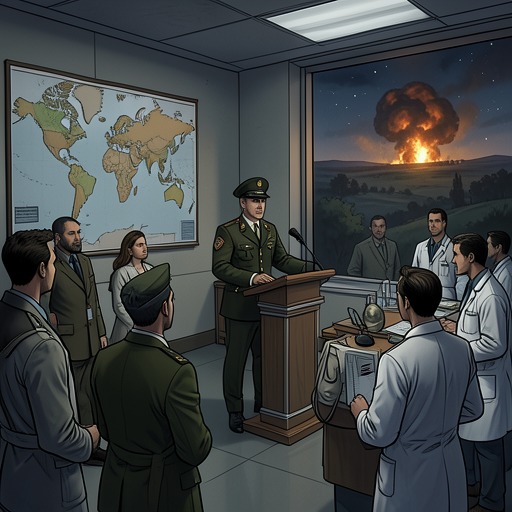
Oppenheimer understood the bomb as both a military achievement and a rupture in the history of physics. He later recalled the Trinity explosion through an image from the Bhagavad Gita: Vishnu assumes a many-armed form and declares, “Now I am become death, the destroyer of worlds.” In his account, a few people laughed, a few cried, and most were silent; the line gave symbolic force to a moment whose consequences could not be contained by the test site. Years afterward, Abraham Pais called the recollection one of Oppenheimer’s priestly exaggerations, and the book notes uncertainty about when the quotation entered public accounts. Yet the phrase endured as a way of expressing the scientists’ encounter with a power that exceeded the language of technical success.
That encounter also shaped Oppenheimer’s criticism of wartime science. In late 1945 he told a Senate committee that the project had shaken the ripe fruit from a tree of accumulated knowledge, producing radar and atomic bombs through a frantic exploitation of what was already known. He argued that the war had nearly stopped physics as a genuine professional activity. The bombings thus signified, for him, not simply the application of science to war but the redirection of scientific work toward destruction—and the possibility that this transformation would outlast the emergency that had justified it.
From the Bombings to Nuclear Policy
The bombings gave urgency to the question of what should follow the wartime project. Oppenheimer and other scientists came to regard international control of nuclear energy as the remaining prudent course. Their concern was not limited to the immediate destruction of two cities: the existence of weapons capable of annihilating civilian populations threatened to make future policy a contest in which military calculations could eclipse moral judgment. In 1949, as the Soviet Union’s success intensified the arms race, Oppenheimer argued against developing a vastly more powerful thermonuclear weapon. He warned that a device with a possible yield of 100 million tons of TNT could destroy hundreds of square miles and become a weapon of genocide. The contrast with Hiroshima’s 15,000-ton bomb made the direction of escalation concrete: the precedent set by the bombings did not mark a limit but opened onto the prospect of far greater destruction.
The same experience informed Oppenheimer’s objections to plans for a massive initial nuclear assault on Soviet cities. He believed that secrecy concealed the scale and intended use of the growing American stockpile from both citizens and allies, while the strategy of unremitting attack risked treating the annihilation of populations as a technical instrument. In a 1951 review of Air Force war planning, he was appalled by a proposed obliteration of Soviet cities; in the Project Vista debate, he instead favored tactical weapons intended to support battlefield operations. That alternative carried its own danger: bringing nuclear weapons onto the battlefield could make their actual use more likely and could trigger escalation toward larger exchanges. The dilemma traced back to the bombings themselves. A weapon first used against cities had made mass destruction a practical instrument of war, and no distinction between strategic and tactical use could erase the consequences of crossing that threshold.
Recollection and Public Memory
In 1965, twenty years after Hiroshima, NBC broadcast Oppenheimer’s recollection of Trinity and his reference to the Bhagavad Gita in a documentary about the decision to use the atomic bomb. Asked about a proposal to begin talks with the Soviet Union to halt nuclear proliferation, he said it should have been undertaken the day after Trinity. The comment joined memory of the first test to the unresolved political aftermath of Hiroshima and Nagasaki: the failure to act early had allowed the danger to persist and grow.
The book’s account also places the bombings against the lives behind the aggregate toll. More than 95 percent of the approximately 225,000 people killed in Hiroshima and Nagasaki were civilians, mostly women and children, and at least half died from radiation poisoning in the months after the blasts. The delayed deaths complicate any account that ends with the flash or the destruction of buildings. They make the bombings an event whose effects unfolded over time, and whose moral and political meaning continued to return in testimony, policy disputes, and public remembrance.
Commemoration and the Limits of Witness
At a special session of the American Physical Society in Washington in the spring of 1967, Isidor Rabi, Bob Serber, Victor Weisskopf, and others memorialized Oppenheimer. Rabi later introduced the collected speeches by describing a man whose public eloquence never exhausted what he held within: “He never expressed himself completely. He always left a feeling that there were depths of sensibility and insight not yet revealed.” That judgment gives the bombings’ continuing place in Oppenheimer’s story a particular shape. His recollections and policy arguments made him a prominent interpreter of the destruction, but neither his words nor the later tributes could make the experience complete or settle its meaning. The event remained at once a human catastrophe and a source of unresolved questions about scientific achievement, public responsibility, and the uses of nuclear power.